
Question 913 marksEasy
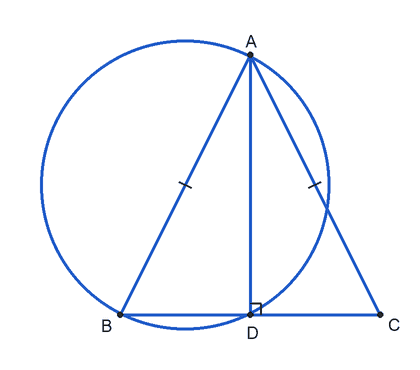
Prove that the circle drawn on any one of the equal sides of an isosceles triangle as diameter bisects the base.
Confirming your payment
Sign up now and get 250 free tokens.
Circles · Question 91 of 110
Prove that the circle drawn on any one of the equal sides of an isosceles triangle as diameter bisects the base.
Solution:
Concept: These facts are used here.
Given: AB = AC; the circle on AB as diameter meets BC at D.
Step 1 — Set up.
Let ABC be a triangle in which AB = AC. The circle on AB as diameter meets the base BC at D. We must prove that D is the mid-point of BC.
Step 2 — Find angle ADB.
Join AD. AB is a diameter and D is on the circle, so is an angle in a semicircle.
BDC is a straight line, so , the angle next to it, is also .
Step 3 — Compare the two triangles.
In and , the angles at D are both , the hypotenuses AB and AC are equal (given), and AD is common. So (RHS), and the corresponding sides BD and DC are equal.
Watch out: The right angle comes from the circle (angle in a semicircle); it is not given, so say where it comes from.
Therefore, BD = DC, so the circle bisects the base. Hence proved.