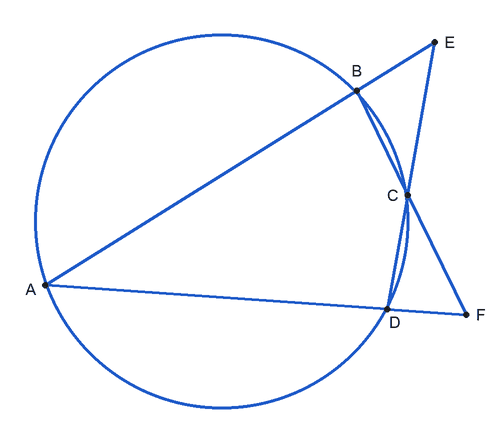
Solution:
Concept: These facts are used here.
- Exterior angle of a cyclic quadrilateral: when one side of a cyclic quadrilateral is produced, the exterior angle formed equals the interior opposite angle.
- Angle sum: the three angles of a triangle add up to 180∘.
- Cyclic quadrilateral: the opposite angles of a quadrilateral whose four vertices lie on a circle add up to 180∘.
Step 1 — Write the angles with one letter.
Let ∠DCF=3k, ∠F=5k and ∠E=4k.
Step 2 — Find angle A.
BC is produced to F, so ∠DCF is the exterior angle of ABCD at C. It equals the interior opposite angle at A.
∠A=3k
Step 3 — Find angle B.
In △ABF the angles are ∠A, ∠ABC and ∠F.
∠ABC=180∘−3k−5k=180∘−8k
Step 4 — Find angle D.
In △ADE the angles are ∠A, ∠ADC and ∠E.
∠ADC=180∘−3k−4k=180∘−7k
Step 5 — Use the opposite angles B and D.
The angles at B and D are opposite angles of ABCD, so they add up to 180∘.
(180∘−8k)+(180∘−7k)360∘−15k15kk=180∘=180∘=180∘=12∘
Step 6 — Find the four angles.
Put k=12∘ into Steps 2–4, and use the cyclic property for C.
∠A=3×12∘=36∘
∠B=180∘−8×12∘=84∘
∠D=180∘−7×12∘=96∘
∠C=180∘−∠A=180∘−36∘=144∘
Watch out: ∠DCF is an exterior angle at C, so it equals the angle at A, not the angle at C.
Therefore, ∠A=36∘, ∠B=84∘, ∠C=144∘ and ∠D=96∘.