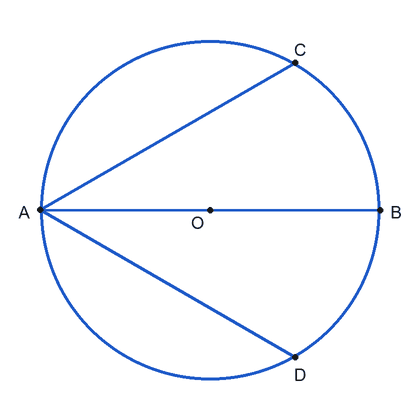
Solution:
Concept: These facts are used here.
- Equal chords: equal chords of a circle subtend equal angles at the centre (and equal angles at the circle), and cut off equal arcs.
- Angle at the centre: the angle that an arc subtends at the centre is double the angle it subtends at any point on the remaining part of the circle.
- Angle in a semicircle: the angle that a diameter subtends at any point on the circle is 90∘.
Step 1 — Part (i): equal arcs.
AC = AD, so the minor arcs AC and AD are equal. AB is a diameter, so the arcs ACB and ADB are both semicircles. Taking the equal arcs away from equal semicircles leaves equal arcs:
arc BC=arc ACB−arc AC=arc ADB−arc AD=arc DB
Step 2 — Part (ii): the bisector.
Equal arcs BC and DB subtend equal angles at A, so ∠BAC=∠BAD, and AB bisects ∠CAD.
Step 3 — Further: find angle BOC.
Arc AC is twice arc BC, and together they make the semicircle, so arc BC is one-third of the semicircle and subtends one-third of 180∘ at O.
∠BOC=3180∘=60∘
Step 4 — (a) Find angle BAC.
The arc BC subtends ∠BOC at the centre and ∠BAC at A.
∠BAC=21×60∘=30∘
Step 5 — (b) Find angle ABC.
AB is a diameter, so ∠ACB=90∘ (angle in a semicircle). By the angle sum of △ABC:
∠ABC=180∘−90∘−30∘=60∘
Watch out: Arc AC + arc BC is a SEMICIRCLE (180∘ at the centre), not the whole circle.
Therefore, (i) arc BC = arc DB; (ii) AB bisects ∠CAD; (a) ∠BAC=30∘; (b) ∠ABC=60∘.