
Question 953 marksMedium
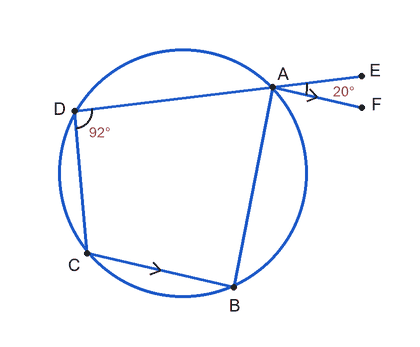
In the given figure, ABCD is a cyclic quadrilateral. AF is drawn parallel to CB and DA is produced to point E. If ∠ADC = 92°, ∠FAE = 20°; determine ∠BCD. Give reason in support of your answer.
Confirming your payment
Sign up now and get 250 free tokens.
Circles · Question 95 of 110
In the given figure, ABCD is a cyclic quadrilateral. AF is drawn parallel to CB and DA is produced to point E. If ∠ADC = 92°, ∠FAE = 20°; determine ∠BCD. Give reason in support of your answer.
Solution:
Concept: These facts are used here.
Step 1 — Find angle ABC.
and are opposite angles of the cyclic quadrilateral ABCD.
Step 2 — Use AF ∥ CB.
AB is a transversal of the parallel lines AF and CB, so the alternate angles and are equal.
Step 3 — Find angle EAB.
AF lies inside , so is the sum of its two parts.
Step 4 — Find angle BCD.
DA is produced to E, so is the exterior angle of ABCD at A. It equals the interior opposite angle at C.
Watch out: The exterior angle at A is (between AE and AB), and it equals the angle at C, the vertex opposite A.
Therefore, .