
Question 433 marksMedium
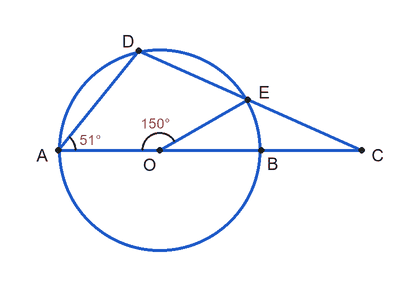
In the figure, O is the centre of the circle, ∠AOE = 150°, ∠DAO = 51°. Calculate the sizes of the angles CEB and OCE.
Confirming your payment
Sign up now and get 250 free tokens.
Circles · Question 43 of 110
In the figure, O is the centre of the circle, ∠AOE = 150°, ∠DAO = 51°. Calculate the sizes of the angles CEB and OCE.
Solution:
Concept: These facts are used here.
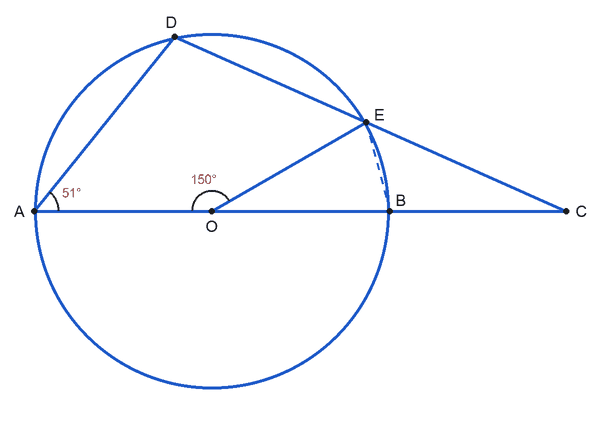
Step 1 — Join EB.
We join EB. Then ABED is a cyclic quadrilateral, and DEC is a straight line, so DE is produced to C.
Step 2 — Find angle CEB.
The exterior angle of ABED equals the interior opposite angle at A. O lies on AB, so that angle is , given as .
Step 3 — Find angle EOB.
AOB is a straight line, so and form a linear pair.
Step 4 — Find angle OBE.
OE = OB (radii), so the base angles of are equal.
Step 5 — Find angle EBC.
ABC is a straight line, so and form a linear pair.
Step 6 — Find angle OCE.
In two angles are now known, and is the same angle as because B lies on CO.
Watch out: is the angle of at B; it is the supplement of , not itself.
Therefore, and .