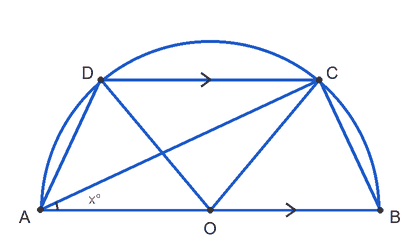
Solution:
Concept: These facts are used here.
- Angle at the centre: the angle that an arc subtends at the centre is double the angle it subtends at any point on the remaining part of the circle.
- Parallel lines: a transversal makes equal alternate angles and co-interior angles that add up to 180∘.
Step 1 — Part (i): find angle COB.
The arc BC subtends ∠COB at the centre and ∠CAB=x∘ at A, on the remaining part of the circle.
∠COB=2×∠CAB=2x∘
Step 2 — Part (ii): find angle DOA.
AC is a transversal of the parallel lines DC and AB, so the alternate angles ∠DCA and ∠CAB are equal. Then the arc AD subtends ∠DOA at the centre and ∠DCA at C.
∠DCA=∠CAB=x∘
∠DOA=2×∠DCA=2x∘
Step 3 — Part (ii): find angle DOC.
AOB is a straight line, so the three angles at O on one side of it add up to 180∘.
∠DOC=180∘−∠DOA−∠COB=180∘−2x∘−2x∘=180∘−4x∘
Step 4 — Part (iii): find angle DAC.
The arc DC subtends ∠DOC at the centre and ∠DAC at A.
∠DAC=21×∠DOC=21(180∘−4x∘)=90∘−2x∘
Step 5 — Part (iv): find angle ADC.
By the angle sum of △ADC:
∠ADC=180∘−∠DAC−∠DCA=180∘−(90∘−2x∘)−x∘=90∘+x∘
Watch out: Remove the bracket carefully in Step 5: −(90∘−2x∘) becomes −90∘+2x∘.
Therefore, (i) ∠COB=2x∘; (ii) ∠DOC=180∘−4x∘; (iii) ∠DAC=90∘−2x∘; (iv) ∠ADC=90∘+x∘.