
Question 743 marksMedium
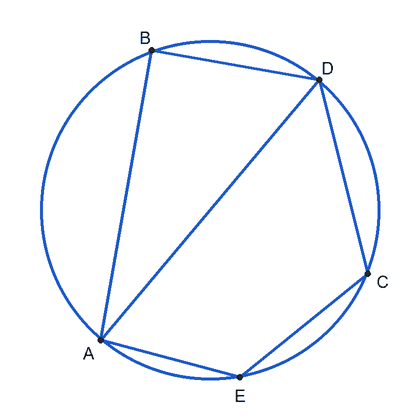
In the given figure, BD is a side of a regular hexagon, DC is a side of a regular pentagon and AD is a diameter. Calculate :
(i) ∠ADC,
(ii) ∠BDA,
(iii) ∠ABC,
(iv) ∠AEC.
Confirming your payment
Sign up now and get 250 free tokens.
Circles · Question 74 of 110
In the given figure, BD is a side of a regular hexagon, DC is a side of a regular pentagon and AD is a diameter. Calculate :
(i) ∠ADC,
(ii) ∠BDA,
(iii) ∠ABC,
(iv) ∠AEC.
Solution:
Concept: These facts are used here.
Step 1 — Find the angles at the centre.
Let O be the centre. BD is a side of a regular hexagon and DC is a side of a regular pentagon. AD is a diameter, so on each side of AD.
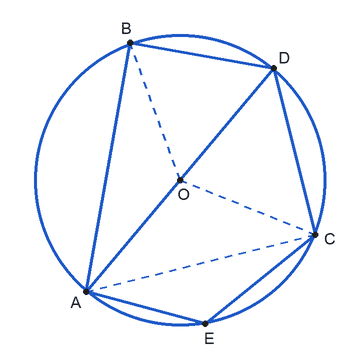
The rest of each half-circle gives the arcs AC (through E) and AB.
Step 2 — Part (i): find angle ADC.
The arc AC (through E) subtends at the centre and at D.
Step 3 — Part (ii): find angle BDA.
The arc AB subtends at the centre and at D.
Step 4 — Part (iii): find angle ABC.
stands on the arc AEC, the same arc as in part (i).
Step 5 — Part (iv): find angle AEC.
Join AC. ABCE is a cyclic quadrilateral in which and are opposite angles.
Watch out: B and C are on opposite sides of the diameter AD, so the hexagon and pentagon angles are each taken from their OWN .
Therefore, (i) ; (ii) ; (iii) ; (iv) .