
Opening your dashboard
Class 10 Maths Chapter 16: Loci Solutions
58 textbook questions with step-by-step answers, free to read, for ICSE 2026-27.
Get talked through Ch 16, not just shown the answer
Reading a finished solution is not the same as being able to do it. The AI tutor takes one question at a time and works it with you, in your own words, until you can.
- Ask it out loud, in your own words
- It gives you the next step, not the answer
- Stuck on part (ii)? Start there
58 questions with solutions
1–3 marks · Mixed difficulty
- 11 mark
Question 1
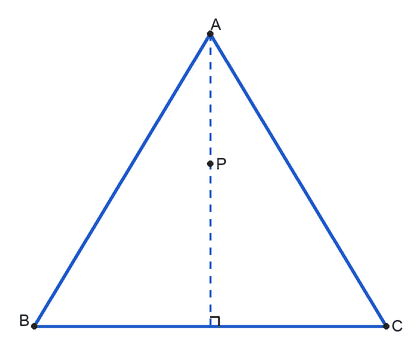
P is a point on perpendicular bisector of side BC of ΔABC, then :
 Solve with AI
Answer
(A) PA = PB
- Correct
(B) PB = PC
(C) PA = PC
(D) none of these
Answer: (B) PB = PC
Concept: Every point on the perpendicular bisector of a line segment is equidistant from the two end points of the segment. Conversely, every point equidistant from the two end points lies on the perpendicular bisector.
Step 1 — Name the segment and its end points.
P lies on the perpendicular bisector of the side BC. The end points of BC are B and C, so these are the two points P is equidistant from.
Step 2 — Apply the theorem.
By the theorem in the Concept line, every point on the perpendicular bisector of BC is equally far from B and from C. So PB = PC, whatever the position of P on that line.
Watch out: The perpendicular bisector of BC says nothing about the vertex A. P is equidistant from B and C only.
Why the other options are wrong:
- (A) PA = PB: this would need P to lie on the perpendicular bisector of AB, which is not given.
- (C) PA = PC: this would need P to lie on the perpendicular bisector of AC, which is not given.
- (D) none of these: PB = PC is always true here (Step 2), so one of the given options is correct.
Therefore, PB = PC, option (B).
- 21 mark
Question 2
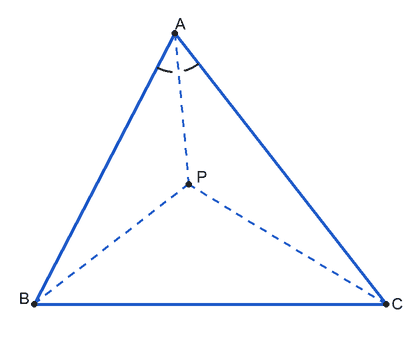
P is a point on bisector of angle A of ΔABC. Then :
 Solve with AI
Answer
(A) P is equidistant from the vertices B and C
(B) PA = PC
(C) PA = PB
- Correct
(D) P is equidistant from sides AB and AC
Answer: (D) P is equidistant from sides AB and AC
Concept: Every point on the bisector of an angle is equidistant from the two arms of the angle. Conversely, a point inside an angle that is equidistant from its arms lies on the bisector. The distance of a point from a line always means the length of the perpendicular from the point to the line.
Step 1 — Name the arms of the angle.
P lies on the bisector of ∠A of ΔABC. The two arms of ∠A are the sides AB and AC.
Step 2 — Apply the theorem.
By the theorem in the Concept line, a point on the bisector of ∠A is equidistant from its arms. So the perpendicular distances of P from AB and from AC are equal.
Watch out: An angle bisector gives equal distances from two sides (lines), not equal distances from two vertices (points).
Why the other options are wrong:
- (A) P is equidistant from the vertices B and C: points equidistant from the vertices B and C lie on the perpendicular bisector of BC, not on the bisector of ∠A.
- (B) PA = PC: this would need P to lie on the perpendicular bisector of AC, which is not given.
- (C) PA = PB: this would need P to lie on the perpendicular bisector of AB, which is not given.
Therefore, P is equidistant from the sides AB and AC, option (D).
- 31 mark
Question 3
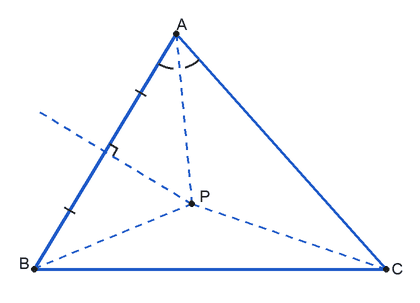
The perpendicular bisector of side AB and bisector of angle A of ΔABC meet at point P. Then :
 Solve with AI
Answer
- Correct
(A) PA = PB
(B) PA = PC
(C) PB = PC
(D) PB bisects ∠ABC
Answer: (A) PA = PB
Concept: P lies on two loci, so it has both properties. A perpendicular bisector gives equal distances from two points: every point on the perpendicular bisector of a segment is equidistant from its end points. An angle bisector gives equal distances from two lines: every point on it is equidistant from the arms of the angle.
Step 1 — Use the perpendicular bisector of AB.
P is on the perpendicular bisector of AB, so P is equidistant from the end points A and B. This gives PA = PB.
Step 2 — Use the bisector of angle A.
P is also on the bisector of ∠A. This tells us only that P is equidistant from the sides AB and AC. It says nothing about the distances of P from the vertices B or C.
Watch out: Equidistant from two points gives a perpendicular bisector; equidistant from two lines gives an angle bisector. Read the question carefully to see which one is meant.
Why the other options are wrong:
- (B) PA = PC: this would need P to lie on the perpendicular bisector of AC, which is not given.
- (C) PB = PC: this would need P to lie on the perpendicular bisector of BC, which is not given.
- (D) PB bisects ∠ABC: PB would bisect ∠ABC only if P were equidistant from the sides BA and BC. We know only that P is equidistant from AB and AC.
Therefore, PA = PB, option (A).
- 41 mark
Question 4
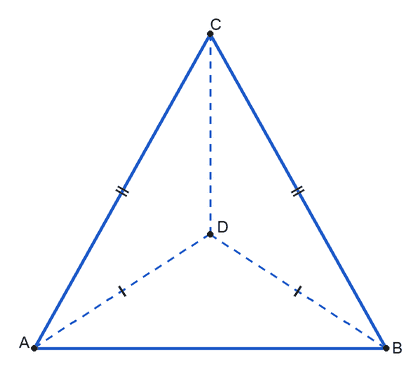
Using the information in the given diagram, state if :
 Solve with AI
Answer
(A) AD = DC
(B) BD = DC
- Correct
(C) CD bisects angle ACB
(D) angle CAD is greater than angle DAB
Answer: (C) CD bisects angle ACB
Concept: Equal marks on two segments mean the segments are equal. Two triangles with three pairs of equal sides are congruent (SSS), and then their corresponding angles are equal.
Step 1 — Read the diagram.
The double marks show CA = CB, and the single marks show DA = DB.
Step 2 — Compare triangles CAD and CBD.
These two triangles share the side CD, so all three pairs of sides are equal.
In ΔCAD and ΔCBD:
- CA = CB (given in the diagram)
- DA = DB (given in the diagram)
- CD = CD (common side)
So ΔCAD ≅ ΔCBD by SSS.
Step 3 — Read off the equal angles.
Corresponding parts of congruent triangles are equal, so ∠ACD = ∠BCD. The line CD therefore splits ∠ACB into two equal parts, that is, CD bisects ∠ACB. (Since C and D are both equidistant from A and B, the line CD is in fact the perpendicular bisector of AB.)
Watch out: The marks give DA = DB, not DA = DC. Check which segments carry the same mark before using them.
Why the other options are wrong:
- (A) AD = DC: the marks show that DA equals DB, not that it equals DC. D can be anywhere on the line CD, so DC can be longer or shorter than DA.
- (B) BD = DC: BD is equal to AD, so this is the same claim as (A) and fails for the same reason.
- (D) angle CAD is greater than angle DAB: from the congruence, ∠CAD = ∠CBD, but nothing fixes how ∠CAD compares with ∠DAB; that depends on where D lies on the line CD.
Therefore, CD bisects angle ACB, option (C).
- 51 mark
Question 5
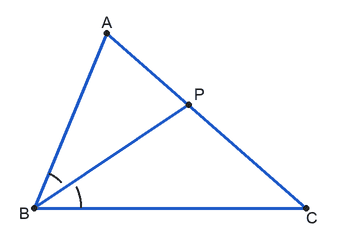
Bisector of angle B of triangle ABC intersects side AC at point P, then point P is :
 Solve with AI
Answer
(A) equidistant from vertices A and C
(B) PA = PB
(C) PB = PC
- Correct
(D) equidistant from sides AB and BC
Answer: (D) equidistant from sides AB and BC
Concept: Every point on the bisector of an angle is equidistant from the two arms of the angle. Conversely, a point inside an angle that is equidistant from its arms lies on the bisector. The distance of a point from a line always means the length of the perpendicular from the point to the line.
Step 1 — Name the arms of angle B.
P lies on the bisector of ∠B. The arms of ∠B are BA and BC.
Step 2 — Draw the perpendicular distances.
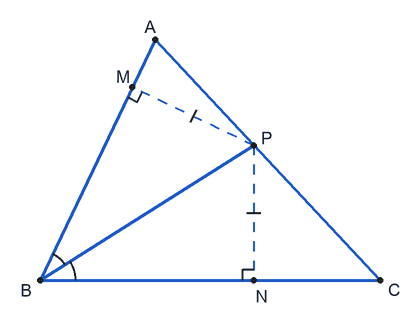
Draw PM ⊥ AB and PN ⊥ BC. These are the distances of P from the two sides.
Step 3 — Apply the theorem.
P is on the bisector of ∠B, so by the theorem in the Concept line PM = PN. Hence P is equidistant from the sides AB and BC.
Watch out: P being on side AC does not make it the mid-point of AC. The bisector of ∠B meets AC at its mid-point only when AB = BC.
Why the other options are wrong:
- (A) equidistant from vertices A and C: P would have to be the mid-point of AC. The bisector of ∠B meets AC at its mid-point only when AB = BC, which is not given.
- (B) PA = PB: this would need P to lie on the perpendicular bisector of AB, which is not given.
- (C) PB = PC: this would need P to lie on the perpendicular bisector of BC, which is not given.
Therefore, P is equidistant from the sides AB and BC, option (D).
- 63 marks
Question 6
Given : PQ is perpendicular bisector of side AB of the triangle ABC.
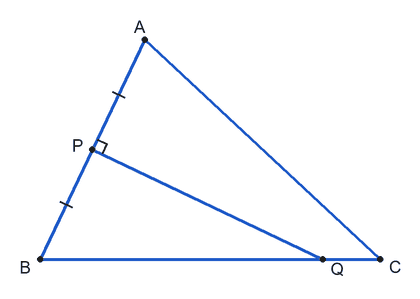
Prove : Q is equidistant from A and B.
Solve with AIWritten solution
Solution:
Concept: Every point on the perpendicular bisector of a line segment is equidistant from the two end points of the segment. Conversely, every point equidistant from the two end points lies on the perpendicular bisector. Here we prove this for the point Q using congruent triangles.
Given: PQ is the perpendicular bisector of side AB of ΔABC, so AP = PB and PQ ⊥ AB.
To prove: QA = QB.
Step 1 — Draw the construction.
Join AQ, so that ΔAPQ and ΔBPQ are formed on either side of PQ.
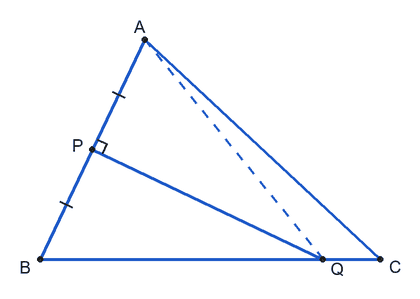
Step 2 — Compare triangles APQ and BPQ.
PQ bisects AB at P and is perpendicular to it, which gives one pair of equal sides and one pair of equal angles; PQ itself is shared.
In ΔAPQ and ΔBPQ:
- AP = BP (PQ bisects AB, so P is the mid-point of AB)
- ∠APQ = ∠BPQ (each is 90°, since PQ ⊥ AB)
- PQ = PQ (common side)
So ΔAPQ ≅ ΔBPQ by SAS.
Step 3 — Conclude.
Corresponding parts of congruent triangles are equal, so QA = QB.
Watch out: SAS needs the angle between the two sides. Here ∠APQ lies between AP and PQ, so SAS applies.
Therefore, QA = QB, so Q is equidistant from A and B. Hence proved.
- 73 marks
Question 7
Given : CP is bisector of angle C of Δ ABC.
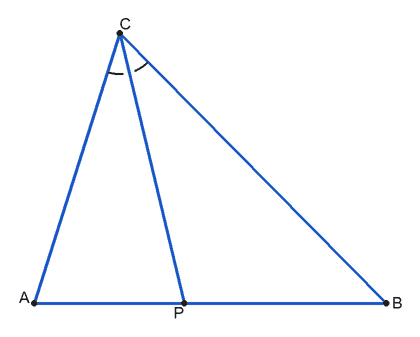
Prove : P is equidistant from AC and BC.
Solve with AIWritten solution
Solution:
Concept: Every point on the bisector of an angle is equidistant from the two arms of the angle. Conversely, a point inside an angle that is equidistant from its arms lies on the bisector. The distance of a point from a line always means the length of the perpendicular from the point to the line. Here we prove it for the point P.
Given: CP is the bisector of ∠C of ΔABC, so ∠ACP = ∠BCP.
To prove: P is equidistant from AC and BC.
Step 1 — Draw the construction.
Draw PM ⊥ AC and PN ⊥ BC. PM and PN are the distances of P from the two sides.
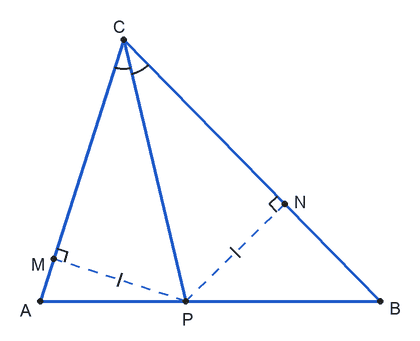
Step 2 — Compare triangles CPM and CPN.
Both are right-angled, they share CP, and CP makes equal angles with CA and CB.
In ΔCPM and ΔCPN:
- ∠PCM = ∠PCN (CP bisects ∠C)
- ∠PMC = ∠PNC (each is 90°, by construction)
- CP = CP (common side)
So ΔCPM ≅ ΔCPN by AAS.
Step 3 — Conclude.
Corresponding parts of congruent triangles are equal, so PM = PN.
Watch out: The distance of a point from a line is the perpendicular distance. Any other segment from the point to the line is longer.
Therefore, PM = PN, so P is equidistant from AC and BC. Hence proved.
- 83 marks
Question 8
Given : AX bisects angle BAC and PQ is perpendicular bisector of AC which meets AX at point Y.

Prove : (i) X is equidistant from AB and AC. (ii) Y is equidistant from A and C.
Solve with AIWritten solution
Solution:
Concept: Two locus theorems are used. Every point on the bisector of an angle is equidistant from the two arms of the angle. Every point on the perpendicular bisector of a line segment is equidistant from the two end points of the segment.
Given: AX bisects ∠BAC. PQ is the perpendicular bisector of AC and meets AX at Y.
To prove: (i) X is equidistant from AB and AC. (ii) Y is equidistant from A and C.
(i)
Step 1 — Draw the perpendiculars from X.
Draw XM ⊥ AB and XN ⊥ AC. These are the distances of X from the two sides.
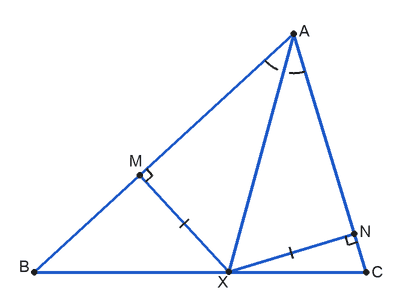
Step 2 — Compare triangles AXM and AXN.
Both are right-angled, they share AX, and AX makes equal angles with AB and AC.
In ΔAXM and ΔAXN:
- ∠XAM = ∠XAN (AX bisects ∠BAC)
- ∠XMA = ∠XNA (each is 90°, by construction)
- AX = AX (common side)
So ΔAXM ≅ ΔAXN by AAS, and hence XM = XN.
So X is equidistant from AB and AC.
(ii)
Step 3 — Name the foot of PQ and join YC.
Let PQ meet AC at D, and join YC. Since PQ is the perpendicular bisector of AC, AD = DC and PQ ⊥ AC.
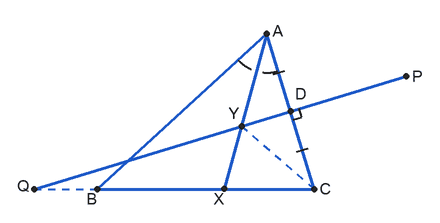
Step 4 — Compare triangles ADY and CDY.
They share DY, have equal bases AD and CD, and equal right angles at D.
In ΔADY and ΔCDY:
- AD = CD (D is the mid-point of AC)
- ∠ADY = ∠CDY (each is 90°, since PQ ⊥ AC)
- DY = DY (common side)
So ΔADY ≅ ΔCDY by SAS, and hence YA = YC.
So Y is equidistant from A and C.
Watch out: X is on an angle bisector, so it is equidistant from two lines; Y is on a perpendicular bisector, so it is equidistant from two points.
Therefore, (i) XM = XN, so X is equidistant from AB and AC; (ii) YA = YC, so Y is equidistant from A and C. Hence proved.
- 93 marks
Question 9
Construct a triangle ABC, in which AB = 4·2 cm, BC = 6·3 cm and AC = 5 cm. Draw perpendicular bisector of BC which meets AC at point D. Prove that D is equidistant from B and C.
Solve with AIWritten solution
Solution:
Concept: Every point on the perpendicular bisector of a line segment is equidistant from the two end points of the segment. Conversely, every point equidistant from the two end points lies on the perpendicular bisector. D lies on the perpendicular bisector of BC, so DB = DC.
Step 1 — Construct the triangle.
We draw the base first and fix A with two arcs, because all three sides are known.
- Draw BC = 6·3 cm.
- With B as centre and radius 4·2 cm, draw an arc.
- With C as centre and radius 5 cm, draw an arc cutting the first arc at A. Join AB and AC.
Step 2 — Draw the perpendicular bisector of BC.
With B and C as centres and any radius more than half of BC, draw arcs on both sides of BC. The line through the two points where the arcs cut is the perpendicular bisector of BC. Mark D, where it meets AC, and M, where it meets BC. Join DB.
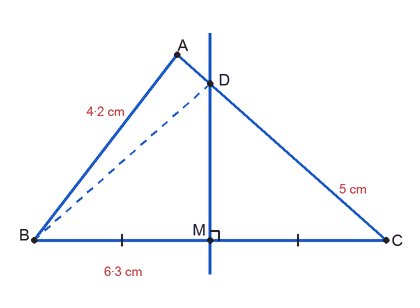
Step 3 — Compare triangles DMB and DMC.
M is the mid-point of BC and DM ⊥ BC, so the two triangles match side, angle, side.
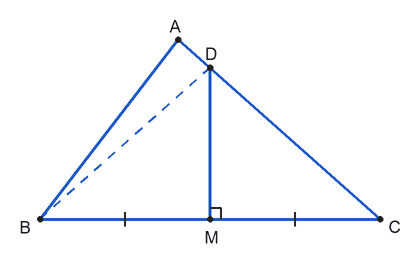
In ΔDMB and ΔDMC:
- BM = CM (M is the mid-point of BC)
- ∠DMB = ∠DMC (each is 90°)
- DM = DM (common side)
So ΔDMB ≅ ΔDMC by SAS, and hence DB = DC.
Check: On measuring, DB and DC both come to about 4·2 cm (by calculation 4·22 cm).
Watch out: The perpendicular bisector must pass through the mid-point of BC and be at right angles to it; draw the arcs with the same radius from B and from C.
Therefore, DB = DC, so D is equidistant from B and C. Hence proved.
- 103 marks
Question 10
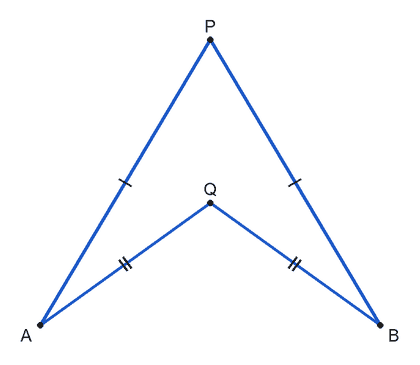
In each of the given figures; PA = PB and QA = QB.
(i)
(ii)
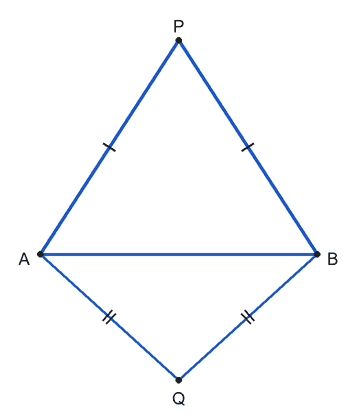
Prove, in each case, that PQ (produce, if required) is perpendicular bisector of AB. Hence, state the locus of the points equidistant from two given fixed points.
Solve with AIWritten solution
Solution:
Concept: Use congruent triangles twice. First show that PQ bisects ∠APB; then show that PQ meets AB at its mid-point and at right angles. This proves the converse of the perpendicular bisector theorem.
Given: PA = PB and QA = QB, in both figures.
To prove: PQ (produced, if required) is the perpendicular bisector of AB.
Step 1 — Draw the construction.
Join PQ. Let PQ (produced in figure (i)) meet AB at M. The same proof works for both figures.
Figure (i):

Figure (ii):

Step 2 — Show that PQ bisects angle APB.
The triangles PAQ and PBQ have all three sides equal in pairs.
In ΔPAQ and ΔPBQ:
- PA = PB (given)
- QA = QB (given)
- PQ = PQ (common side)
So ΔPAQ ≅ ΔPBQ by SSS, and hence ∠APQ = ∠BPQ, that is, ∠APM = ∠BPM.
Step 3 — Show that M is the mid-point and the angles at M are equal.
Now compare the triangles that PM makes with A and with B.
In ΔAPM and ΔBPM:
- PA = PB (given)
- ∠APM = ∠BPM (Step 2)
- PM = PM (common side)
So ΔAPM ≅ ΔBPM by SAS. Hence AM = BM and ∠AMP = ∠BMP.
Step 4 — Show that the angles at M are right angles.
∠AMP and ∠BMP lie on the straight line AB, so they add up to 180°. They are also equal (Step 3), so each is half of 180°.
Step 5 — State the locus.
P and Q are any two points that are each equidistant from A and B, and both lie on the perpendicular bisector of AB. So every point equidistant from A and B lies on this line.
Watch out: Showing AM = BM alone is not enough; a perpendicular bisector must also be at 90° to AB, which is why Step 4 is needed.
Therefore, PQ is the perpendicular bisector of AB, and the locus of points equidistant from two given fixed points is the perpendicular bisector of the line segment joining them. Hence proved.
- 113 marks
Question 11
Construct a triangle ABC in which angle ABC = 75°, AB = 5 cm and BC = 6·4 cm. Draw perpendicular bisector of side BC and also the bisector of angle ACB. If these bisectors intersect each other at point P; prove that P is equidistant from B and C; and also from AC and BC.
Solve with AIWritten solution
Solution:
Concept: P lies on two loci. Every point on the perpendicular bisector of a line segment is equidistant from the two end points of the segment. Every point on the bisector of an angle is equidistant from the two arms of the angle.
Step 1 — Construct the triangle.
Two sides and the included angle are known, so we draw the base and the 75° angle at B first.
- Draw BC = 6·4 cm.
- At B, construct ∠CBX = 75° (construct 60° and 90° at B and bisect the angle between them).
- On BX, cut off BA = 5 cm. Join AC.
Step 2 — Draw the two bisectors.
The point P must lie on both loci, so we draw both and mark where they meet.
- Draw the perpendicular bisector of BC; let it meet BC at M.
- Draw the bisector of ∠ACB.
- Mark P, where the two bisectors meet. Join PB.
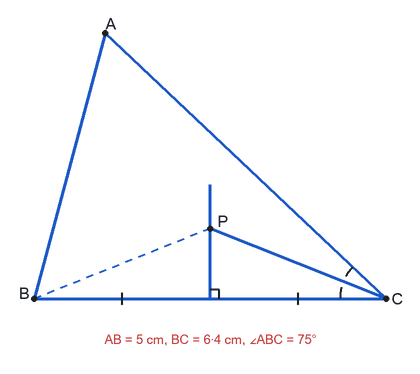
Step 3 — Draw the construction for the proof.
Draw PN ⊥ AC, so that the distances of P from AC and from BC are PN and PM.
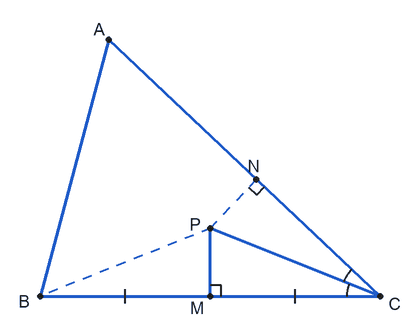
Step 4 — Prove PB = PC.
Compare the triangles on either side of PM.
In ΔPMB and ΔPMC:
- BM = CM (M is the mid-point of BC)
- ∠PMB = ∠PMC (each is 90°)
- PM = PM (common side)
So ΔPMB ≅ ΔPMC by SAS, and hence PB = PC.
Step 5 — Prove PM = PN.
Compare the two right-angled triangles that share PC.
In ΔPMC and ΔPNC:
- ∠PCM = ∠PCN (CP bisects ∠ACB)
- ∠PMC = ∠PNC (each is 90°)
- PC = PC (common side)
So ΔPMC ≅ ΔPNC by AAS, and hence PM = PN.
Check: On measuring, PB = PC ≈ 3·4 cm (by calculation 3.44 cm).
Watch out: PM is the distance of P from BC because PM ⊥ BC; P is equidistant from the lines AC and BC, which is not the same as PA = PC.
Therefore, PB = PC, so P is equidistant from B and C; and PM = PN, so P is equidistant from AC and BC. Hence proved.
- 123 marks
Question 12
In parallelogram ABCD, side AB is greater than side BC and P is a point in AC such that PB bisects angle B. Prove that P is equidistant from AB and BC.
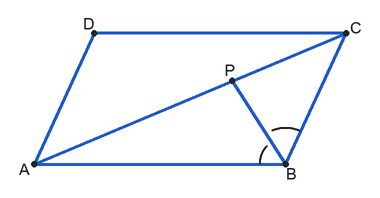 Solve with AI
Written solution
Solution:
Concept: Every point on the bisector of an angle is equidistant from the two arms of the angle. Conversely, a point inside an angle that is equidistant from its arms lies on the bisector. The distance of a point from a line always means the length of the perpendicular from the point to the line. P lies on the bisector of ∠B, whose arms are BA and BC.
Given: ABCD is a parallelogram with AB > BC. P is a point on the diagonal AC such that PB bisects ∠ABC.
To prove: P is equidistant from AB and BC.
Step 1 — Draw the construction.
Draw PM ⊥ AB and PN ⊥ BC. These are the distances of P from the two sides.
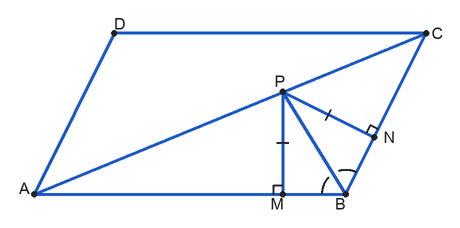
Step 2 — Compare triangles BPM and BPN.
Both are right-angled, they share BP, and BP makes equal angles with BA and BC.
In ΔBPM and ΔBPN:
- ∠PBM = ∠PBN (PB bisects ∠ABC)
- ∠PMB = ∠PNB (each is 90°, by construction)
- BP = BP (common side)
So ΔBPM ≅ ΔBPN by AAS.
Step 3 — Conclude.
Corresponding parts of congruent triangles are equal, so PM = PN.
Watch out: The proof uses only the fact that P is on the bisector of ∠B. The condition AB > BC just tells us that this bisector is not the diagonal BD, so it cuts the diagonal AC at a point P that is not its mid-point.
Therefore, PM = PN, so P is equidistant from AB and BC. Hence proved.
- 133 marks
Question 13
In triangle LMN, bisectors of interior angles at L and N intersect each other at point A. Prove that :
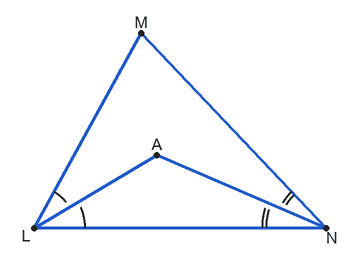
(i) point A is equidistant from all the three sides of the triangle.
(ii) AM bisects angle LMN.
Solve with AIWritten solution
Solution:
Concept: Every point on the bisector of an angle is equidistant from the two arms of the angle. Conversely, a point inside an angle that is equidistant from its arms lies on the bisector. The distance of a point from a line always means the length of the perpendicular from the point to the line. Part (ii) uses the converse.
Given: In ΔLMN, the bisectors of ∠L and ∠N meet at A.
To prove: (i) A is equidistant from LM, MN and LN. (ii) AM bisects ∠LMN.
Step 1 — Draw the construction.
Draw AP ⊥ LM, AQ ⊥ MN and AR ⊥ LN, and join AM. AP, AQ and AR are the distances of A from the three sides.
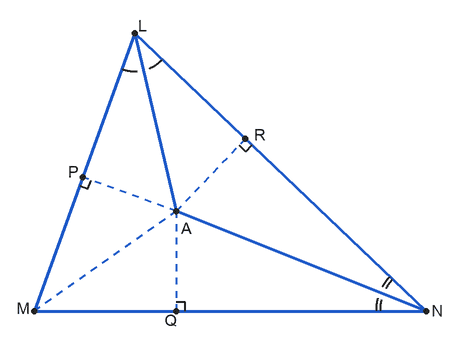
(i)
Step 2 — Use the bisector of angle L.
A lies on the bisector of ∠L, whose arms are LM and LN. So A is equidistant from LM and LN, that is, AP = AR.
Step 3 — Use the bisector of angle N.
A also lies on the bisector of ∠N, whose arms are NL and NM. So AR = AQ.
Step 4 — Combine the two results.
AP = AR and AR = AQ, so all three distances are equal. Hence A is equidistant from all three sides of the triangle.
(ii)
Step 5 — Compare triangles APM and AQM.
Both are right-angled triangles with the same hypotenuse AM, and AP = AQ from part (i).
In ΔAPM and ΔAQM:
- ∠APM = ∠AQM (each is 90°, by construction)
- AM = AM (common hypotenuse)
- AP = AQ (proved in part (i))
So ΔAPM ≅ ΔAQM by RHS, and hence ∠AMP = ∠AMQ.
So AM bisects ∠LMN.
Watch out: In RHS the right angle, the hypotenuse and one other side must match; here the other side is AP = AQ from part (i).
Note: A is the incentre of ΔLMN. All three angle bisectors of a triangle pass through it.
Therefore, (i) AP = AQ and AQ = AR, so A is equidistant from all three sides; (ii) ∠AMP = ∠AMQ, so AM bisects ∠LMN. Hence proved.
- 143 marks
Question 14
Use ruler and compasses only for this question.
(i) Construct Δ ABC, where AB = 3·5 cm, BC = 6 cm and ∠ABC = 60°.
(ii) Construct the locus of points inside the triangle which are equidistant from BA and BC.
(iii) Construct the locus of points inside the triangle which are equidistant from B and C.
(iv) Mark the point P which is equidistant from AB, BC and also equidistant from B and C. Measure and record the length of PB.
Solve with AIWritten solution
Solution:
Concept: The locus of points equidistant from two intersecting lines is the bisector of the angle between them. The locus of points equidistant from two fixed points is the perpendicular bisector of the segment joining them. The required point lies on both loci, so it is where they meet.
(i)
Step 1 — Construct the triangle.
Two sides and the included angle are given, so we draw the base and the 60° angle first.
- Draw BC = 6 cm.
- At B, construct ∠CBX = 60° with compasses.
- On BX, cut off BA = 3·5 cm. Join AC. ΔABC is the required triangle.
(ii)
Step 2 — Draw the locus equidistant from BA and BC.
BA and BC are the arms of ∠ABC, so this locus is the bisector of ∠ABC. Construct it and draw the part of it inside the triangle.
(iii)
Step 3 — Draw the locus equidistant from B and C.
B and C are two points, so this locus is the perpendicular bisector of BC. Construct it and draw the part inside the triangle; let it meet BC at M.
(iv)
Step 4 — Mark P and measure PB.
P lies on both loci, so mark P where they meet. On measuring, PB is about 3·5 cm.

Step 5 — Check PB by calculation.
In the right-angled triangle PMB, BM is half of BC and ∠PBM is half of 60°, so the cosine ratio gives PB.

Using the cosine of ∠PBM in ΔPMB:
Watch out: The question says inside the triangle, so draw only the parts of the two loci that lie inside ΔABC.
Therefore, P is the point where the bisector of ∠ABC meets the perpendicular bisector of BC, and PB ≈ 3·5 cm.
- 151 mark
Question 15
The locus of the centres of all the circles, which are tangents to the arms AB and BC of angle ABC is :
 Solve with AI
Answer
(A) perpendicular bisector of arm AB
(B) perpendicular bisector of arm BC
- Correct
(C) bisector of angle ABC
(D) none of these
Answer: (C) bisector of angle ABC
Concept: A circle touches (is tangent to) a line when the perpendicular distance of its centre from the line equals its radius. Every point on the bisector of an angle is equidistant from the two arms of the angle.
Step 1 — Use the arm AB.
Each circle touches the arm AB, so its centre is at a distance equal to its radius from AB.
Step 2 — Use the arm BC.
The same circle touches the arm BC, so its centre is at the same distance (its radius) from BC.
Step 3 — Name the locus.
So every centre is equidistant from the two arms AB and BC, and it lies inside ∠ABC. Points inside an angle that are equidistant from its arms lie on the bisector of the angle.
Watch out: Equidistant from two points gives a perpendicular bisector; equidistant from two lines gives an angle bisector. Read the question carefully to see which one is meant.
Why the other options are wrong:
- (A) perpendicular bisector of arm AB: the perpendicular bisector of AB is the locus of points equidistant from the two points A and B, not from the two arms.
- (B) perpendicular bisector of arm BC: the perpendicular bisector of BC is the locus of points equidistant from the two points B and C, not from the two arms.
- (D) none of these: the bisector of angle ABC is one of the options (Step 3), so 'none of these' cannot be chosen.
Therefore, the locus of the centres is the bisector of angle ABC, option (C).
- 161 mark
Question 16
P is a moving point and AB is a chord of a circle. If P moves, within this circle, in such a way that it is at equal distances from points A and B. The locus of P is :
Solve with AIAnswer
(A) a chord perpendicular to chord AB
(B) a chord that bisects the chord AB.
(C) a diameter of the circle
- Correct
(D) the diameter of the circle which is perpendicular to chord AB
Answer: (D) the diameter of the circle which is perpendicular to chord AB
Concept: Every point on the perpendicular bisector of a line segment is equidistant from the two end points of the segment. The perpendicular bisector of any chord of a circle passes through the centre of the circle.
Step 1 — Use PA = PB.
P is always at equal distances from A and B, so P lies on the perpendicular bisector of AB.
Step 2 — Locate this line in the circle.
AB is a chord, so its perpendicular bisector passes through the centre O.
Step 3 — Keep only the part inside the circle.
P moves within the circle. The part of this line inside the circle is a chord through the centre, that is, a diameter, and it is perpendicular to AB.
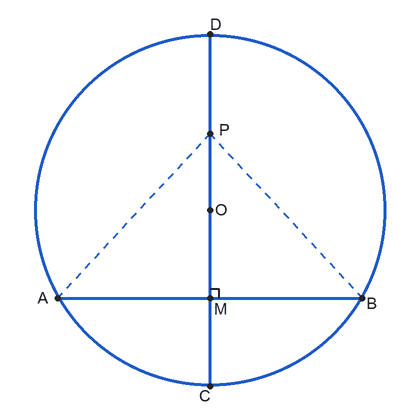
Watch out: A diameter is the right kind of line, but only the one diameter perpendicular to AB works.
Why the other options are wrong:
- (A) a chord perpendicular to chord AB: a chord can be perpendicular to AB without passing through the mid-point of AB; then its points are not equidistant from A and B.
- (B) a chord that bisects the chord AB: a chord can pass through the mid-point of AB without being perpendicular to it; then only the mid-point of AB on it is equidistant from A and B.
- (C) a diameter of the circle: this does not say which diameter. Only the diameter perpendicular to AB has all its points equidistant from A and B.
Therefore, the locus of P is the diameter of the circle which is perpendicular to chord AB (CD in the figure), option (D).
- 171 mark
Question 17
AB is a line segment. A point P moves in such a way that the triangle APB is always an isosceles triangle with base AB. The locus of point P is the line which :
Solve with AIAnswer
(A) is parallel to AB.
(B) is perpendicular to AB.
- Correct
(C) is perpendicular bisector of AB.
(D) passes through the mid-point of AB.
Answer: (C) is perpendicular bisector of AB.
Concept: In an isosceles triangle the two sides other than the base are equal. Every point on the perpendicular bisector of a line segment is equidistant from the two end points of the segment. Conversely, every point equidistant from the two end points lies on the perpendicular bisector.
Step 1 — Find the equal sides.
AB is the base of the isosceles triangle APB, so the two equal sides are PA and PB.
Step 2 — Name the locus.
PA = PB means P is equidistant from the fixed points A and B. So P lies on the perpendicular bisector of AB.

Step 3 — Leave out the mid-point.
At the mid-point M of AB, the points P, A and B lie on one line and make no triangle, so M itself is left out of the locus.
Watch out: 'passes through the mid-point' is not enough; the line must also be perpendicular to AB.
Why the other options are wrong:
- (A) is parallel to AB: points on a line parallel to AB are at the same distance from the line AB, but only one point of such a line has PA = PB.
- (B) is perpendicular to AB: a perpendicular to AB that misses the mid-point of AB has every point nearer to one end of AB than to the other.
- (D) passes through the mid-point of AB: a line through the mid-point that is not perpendicular to AB has only that one point equidistant from A and B.
Therefore, the locus of P is the perpendicular bisector of AB, option (C).
- 181 mark
Question 18
AB is a line segment and P is a moving point that moves in such a way that it is always equidistant from AB. The locus of point P is the line which:
Solve with AIAnswer
- Correct
(A) is parallel to AB and through point P.
(B) is perpendicular to AB through point P.
(C) is perpendicular bisector of AB.
(D) passes through the mid-point of AB.
Answer: (A) is parallel to AB and through point P.
Concept: The distance of a point from a line is the length of the perpendicular from the point to the line. The locus of a point at a fixed distance from a fixed straight line is a pair of straight lines parallel to the given line, one on each side of it, each at that distance from it.
Step 1 — Read the condition.
P moves so that its perpendicular distance from AB always stays the same.
Step 2 — Find the points at that distance.
On the side of AB where P is, all the points at this fixed distance lie on one straight line parallel to AB.
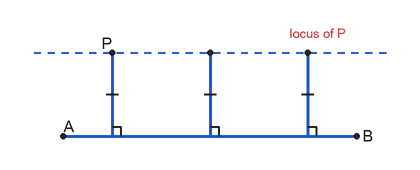
Step 3 — Fix the line.
P itself is one of these points, so this parallel line passes through P.
Watch out: The full locus at a fixed distance is a pair of parallel lines, one on each side of AB. The option describes the one on P's side, which is the best of the four choices.
Why the other options are wrong:
- (B) is perpendicular to AB through point P: as P moves along a line perpendicular to AB, its distance from AB changes.
- (C) is perpendicular bisector of AB: the perpendicular bisector of AB is the locus of points equidistant from the points A and B; along it the distance from the line AB changes.
- (D) passes through the mid-point of AB: a line through the mid-point of AB (other than AB itself) gets farther from AB as you move along it, so the distance is not fixed.
Therefore, the locus of P is the line parallel to AB through the point P, option (A).
- 191 mark
Question 19
A point P moves in such a way that it is at a distance less than or equal to 5 cm from a fixed point O. The locus of point P is :
Solve with AIAnswer
(A) a circle with radius 5 cm.
(B) a circle with OP as radius.
(C) a circle with diameter of 10 cm.
- Correct
(D) a circle of radius 5 cm (including circumference of the circle and inside of it) and the fixed point O as its centre.
Answer: (D) a circle of radius 5 cm (including circumference of the circle and inside of it) and the fixed point O as its centre.
Concept: The locus of a point at a fixed distance from a fixed point is a circle, with the fixed point as centre and the fixed distance as radius. Points nearer than that distance lie inside the circle.
Step 1 — Take the case OP = 5 cm.
Points exactly 5 cm from O lie on the circle with centre O and radius 5 cm.
Step 2 — Take the case OP < 5 cm.
Points less than 5 cm from O lie inside this circle.
Step 3 — Combine the two cases.
The condition is OP ≤ 5 cm, so both cases are allowed: the circumference and the whole region inside it (shaded in the figure).

Watch out: 'less than or equal to' includes the circle itself; 'less than' alone would leave the circumference out.
Why the other options are wrong:
- (A) a circle with radius 5 cm: this gives only the points exactly 5 cm away, and names no centre; the points inside are missed.
- (B) a circle with OP as radius: OP is not a fixed length here. It can be anything from 0 cm to 5 cm.
- (C) a circle with diameter of 10 cm: this is again only the circumference of a circle of radius 5 cm, with no centre named; the points inside are missed.
Therefore, the locus is the circle of radius 5 cm with centre O, including its circumference and all the points inside it, option (D).
- 203 marks
Question 20
Describe the locus of a point at a distance 3 cm from a fixed point.
Solve with AIWritten solution
Solution:
Concept: The locus of a point at a fixed distance from a fixed point is a circle, with the fixed point as centre and the fixed distance as radius.
Step 1 — Name the points.
Let the fixed point be O and the moving point be P.
Step 2 — Write the condition.
The condition is that OP = 3 cm for every position of P.
Step 3 — Find the locus.
All the points 3 cm from O lie on the circle with centre O and radius 3 cm, and every point of that circle is 3 cm from O.

Watch out: The locus is the circle (the curve) only, not the region inside it.
Therefore, the locus is a circle with the fixed point as centre and radius 3 cm.
- 213 marks
Question 21
Describe the locus of points at a distance 2 cm from a fixed line.
Solve with AIWritten solution
Solution:
Concept: The locus of a point at a fixed distance from a fixed straight line is a pair of straight lines parallel to the given line, one on each side of it, each at that distance from it.
Step 1 — Recall how distance is measured.
The distance of a point from a line is measured along the perpendicular to the line.
Step 2 — Look at both sides.
A point 2 cm from the fixed line can be on either side of it.
Step 3 — Find the locus on each side.
On each side, all such points lie on a straight line parallel to the fixed line and 2 cm from it.
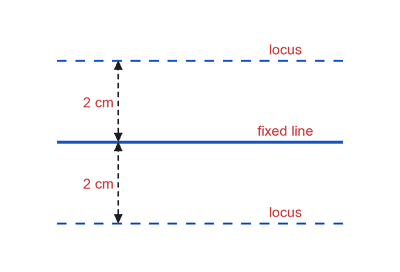
Watch out: There are two lines, one on each side. Drawing only one gives half the locus.
Therefore, the locus is a pair of straight lines parallel to the fixed line, one on each side of it, each 2 cm from it.
- 223 marks
Question 22
Describe the locus of the centre of a wheel of a bicycle going straight along a level road.
Solve with AIWritten solution
Solution:
Concept: A wheel standing on a road touches it at one point, and its centre is exactly one radius above that point. A point that stays at a fixed distance from a straight line, on one side of it, moves on a line parallel to it.
Step 1 — Name the radius.
Let the radius of the wheel be r. The road is level, so it is a straight horizontal line.
Step 2 — Find the height of the centre.
As the bicycle moves straight ahead, the centre C of the wheel always stays at a height r above the road.
Step 3 — Find the locus.
So C is always at the same distance r from the road, on the same side of it, and moves on a line parallel to the road.
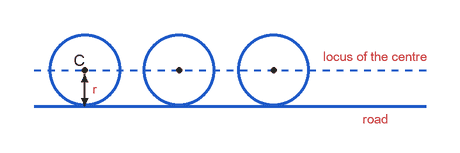
Watch out: The question asks for the path of the centre, not of a point on the rim (which traces a curve).
Therefore, the locus is a straight line parallel to the road, at a height equal to the radius of the wheel above it.
- 233 marks
Question 23
Describe the locus of the moving end of the minute hand of a clock.
Solve with AIWritten solution
Solution:
Concept: The locus of a point at a fixed distance from a fixed point is a circle, with the fixed point as centre and the fixed distance as radius.
Step 1 — Find the fixed point.
One end of the minute hand is fixed at the centre O of the clock; the other end P moves.
Step 2 — Find the fixed distance.
The length of the hand does not change, so OP is the same for every position.
Step 3 — Find the locus.
P is always at a fixed distance from the fixed point O, and in one hour the hand turns all the way round. So P traces the whole circle.
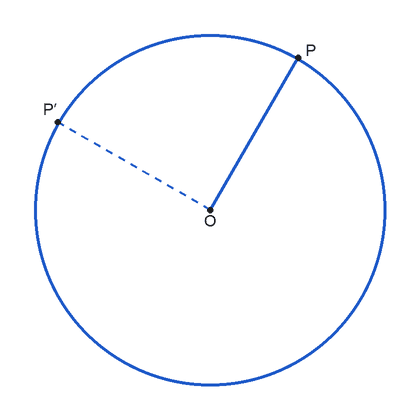
Watch out: The radius of the locus is the length of the minute hand, not the radius of the clock face.
Therefore, the locus is a circle with the centre of the clock as centre and the length of the minute hand as radius.
- 243 marks
Question 24
Describe the locus of a stone dropped from the top of a tower.
Solve with AIWritten solution
Solution:
Concept: A locus is the path traced by a moving point. A stone that is dropped (not thrown) starts from rest and falls straight down under gravity.
Step 1 — Start from rest.
The stone starts from rest at the top of the tower, at the point S.
Step 2 — Find the direction of motion.
Gravity pulls it vertically downwards. Ignoring the wind, nothing pushes it sideways.
Step 3 — Find the locus.
So the stone moves along the vertical line through S until it reaches the ground at G.
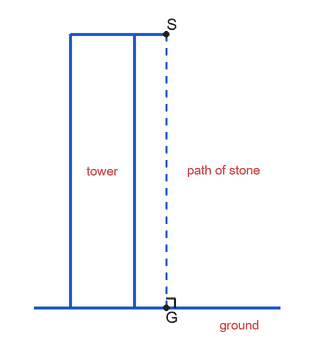
Watch out: A stone thrown sideways would follow a curved path; 'dropped' means it falls straight down.
Therefore, the locus is the vertical straight line through the point from which the stone is dropped, from that point down to the ground (SG in the figure).
- 253 marks
Question 25
Describe the locus of a runner running around a circular track and always keeping a distance of 1·5 m from the inner edge.
Solve with AIWritten solution
Solution:
Concept: The inner edge of a circular track is a circle. The locus of a point at a fixed distance from a fixed point is a circle, with the fixed point as centre and the fixed distance as radius.
Step 1 — Name the inner edge.
Let the inner edge be a circle with centre O and radius r metres.
Step 2 — Find the runner's distance from O.
The runner is always 1·5 m outside the inner edge, measured along the line from O. So the runner's distance from O never changes.
Step 3 — Find the locus.
A point at a fixed distance from the fixed point O moves on a circle with centre O.

Watch out: The radius of the path is r + 1·5 m, not 1·5 m: the 1·5 m is measured from the inner edge, not from the centre.
Therefore, the locus is a circle with the same centre as the track, whose radius is 1·5 m more than the radius of the inner edge.
- 263 marks
Question 26
Describe the locus of the door-handle, as the door opens.
Solve with AIWritten solution
Solution:
Concept: A door turns about the line of its hinges, and every point of the door keeps its distance from that line. The locus of a point at a fixed distance from a fixed point is a circle, with the fixed point as centre and the fixed distance as radius.
Step 1 — Look from above.
Seen from above, the line of the hinges appears as a fixed point H and the handle as a point K.
Step 2 — Find the fixed distance.
The handle is fixed on the door, so the distance HK does not change as the door opens.
Step 3 — Find the path.
So K moves along a circle with centre H and radius HK.
Step 4 — Keep only the part the door covers.
A door does not turn all the way round, so K covers only an arc of this circle.
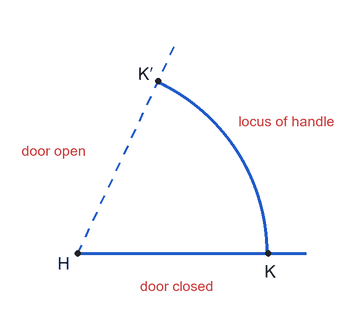
Watch out: The locus is only an arc, not a full circle, because the door stops (or meets the wall).
Therefore, the locus is an arc of a circle whose centre is on the line of the hinges, at the height of the handle, and whose radius is the distance of the handle from the hinges.
- 273 marks
Question 27
Describe the locus of points inside a circle and equidistant from two fixed points on the circumference of the circle.
Solve with AIWritten solution
Solution:
Concept: Every point on the perpendicular bisector of a line segment is equidistant from the two end points of the segment. The perpendicular bisector of any chord of a circle passes through the centre of the circle.
Step 1 — Name the chord.
Let the two fixed points on the circumference be A and B. Then AB is a chord of the circle.
Step 2 — Find the line.
A point P equidistant from A and B lies on the perpendicular bisector of AB.
Step 3 — Locate the line.
The perpendicular bisector of the chord AB passes through the centre O of the circle.
Step 4 — Keep the part inside the circle.
The points must be inside the circle. The part of this line inside the circle is a diameter, perpendicular to AB.
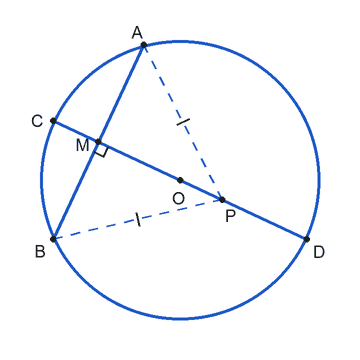
Watch out: The locus is not just any diameter; it is the diameter perpendicular to the chord AB.
Therefore, the locus is the diameter of the circle which is perpendicular to the chord AB (CD in the figure).
- 283 marks
Question 28
Describe the locus of the centres of all circles passing through two fixed points.
Solve with AIWritten solution
Solution:
Concept: All radii of a circle are equal. Every point on the perpendicular bisector of a line segment is equidistant from the two end points of the segment.
Step 1 — Name the points.
Let the two fixed points be A and B, and let O be the centre of any circle through A and B.
Step 2 — Use equal radii.
OA and OB are both radii of this circle, so OA = OB.
Step 3 — Find the locus.
So O is equidistant from the fixed points A and B. This is true for the centre of every such circle, so every centre lies on the perpendicular bisector of AB.
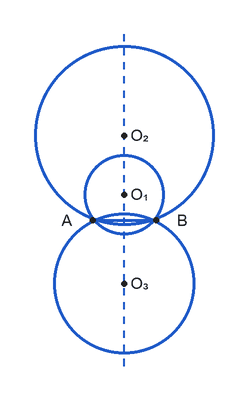
Watch out: The centres do not lie on AB itself (except the mid-point); they lie on the line at right angles to AB through its mid-point.
Therefore, the locus is the perpendicular bisector of the line segment AB joining the two fixed points.
- 293 marks
Question 29
Describe the locus of vertices of all isosceles triangles having a common base.
Solve with AIWritten solution
Solution:
Concept: In an isosceles triangle the two sides other than the base are equal. Every point on the perpendicular bisector of a line segment is equidistant from the two end points of the segment.
Step 1 — Name the triangles.
Let the common base be BC and let A be the third vertex of any one of the isosceles triangles (A′ and A″ in the figure are other positions).
Step 2 — Find the equal sides.
BC is the base, so the equal sides are AB and AC.
Step 3 — Find the locus.
AB = AC means A is equidistant from the fixed points B and C. So A lies on the perpendicular bisector of BC, on either side of BC.

Step 4 — Leave out the mid-point.
At the mid-point M of BC, the points A, B and C would lie on one line and make no triangle, so M is left out.
Watch out: The vertex can be on either side of the base, so the whole perpendicular bisector (except M) is the locus.
Therefore, the locus is the perpendicular bisector of the common base BC, leaving out the mid-point of BC.
- 303 marks
Question 30
Describe the locus of a point P, so that : AB² = AP² + BP², where A and B are two fixed points.
Solve with AIWritten solution
Solution:
Concept: By the converse of Pythagoras' theorem, if the square on one side of a triangle equals the sum of the squares on the other two sides, the angle opposite the first side is 90°. The angle in a semicircle is 90°.
Step 1 — Write the condition.
In ΔAPB it is given that the square on AB equals the sum of the squares on AP and BP.
Step 2 — Find the angle at P.
By the converse of Pythagoras' theorem, the angle opposite AB is a right angle. So ∠APB = 90°.
Step 3 — Name the circle.
AB is fixed, and AB subtends a right angle at P. The angle in a semicircle is 90°, so P lies on the circle that has AB as a diameter.
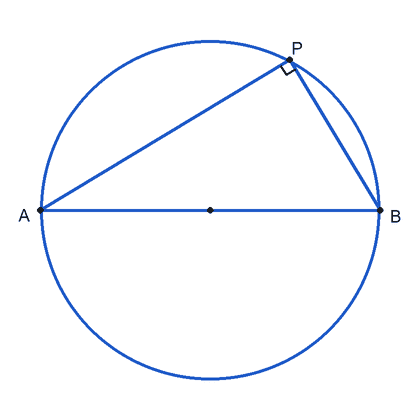
Step 4 — Check the converse.
For any point P on this circle (other than A and B), ∠APB = 90°, so AB² = AP² + BP². So every point of the circle satisfies the condition.
Watch out: The right angle is at P, the vertex opposite AB, because AB is the side whose square is the sum of the other two.
Note: At A and at B no triangle APB is formed, but the equation still holds there (at P = A, AP = 0 and BP = AB), so these two points also satisfy the condition.
Therefore, the locus is the circle drawn on AB as diameter.
- 313 marks
Question 31
Describe the locus of a point in rhombus ABCD, so that it is equidistant from
(i) AB and BC;
(ii) B and D.
Solve with AIWritten solution
Solution:
Concept: Every point on the bisector of an angle is equidistant from the two arms of the angle. Every point on the perpendicular bisector of a line segment is equidistant from the two end points of the segment. In a rhombus, each diagonal bisects the angles at its ends, and the diagonals bisect each other at right angles.

(i) Equidistant from AB and BC
Step 1 — Name the angle.
AB and BC are the arms of ∠ABC. Points inside the rhombus equidistant from AB and BC lie on the bisector of ∠ABC.
Step 2 — Find that bisector.
In a rhombus, the diagonal BD bisects ∠ABC. So the locus is the diagonal BD.
(ii) Equidistant from B and D
Step 3 — Name the line.
Points equidistant from the points B and D lie on the perpendicular bisector of BD.
Step 4 — Find that line.
The diagonals of a rhombus bisect each other at right angles, so AC passes through the mid-point O of BD and is perpendicular to BD. So AC is the perpendicular bisector of BD.
Watch out: Part (i) is about two sides (lines), part (ii) about two vertices (points), so they need different theorems.
Therefore, (i) the locus is the diagonal BD; (ii) the locus is the diagonal AC.
- 323 marks
Question 32
Describe : The locus of points at distances less than 3 cm from a given point.
Solve with AIWritten solution
Solution:
Concept: The locus of a point at a fixed distance from a fixed point is a circle, with the fixed point as centre and the fixed distance as radius. Points nearer than that distance lie inside the circle.
Step 1 — Write the condition.
Let the given point be O and the moving point be P. The condition is OP < 3 cm.
Step 2 — Find the boundary.
Points exactly 3 cm from O lie on the circle with centre O and radius 3 cm.
Step 3 — Find the points inside.
Points nearer to O than 3 cm lie inside this circle.
Step 4 — Decide about the circumference.
A point on the circumference is exactly 3 cm from O. That is not less than 3 cm, so the circumference is left out (drawn dashed).
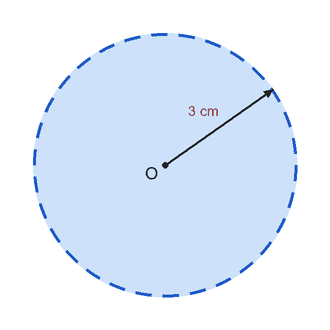
Watch out: 'less than' leaves out the circumference itself; only 'less than or equal to' includes it.
Therefore, the locus is all the points inside the circle with the given point as centre and radius 3 cm, not including the circumference.
- 333 marks
Question 33
Describe : The locus of points at distances greater than 4 cm from a given point.
Solve with AIWritten solution
Solution:
Concept: The locus of a point at a fixed distance from a fixed point is a circle, with the fixed point as centre and the fixed distance as radius. Points farther than that distance lie outside the circle.
Step 1 — Write the condition.
Let the given point be O and the moving point be P. The condition is OP > 4 cm.
Step 2 — Find the boundary.
Points exactly 4 cm from O lie on the circle with centre O and radius 4 cm.
Step 3 — Find the points outside.
Points farther from O than 4 cm lie outside this circle.
Step 4 — Decide about the circumference.
A point on the circumference is exactly 4 cm from O. That is not greater than 4 cm, so the circumference is left out (drawn dashed).

Watch out: 'greater than' leaves out the circumference itself; only 'greater than or equal to' includes it.
Therefore, the locus is all the points outside the circle with the given point as centre and radius 4 cm, not including the circumference.
- 343 marks
Question 34
Describe : The locus of points at distances less than or equal to 2·5 cm from a given point.
Solve with AIWritten solution
Solution:
Concept: The locus of a point at a fixed distance from a fixed point is a circle, with the fixed point as centre and the fixed distance as radius. Points nearer than that distance lie inside the circle.
Step 1 — Write the condition.
Let the given point be O and the moving point be P. The condition is OP ≤ 2·5 cm.
Step 2 — Find the boundary.
Points exactly 2·5 cm from O lie on the circle with centre O and radius 2·5 cm.
Step 3 — Find the points inside.
Points nearer to O than 2·5 cm lie inside this circle.
Step 4 — Decide about the circumference.
A point on the circumference is exactly 2·5 cm from O. This is allowed, since the condition is less than or equal to 2·5 cm, so the circumference is included.
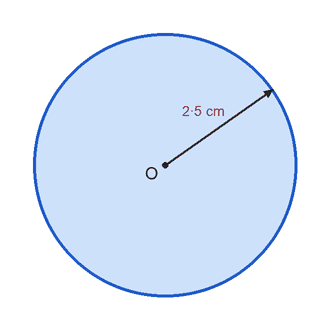
Watch out: 'less than or equal to' includes the circumference, so draw it as a full (not dashed) line.
Therefore, the locus is the circle with the given point as centre and radius 2·5 cm, together with all the points inside it.
- 353 marks
Question 35
Describe : The locus of points at distances greater than or equal to 35 mm from a given point.
Solve with AIWritten solution
Solution:
Concept: The locus of a point at a fixed distance from a fixed point is a circle, with the fixed point as centre and the fixed distance as radius. Points farther than that distance lie outside the circle.
Step 1 — Change the units.
The distance is given in millimetres. Since 10 mm = 1 cm, we divide by 10.
Step 2 — Write the condition.
Let the given point be O and the moving point be P. The condition is OP ≥ 3·5 cm.
Step 3 — Find the boundary.
Points exactly 3·5 cm from O lie on the circle with centre O and radius 3·5 cm.
Step 4 — Find the points outside.
Points farther from O than 3·5 cm lie outside this circle.
Step 5 — Decide about the circumference.
A point on the circumference is exactly 3·5 cm from O. This is allowed, since the condition is greater than or equal to 3·5 cm, so the circumference is included.
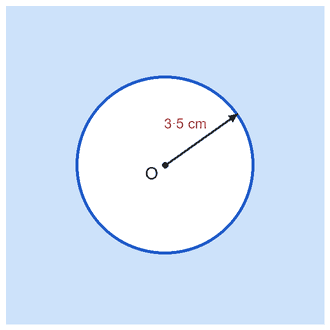
Watch out: Convert 35 mm to 3·5 cm before drawing; a radius of 35 cm would be wrong by a factor of 10.
Therefore, the locus is the circle with the given point as centre and radius 3·5 cm (35 mm), together with all the points outside it.
- 363 marks
Question 36
Describe : The locus of the centre of a given circle which rolls around the outside of a second circle and is always touching it.
Solve with AIWritten solution
Solution:
Concept: When two circles touch each other externally, the distance between their centres equals the sum of their radii. The locus of a point at a fixed distance from a fixed point is a circle, with the fixed point as centre and the fixed distance as radius.
Step 1 — Name the circles.
Let the fixed (second) circle have centre O and radius R, and the rolling circle have centre C and radius r.
Step 2 — Find the distance OC.
The rolling circle always touches the fixed circle from outside, so in every position the distance between the centres is the sum of the radii.
Step 3 — Find the locus.
R and r do not change, so C is always at the fixed distance R + r from the fixed point O. It therefore moves on a circle with centre O.
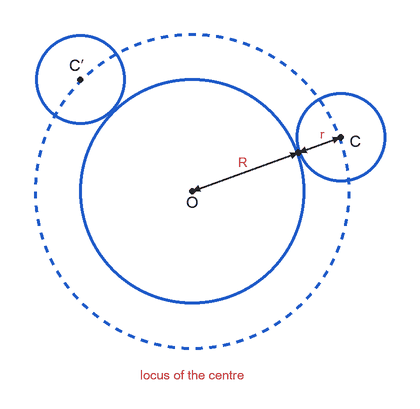
Watch out: The centre is at distance R + r from O, not R: it stays one radius r outside the fixed circle.
Therefore, the locus is a circle with centre O (the centre of the second circle) and radius R + r (the sum of the two radii).
- 373 marks
Question 37
Describe : The locus of the centres of all circles that are tangent to both the arms of a given angle.
Solve with AIWritten solution
Solution:
Concept: A circle touches (is tangent to) a line when the perpendicular distance of its centre from the line equals its radius. Every point on the bisector of an angle is equidistant from the two arms of the angle.
Step 1 — Use the first arm.
Take any circle that touches both arms of the given angle. Its centre is at a distance equal to its radius from the first arm.
Step 2 — Use the second arm.
Its centre is at the same distance (the radius) from the second arm.
Step 3 — Find the locus.
So the centre is equidistant from the two arms and lies inside the angle. This is true for every such circle, whatever its size, so the centres lie on the bisector of the angle.
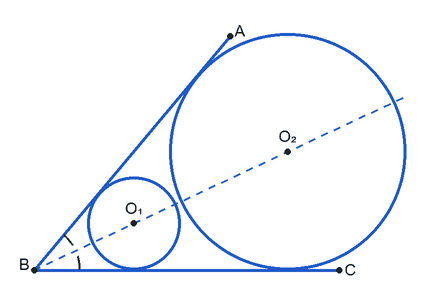
Watch out: The distance of a point from a line is the perpendicular distance. Any other segment from the point to the line is longer.
Therefore, the locus is the bisector of the given angle.
- 383 marks
Question 38
Describe : The locus of the mid-points of all chords parallel to a given chord of a circle.
Solve with AIWritten solution
Solution:
Concept: The perpendicular drawn from the centre of a circle to a chord bisects the chord.
Step 1 — Draw the diameter.
Let AB be the given chord and O the centre. Draw the diameter CD perpendicular to AB.
Step 2 — Compare directions.
Every chord parallel to AB is also perpendicular to CD.
Step 3 — Use the theorem.
CD passes through the centre O and is perpendicular to each of these chords, so it bisects each of them. So the mid-point of every such chord lies on CD.
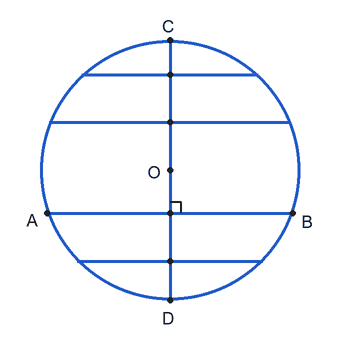
Watch out: The locus is the diameter perpendicular to the chords, not the diameter parallel to them.
Therefore, the locus is the diameter of the circle which is perpendicular to the given chord (CD in the figure; the dots are the mid-points of the chords).
- 393 marks
Question 39
Describe : The locus of points within a circle that are equidistant from the end points of a given chord.
Solve with AIWritten solution
Solution:
Concept: Every point on the perpendicular bisector of a line segment is equidistant from the two end points of the segment. The perpendicular bisector of any chord of a circle passes through the centre of the circle.
Step 1 — Find the line.
Let AB be the given chord. A point P equidistant from its end points A and B lies on the perpendicular bisector of AB.
Step 2 — Locate the line.
The perpendicular bisector of a chord passes through the centre O of the circle.
Step 3 — Keep the part within the circle.
The points must be within the circle. The part of this line inside the circle is a diameter, perpendicular to AB.

Watch out: Only the diameter perpendicular to the chord works, not just any diameter.
Therefore, within the circle, the locus is the diameter of the circle which is perpendicular to the given chord (CD in the figure).
- 403 marks
Question 40
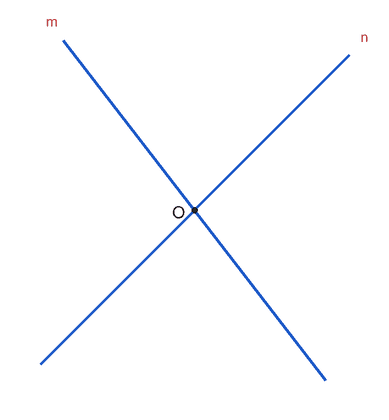
In the given figure, obtain all the points equidistant from lines m and n; and 2·5 cm from O.
 Solve with AI
Written solution
Solution:
Concept: The required points satisfy two conditions, so they lie on two loci at once. The locus of points equidistant from two intersecting lines is the pair of lines that bisect the angles between them. The locus of a point at a fixed distance from a fixed point is a circle, with the fixed point as centre and the fixed distance as radius.
Step 1 — Draw the first locus.
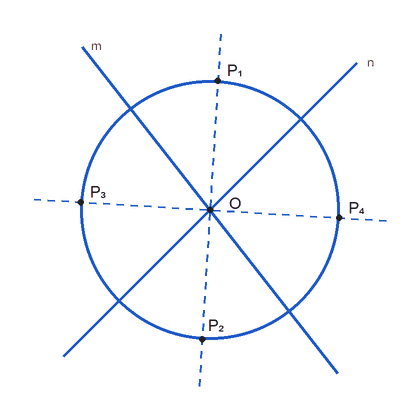
The lines m and n meet at O and form two pairs of vertically opposite angles. Construct the bisector of each pair. These two bisectors pass through O and are at right angles to each other, and every point on them is equidistant from m and n.
Step 2 — Draw the second locus.
With O as centre and radius 2·5 cm, draw a circle. Every point on it is 2·5 cm from O.
Step 3 — Mark the points.
Mark the points where the circle cuts the two bisectors. Each bisector passes through the centre O, so the circle cuts it at two points, one on each side of O.
Step 4 — Count the points.
There are two bisectors and two points on each.
Watch out: Two intersecting lines have two angle bisectors. Using only one gives just two of the four points.
Therefore, there are four such points, P₁, P₂, P₃ and P₄; each is 2·5 cm from O and equidistant from m and n.
- 413 marks
Question 41
Sketch and describe the locus of the vertices of all triangles with a given base and a given altitude.
Solve with AIWritten solution
Solution:
Concept: The altitude of a triangle is the perpendicular distance of a vertex from the opposite side. The locus of a point at a fixed distance from a fixed straight line is a pair of straight lines parallel to the given line, one on each side of it, each at that distance from it.
Step 1 — Name the triangle.
Let the given base be BC and the given altitude be h. Let A be the third vertex of any such triangle.
Step 2 — Use the altitude.
The altitude from A to BC is h, so A is always at a perpendicular distance h from the line BC.
Step 3 — Find the locus.
A can be on either side of BC. On each side, the points at distance h from BC lie on a line parallel to BC (A′ and A″ in the sketch are other positions).
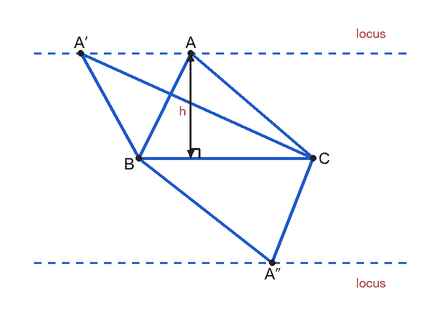
Watch out: The vertex may lie on either side of the base, so there are two parallel lines.
Therefore, the locus is a pair of straight lines parallel to BC, one on each side of BC, each at a distance h from it.
- 423 marks
Question 42
A straight line AB is 8 cm long. Draw and describe the locus of a point which is :
(i) always 4 cm from the line AB.
(ii) equidistant from A and B.
Mark the two points X and Y, which are 4 cm from AB and equidistant from A and B. Describe the figure AXBY.
Solve with AIWritten solution
Solution:
Concept: The locus of a point at a fixed distance from a fixed straight line is a pair of straight lines parallel to the given line, one on each side of it, each at that distance from it. Every point on the perpendicular bisector of a line segment is equidistant from the two end points of the segment.
Step 1 — Draw AB and the first locus.
Draw AB = 8 cm. Then draw two lines parallel to AB, one on each side of it, each 4 cm from AB. This pair of parallel lines is the locus for part (i).
Step 2 — Draw the second locus.
Draw the perpendicular bisector of AB; let it meet AB at O. It is the locus for part (ii).
Step 3 — Mark X and Y.
Mark X and Y, where the perpendicular bisector cuts the two parallel lines. X and Y are 4 cm from AB and equidistant from A and B. Join AX, XB, BY and YA.

Step 4 — Find the half-diagonals.
O is the mid-point of AB, so OA and OB are half of 8 cm. X and Y are 4 cm from AB along the perpendicular XY, so OX and OY are 4 cm as well.
Step 5 — Name the figure.
The diagonals AB and XY bisect each other at O, so AXBY is a parallelogram. The diagonal XY is 4 + 4 = 8 cm, equal to AB, so the parallelogram is a rectangle. Its diagonals are also at right angles (XY ⊥ AB), so the rectangle is a square.
Step 6 — Find the side.
In the right-angled triangle AOX, Pythagoras' theorem gives the side AX.
Watch out: Equal diagonals alone give a rectangle; it is the right angle between the diagonals that makes AXBY a square.
Therefore, the loci are (i) a pair of lines parallel to AB, each 4 cm from it, and (ii) the perpendicular bisector of AB; and AXBY is a square of side 4√2 ≈ 5·66 cm.
- 433 marks
Question 43
Draw a triangle ABC in which AB = 6 cm, BC = 4·5 cm and AC = 5 cm. Draw and label :
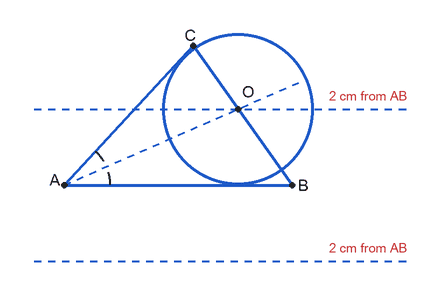
(i) the locus of the centres of all circles which touch AB and AC,
(ii) the locus of the centres of all the circles of radius 2 cm which touch AB.
Hence, construct the circle of radius 2 cm which touches AB and AC.
Solve with AIWritten solution
Solution:
Concept: A circle touches (is tangent to) a line when the perpendicular distance of its centre from the line equals its radius. So the centre of a circle touching AB and AC is equidistant from AB and AC (it lies on the bisector of ∠BAC), and the centre of a circle of radius 2 cm touching AB is 2 cm from AB (it lies on a line parallel to AB, 2 cm from it).
Step 1 — Construct the triangle.
All three sides are known, so we draw AB and fix C with two arcs.
- Draw AB = 6 cm.
- With A as centre and radius 5 cm, draw an arc. With B as centre and radius 4·5 cm, draw an arc cutting the first at C. Join AC and BC.
Step 2 — Draw locus (i).
A circle touching AB and AC has its centre equidistant from AB and AC, so construct the bisector of ∠BAC. This is the locus of the centres of all circles that touch AB and AC.
Step 3 — Draw locus (ii).
At any point of AB, draw a perpendicular to AB and cut off 2 cm on it, on the same side as C. Through this point draw a line parallel to AB. This line, with the similar line 2 cm below AB, is the locus of the centres of all circles of radius 2 cm that touch AB: a pair of lines parallel to AB, each 2 cm from it.
Step 4 — Construct the circle.
Mark O, where the bisector of ∠A meets the parallel line above AB. With O as centre and radius 2 cm, draw the circle.
Step 5 — Justify the circle.
O is on the line 2 cm from AB, so the circle of radius 2 cm about O touches AB. O is also on the bisector of ∠A, so it is 2 cm from AC as well, and the circle touches AC.
Check: On measuring, AO ≈ 5 cm (by calculation 4.99 cm). The circle runs across side BC (its centre O lies almost exactly on BC), because its radius, 2 cm, is larger than the radius of the incircle of this triangle (about 1·4 cm).
Watch out: Use the parallel line on the same side of AB as C; the lower line would give a circle on the other side of AB that cannot touch side AC.
Therefore, the loci are (i) the bisector of ∠BAC and (ii) the pair of lines parallel to AB at 2 cm, and the circle with centre O (where they meet, above AB) and radius 2 cm is the required circle touching AB and AC.
- 443 marks
Question 44
Draw an angle ABC = 75°. Find a point P such that P is at a distance of 2 cm from AB and 1·5 cm from BC.
Solve with AIWritten solution
Solution:
Concept: The locus of a point at a fixed distance from a fixed straight line is a pair of straight lines parallel to the given line, one on each side of it, each at that distance from it. P must lie on two such loci at once: a line 2 cm from AB and a line 1·5 cm from BC.
Step 1 — Draw the angle.
We need the arms BA and BC with 75° between them.
- Draw a ray BC.
- At B, construct ∠ABC = 75° (construct 60° and 90° at B and bisect the angle between them).
Step 2 — Draw the line 1·5 cm from BC.
At any point of BC, draw a perpendicular to BC and cut off 1·5 cm on it, inside the angle. Through this point draw a line parallel to BC. Every point on it is 1·5 cm from BC.
Step 3 — Draw the line 2 cm from AB.
At any point of BA, draw a perpendicular to BA and cut off 2 cm on it, inside the angle. Through this point draw a line parallel to BA. Every point on it is 2 cm from AB.
Step 4 — Mark P.
Mark P, where the two parallel lines meet. P is on both lines, so it is 2 cm from AB and 1·5 cm from BC.
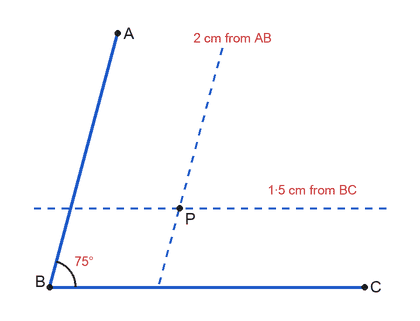
Check: On measuring, BP ≈ 2·9 cm (by calculation 2.89 cm).
Watch out: Cut off the distances perpendicular to the arms, not along them.
Note: Taking lines on the other sides of the arms as well gives three more such points outside the angle; the point inside the angle is the one usually asked for.
Therefore, P is the point where the line 2 cm from AB meets the line 1·5 cm from BC (inside ∠ABC).
- 453 marks
Question 45
Construct a triangle ABC, with AB = 5·6 cm, AC = BC = 9·2 cm. Find the points equidistant from AB and AC; and also 2 cm from BC. Measure the distance between the two points obtained.
Solve with AIWritten solution
Solution:
Concept: Points equidistant from AB and AC lie on the bisector of ∠BAC. Points 2 cm from BC lie on a pair of lines parallel to BC, one on each side of it, each 2 cm from it. The required points lie on both loci.
Step 1 — Construct the triangle.
All three sides are known, and AC = BC, so C is found with two equal arcs.
- Draw AB = 5·6 cm.
- With A and B as centres and radius 9·2 cm, draw arcs cutting each other at C. Join AC and BC.
Step 2 — Draw locus 1.
Construct the bisector of ∠BAC and produce it beyond BC; let it meet BC at K.
Step 3 — Draw locus 2.
Draw two lines parallel to BC, one on each side of BC, each 2 cm from it.
Step 4 — Mark the points.
Mark X (inside the triangle) and Y (outside, beyond BC), where the bisector cuts these two lines. On measuring, XY ≈ 4·2 cm.

Step 5 — Find angle A.
AC = BC, so the perpendicular from C meets AB at its mid-point, 2·8 cm from A. The cosine ratio in that right-angled triangle gives ∠A.
This gives ∠A ≈ 72·3°, and ∠B is the same.
Step 6 — Find the angle at K.
In ΔABK, the angle at A is half of ∠A and the angle at B equals ∠A (since AC = BC). The angles of a triangle add up to 180°.
Step 7 — Find XY.
The two parallel lines are 2 + 2 = 4 cm apart, and the bisector crosses them at 71·6°. So XY is the slant distance across a 4 cm gap.
Watch out: Draw the parallel lines on both sides of BC; the second point Y lies outside the triangle.
Therefore, the two required points are X and Y, and the distance between them is XY ≈ 4·2 cm.
- 463 marks
Question 46
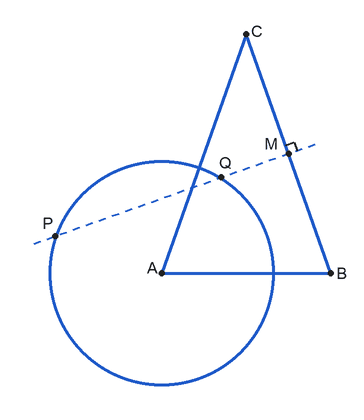
Construct a triangle ABC, with AB = 6 cm, AC = BC = 9 cm. Find a point 4 cm from A and equidistant from B and C.
Solve with AIWritten solution
Solution:
Concept: Points equidistant from B and C lie on the perpendicular bisector of BC. Points 4 cm from A lie on the circle with centre A and radius 4 cm. The required point lies on both loci.
Step 1 — Construct the triangle.
All three sides are known, and AC = BC, so C is found with two equal arcs.
- Draw AB = 6 cm.
- With A and B as centres and radius 9 cm, draw arcs cutting each other at C. Join AC and BC.
Step 2 — Draw locus 1.
Construct the perpendicular bisector of BC (it meets BC at its mid-point M) and produce it on both sides.
Step 3 — Draw locus 2.
With A as centre and radius 4 cm, draw a circle.
Step 4 — Mark the points.
Mark P and Q, where the circle cuts the perpendicular bisector. Q lies inside the triangle.
Step 5 — Explain why there are two points.
The perpendicular distance of A from the perpendicular bisector of BC is 2·5 cm, which is less than the radius 4 cm, so the circle cuts the line at two points.
Watch out: Both P and Q satisfy the two conditions. Q is the one inside the triangle, which is the usual answer.
Note: The second point P, outside the triangle, also satisfies both conditions (PA = 4 cm and PB = PC).
Therefore, the required point is Q (inside ΔABC): QA = 4 cm and QB = QC.
- 471 mark
Question 47
The locus of a point which is equidistant from two non-parallel lines AB and CD is :
Solve with AIAnswer
(A) perpendicular to AB.
(B) perpendicular to CD.
- Correct
(C) bisector of angle between AB and CD.
(D) perpendicular bisector of CD.
Answer: (C) bisector of angle between AB and CD.
Concept: The locus of points equidistant from two intersecting lines is the pair of lines that bisect the angles between them.
Step 1 — Find where the lines meet.
AB and CD are not parallel, so they meet at a point; call it O.
Step 2 — Take a point of the locus.
Take a point P equidistant from the two lines, and draw PM ⊥ AB and PN ⊥ CD, so that PM = PN.
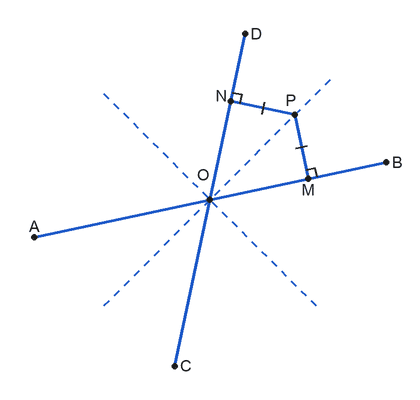
Step 3 — Compare triangles POM and PON.
Both are right-angled, they share the hypotenuse PO, and PM = PN. So ΔPOM ≅ ΔPON by RHS.
Step 4 — Conclude.
Hence ∠POM = ∠PON, so PO bisects the angle between AB and CD. (Two intersecting lines make two pairs of angles, so there are two such bisectors, shown dashed.)
Watch out: Equidistant from two points gives a perpendicular bisector; equidistant from two lines gives an angle bisector. Read the question carefully to see which one is meant.
Why the other options are wrong:
- (A) perpendicular to AB: the locus makes equal angles with AB and CD, and each of these is less than 90°; a line perpendicular to AB makes 90° with AB.
- (B) perpendicular to CD: for the same reason, the locus cannot make 90° with CD.
- (D) perpendicular bisector of CD: the perpendicular bisector of CD is the locus of points equidistant from the two points C and D, not from the two lines.
Therefore, the locus is the bisector of the angle between AB and CD, option (C).
- 481 mark
Question 48
Three isosceles triangles PBC, QBC and RBC are on the same base, then :
Solve with AIAnswer
- Correct
(A) P, Q and R are collinear.
(B) ΔPQR is isosceles triangle.
(C) Q lies on the circumference of a circle with BC as diameter.
(D) Q is mid-point of line segment PR.
Answer: (A) P, Q and R are collinear.
Concept: In an isosceles triangle the two sides other than the base are equal. Every point on the perpendicular bisector of a line segment is equidistant from the two end points of the segment.
Step 1 — Use triangle PBC.
ΔPBC is isosceles with base BC, so PB = PC. So P is equidistant from B and C.
Step 2 — Do the same for Q and R.
In the same way, QB = QC and RB = RC.
Step 3 — Find the common line.
So P, Q and R all lie on the perpendicular bisector of BC, which is one straight line.

Watch out: 'isosceles on the same base' means the equal sides are the two sides other than BC.
Why the other options are wrong:
- (B) ΔPQR is isosceles triangle: P, Q and R lie on one straight line, so they do not form a triangle at all.
- (C) Q lies on the circumference of a circle with BC as diameter: Q would lie on that circle only if ∠BQC = 90°, which is not given.
- (D) Q is mid-point of line segment PR: the three points are on one line, but nothing is given about the lengths PQ and QR.
Therefore, P, Q and R are collinear, option (A).
- 491 mark
Question 49
Locus of the centres of the circles passing through two fixed points A and B is :
Solve with AIAnswer
(A) a line parallel to line segment AB.
(B) the bisector of line segment AB.
(C) perpendicular to line segment AB.
- Correct
(D) perpendicular bisector of line segment AB.
Answer: (D) perpendicular bisector of line segment AB.
Concept: All radii of a circle are equal. Every point on the perpendicular bisector of a line segment is equidistant from the two end points of the segment.
Step 1 — Take any such circle.
Let O be the centre of any circle passing through A and B.
Step 2 — Use equal radii.
OA and OB are radii of the same circle, so OA = OB.
Step 3 — Find the locus.
So O is equidistant from the fixed points A and B. This holds for the centre of every such circle, so all the centres lie on the perpendicular bisector of AB.
Watch out: A line through the mid-point of AB is not enough; it must also be at right angles to AB.
Why the other options are wrong:
- (A) a line parallel to line segment AB: only one point of a line parallel to AB is equidistant from A and B, so its other points cannot be centres.
- (B) the bisector of line segment AB: a line can bisect AB (pass through its mid-point) without being perpendicular to it; its other points are then not equidistant from A and B.
- (C) perpendicular to line segment AB: a perpendicular to AB must also pass through the mid-point of AB; otherwise none of its points is equidistant from A and B.
Therefore, the locus of the centres is the perpendicular bisector of line segment AB, option (D).
- 501 mark
Question 50
A point is equidistant from the sides of an obtuse angle triangle. The point is called :
Solve with AIAnswer
(A) circumcentre of the triangle
- Correct
(B) incentre of the triangle
(C) centroid of the triangle
(D) orthocentre of the triangle
Answer: (B) incentre of the triangle
Concept: Every point on the bisector of an angle is equidistant from the two arms of the angle. The bisectors of the three angles of a triangle meet at one point, called the incentre.
Step 1 — Use sides AB and BC.
A point equidistant from the sides AB and BC lies on the bisector of ∠B.
Step 2 — Use sides BC and CA.
A point equidistant from the sides BC and CA lies on the bisector of ∠C.
Step 3 — Name the point.
A point equidistant from all three sides lies on both bisectors, so it is the point where the angle bisectors meet: the incentre I. This is true for every triangle, obtuse-angled or not.

Watch out: The circumcentre is equidistant from the vertices; the incentre is equidistant from the sides.
Why the other options are wrong:
- (A) circumcentre of the triangle: the circumcentre is where the perpendicular bisectors of the sides meet; it is equidistant from the three vertices, not the sides.
- (C) centroid of the triangle: the centroid is where the medians meet; in general it is not equidistant from the sides.
- (D) orthocentre of the triangle: the orthocentre is where the altitudes meet; in an obtuse-angled triangle it even lies outside the triangle, so it cannot be equidistant from all three sides.
Therefore, the point is the incentre of the triangle, option (B).
- 511 mark
Question 51
In ΔABC, point P moves such that it remains at a fixed distance (i.e. radius) of 2·8 cm from vertex B. The locus of point P is :
Solve with AIAnswer
(A) bisector of angle ABC.
(B) a line parallel to BC and at a distance of 2·8 cm from it.
- Correct
(C) circle with centre at point B and radius = 2·8 cm.
(D) perpendicular bisector of BC.
Answer: (C) circle with centre at point B and radius = 2·8 cm.
Concept: The locus of a point at a fixed distance from a fixed point is a circle, with the fixed point as centre and the fixed distance as radius.
Step 1 — Find the fixed point.
The vertex B is a fixed point.
Step 2 — Find the fixed distance.
P moves so that BP = 2·8 cm in every position.
Step 3 — Name the locus.
So P is always at a fixed distance from a fixed point, and it moves on the circle with centre B and radius 2·8 cm.
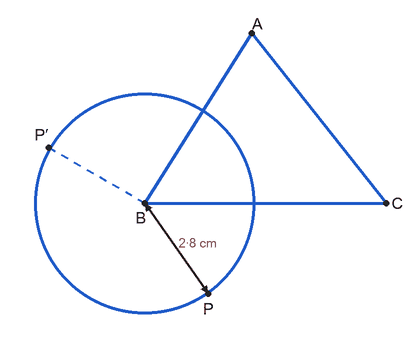
Watch out: A fixed distance from a point gives a circle; a fixed distance from a line gives parallel lines.
Why the other options are wrong:
- (A) bisector of angle ABC: the bisector of ∠ABC is the locus of points equidistant from the arms BA and BC; along it the distance from B keeps changing.
- (B) a line parallel to BC and at a distance of 2·8 cm from it: this is the locus of points 2·8 cm from the line BC (on one side), not from the point B.
- (D) perpendicular bisector of BC: the perpendicular bisector of BC is the locus of points equidistant from B and C; along it the distance from B keeps changing.
Therefore, the locus of P is the circle with centre B and radius 2·8 cm, option (C).
- 523 marks
Question 52
Draw an ∠ABC = 60°, having AB = 4·6 cm and BC = 5 cm. Find a point P equidistant from AB and BC; and also equidistant from A and B.
Solve with AIWritten solution
Solution:
Concept: Points equidistant from AB and BC lie on the bisector of ∠ABC. Points equidistant from A and B lie on the perpendicular bisector of AB. P lies on both loci.
Step 1 — Draw the angle.
Two arm lengths and the angle between them are given.
- Draw BC = 5 cm.
- At B, construct ∠CBX = 60° with compasses. On BX, cut off BA = 4·6 cm.
Step 2 — Draw the two loci.
P must satisfy both conditions, so we draw both loci.
- Construct the bisector of ∠ABC (locus 1).
- Construct the perpendicular bisector of AB (locus 2); let it meet AB at its mid-point M.
Step 3 — Mark P.
Mark P, where the two loci meet. P is on the bisector of ∠ABC, so it is equidistant from AB and BC; P is on the perpendicular bisector of AB, so PA = PB.
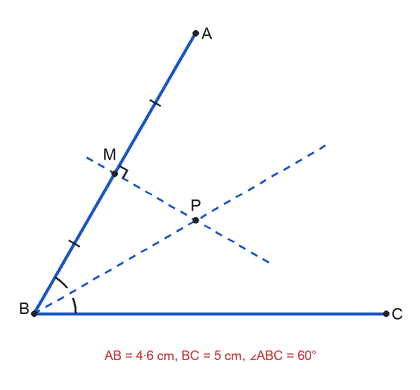
Step 4 — Check BP by calculation.
M is the mid-point of AB, so BM is half of 4·6 cm. BP bisects 60°, so ∠PBM = 30°, and ΔPMB is right-angled at M.
Using the cosine of ∠PBM:
Watch out: Here the perpendicular bisector is of AB (equidistant from A and B), not of BC.
Therefore, P is the point where the bisector of ∠ABC meets the perpendicular bisector of AB, and BP ≈ 2·7 cm.
- 533 marks
Question 53
On a graph paper, draw the lines x = 3 and y = –5. Now, on the same graph paper, draw the locus of the point which is equidistant from the given lines.
Solve with AIWritten solution
Solution:
Concept: The locus of points equidistant from two intersecting lines is the pair of lines that bisect the angles between them. On a graph, the distance of the point (x, y) from the vertical line x = 3 is |x − 3|, and from the horizontal line y = −5 it is |y + 5|.
Step 1 — Draw the given lines.
x = 3 is a vertical line and y = −5 is a horizontal line. They meet at right angles at the point (3, −5).
Step 2 — Write the condition.
A point (x, y) of the locus is equally far from the two lines, so the two distances are equal.
Step 3 — Take the same signs.
If y + 5 and x − 3 have the same sign, the two expressions are equal. We then subtract 5 from both sides.
Step 4 — Take opposite signs.
If they have opposite signs, one is minus the other. We remove the bracket and then subtract 5 from both sides.
Step 5 — Plot the two lines.
We plot three points on each line and join them.
Line Points y = x − 8 (0, −8), (3, −5), (8, 0) y = −x − 2 (0, −2), (3, −5), (−2, 0) 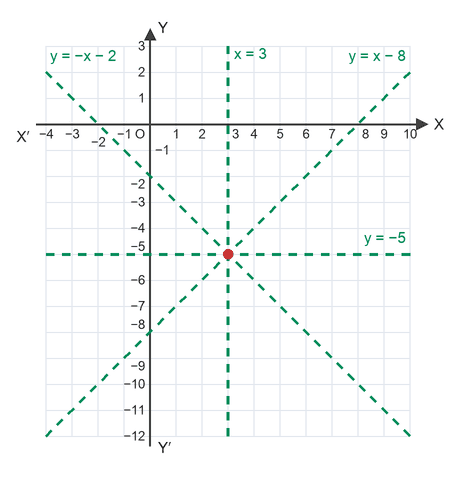
Check: Take the point (8, 0), which lies on the line y = x − 8. Its distances from the two given lines are worked out below, and they are equal.
Watch out: Both lines pass through (3, −5), where the given lines cross; check this on your graph before joining the points.
Therefore, the locus is the pair of lines y = x − 8 and y = −x − 2, the two bisectors of the angles between x = 3 and y = −5.
- 543 marks
Question 54
On a graph paper, draw the line x = 6. Now, on the same graph paper, draw the locus of the point which moves in such a way that its distance from the given line is always equal to 3 units.
Solve with AIWritten solution
Solution:
Concept: The locus of a point at a fixed distance from a fixed straight line is a pair of straight lines parallel to the given line, one on each side of it, each at that distance from it.
Step 1 — Draw the given line.
x = 6 is a vertical line, parallel to the y-axis.
Step 2 — Read the condition.
The distance of a point (x, y) from this vertical line is measured horizontally, and it must be 3 units, to the left or to the right of the line.
Step 3 — Find the line on the left.
Points 3 units to the left have x three less than 6.
Step 4 — Find the line on the right.
Points 3 units to the right have x three more than 6.
Step 5 — Draw the locus.
Draw the vertical lines x = 3 and x = 9 on the same graph paper.
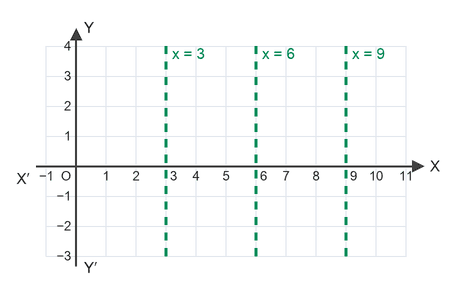
Watch out: The locus has two lines, one on each side of x = 6.
Therefore, the locus is the pair of lines x = 3 and x = 9, both parallel to x = 6.
- 553 marks
Question 55
Ruler and compasses may be used in this question. All construction lines and arcs must be clearly shown and be of sufficient length and clarity to permit assessment.
(i) Construct a Δ ABC, in which BC = 6 cm, AB = 9 cm and angle ABC = 60°.
(ii) Construct the locus of all points inside triangle ABC, which are equidistant from B and C.
(iii) Construct the locus of the vertices of the triangles with BC as base and which are equal in area to triangle ABC.
(iv) Mark the point Q, in your construction, which would make Δ QBC equal in area to Δ ABC, and isosceles.
(v) Measure and record the length of CQ.
Solve with AIWritten solution
Solution:
Concept: Points equidistant from B and C lie on the perpendicular bisector of BC. Triangles on the same base have equal areas when they have equal heights, so their third vertices lie on a line parallel to the base.
(i)
Step 1 — Construct the triangle.
Two sides and the included angle are given.
- Draw BC = 6 cm.
- At B, construct ∠CBX = 60° with compasses. On BX, cut off BA = 9 cm. Join AC.
(ii)
Step 2 — Draw the locus equidistant from B and C.
Construct the perpendicular bisector of BC and draw the part of it inside the triangle. It meets BC at its mid-point M.
(iii)
Step 3 — Find the condition for equal area.
The area of a triangle is ½ × base × height. With the same base BC, the area equals that of ΔABC only when the height equals the height of A above BC. So the vertex must stay at the same distance from BC as A.
Step 4 — Draw the locus of equal area.
Through A, construct the line parallel to BC. This is the required locus.
(iv)
Step 5 — Mark Q.
Q must be on the line through A parallel to BC (equal area). For ΔQBC to be isosceles, QB = QC, so Q must also be on the perpendicular bisector of BC. Produce the perpendicular bisector to meet the parallel line, and mark Q there.

(v)
Step 6 — Measure CQ.
On measuring, CQ ≈ 8·4 cm.
Step 7 — Check CQ by calculation.
First find the height of A above BC using the sine of 60°.
Q is at the same height, so QM ≈ 7·79 cm, and CM = 3 cm (half of BC). Pythagoras' theorem in the right-angled triangle QMC gives CQ.
Watch out: The perpendicular bisector alone gives isosceles triangles of every area; Q must lie on it and on the line through A parallel to BC.
Therefore, Q is the point where the perpendicular bisector of BC meets the line through A parallel to BC, and CQ ≈ 8·4 cm.
- 563 marks
Question 56
Construct an isosceles triangle ABC such that AB = 6 cm, BC = AC = 4 cm. Bisect ∠C internally and mark a point P on this bisector such that CP = 5 cm. Find the points Q and R which are 5 cm from P and also 5 cm from the line AB.
Solve with AIWritten solution
Solution:
Concept: Points 5 cm from P lie on the circle with centre P and radius 5 cm. Points 5 cm from the line AB lie on a pair of lines parallel to AB, each 5 cm from it. Q and R lie on both loci.
Step 1 — Construct the triangle.
All three sides are known, and AC = BC, so C is found with two equal arcs.
- Draw AB = 6 cm.
- With A and B as centres and radius 4 cm, draw arcs cutting each other at C. Join AC and BC.
Step 2 — Mark P.
Bisect ∠ACB. Since AC = BC, this bisector is perpendicular to AB and passes through its mid-point. Produce it beyond AB and cut off CP = 5 cm on it.
Step 3 — Draw the two loci.
Draw two lines parallel to AB, one 5 cm above it and one 5 cm below it. Then, with P as centre and radius 5 cm, draw a circle.
Step 4 — Mark Q and R.
Mark Q and R, where the circle cuts the line 5 cm below AB. Each is 5 cm from P and 5 cm from AB. On measuring, QR ≈ 8·5 cm.

Step 5 — Find the height of C.
The bisector meets AB at its mid-point, 3 cm from A, so Pythagoras' theorem gives the height of C above AB.
Step 6 — Find how far P is below AB.
CP = 5 cm, and 2·65 cm of it is above AB.
Step 7 — Test the upper line.
The upper line is 5 cm above AB, so its distance from P is the depth of P plus 5 cm.
This is more than the radius 5 cm, so the circle does not reach the upper line.
Step 8 — Test the lower line.
The lower line is 5 cm below AB, so its distance from P is 5 cm minus the depth of P.
This is less than 5 cm, so the circle cuts the lower line at two points, Q and R.
Watch out: Draw both parallel lines; only the lower one meets the circle, and the calculation in Steps 7 and 8 shows why.
Therefore, Q and R are the two points where the circle of radius 5 cm about P meets the line 5 cm below AB, and QR ≈ 8·5 cm.
- 573 marks
Question 57
Construct a triangle BCP given BC = 5 cm, BP = 4 cm and ∠PBC = 45°.
(i) Complete the rectangle ABCD such that :
(a) P is equidistant from AB and BC.
(b) P is equidistant from C and D.
(ii) Measure and record the length of AB.
Solve with AIWritten solution
Solution:
Concept: Points equidistant from AB and BC lie on the bisector of ∠ABC. Points equidistant from C and D lie on the perpendicular bisector of CD. Each angle of a rectangle is 90°.
Step 1 — Construct triangle BCP.
Two sides and the included angle are given.
- Draw BC = 5 cm.
- At B, construct ∠CBX = 45° (construct 90° at B and bisect it).
- On BX, cut off BP = 4 cm. Join PC.
Step 2 — Use condition (a).
In rectangle ABCD, ∠ABC = 90°, and its bisector makes 45° with BC. Since ∠PBC = 45°, BP is already this bisector. So P is equidistant from AB and BC as soon as BA is drawn perpendicular to BC.
Step 3 — Use condition (b).
P must lie on the perpendicular bisector of CD. CD is perpendicular to BC, so its perpendicular bisector is parallel to BC, and it must pass through P. So the mid-point of CD is at the same height as P, and CD is twice the height of P above BC.
Step 4 — Complete the rectangle.
We now draw the sides through B and C and fix D from the mid-point N.
- At B, draw BY ⊥ BC. At C, draw CZ ⊥ BC.
- Through P, draw a line parallel to BC; let it meet CZ at N.
- On CZ, cut off ND = CN. Now the line through P bisects CD at right angles.
- Through D, draw a line parallel to BC to meet BY at A. ABCD is the required rectangle.
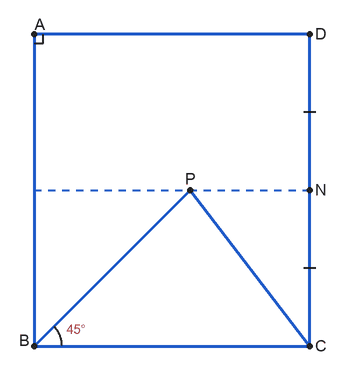
Step 5 — Measure AB.
On measuring, AB ≈ 5·7 cm.
Step 6 — Check AB by calculation.
The height of P above BC comes from the sine of 45°, and AB = CD is twice it.
Watch out: CD must be twice the height of P, because P's level is the mid-point of CD, not its top.
Therefore, ABCD is the rectangle with CN = ND (N level with P), and AB ≈ 5·7 cm.
- 583 marks
Question 58
Use ruler and compasses only for the following question. All construction lines and arcs must be clearly shown.
(i) Construct a ΔABC in which BC = 6·5 cm, ∠ABC = 60° and AB = 5 cm.
(ii) Construct the locus of points at a distance of 3·5 cm from A.
(iii) Construct the locus of points equidistant from AC and BC.
(iv) Mark 2 points X and Y which are at a distance of 3·5 cm from A and also equidistant from AC and BC. Measure XY.
Solve with AIWritten solution
Solution:
Concept: Points 3·5 cm from A lie on the circle with centre A and radius 3·5 cm. Points equidistant from AC and BC lie on the bisector of ∠ACB. X and Y lie on both loci.
(i)
Step 1 — Construct the triangle.
Two sides and the included angle are given.
- Draw BC = 6·5 cm.
- At B, construct ∠CBX = 60° with compasses. On BX, cut off BA = 5 cm. Join AC.
(ii)
Step 2 — Draw the circle.
With A as centre and radius 3·5 cm, draw a circle. It is the locus of points 3·5 cm from A.
(iii)
Step 3 — Draw the bisector.
Construct the bisector of ∠ACB and produce it. It is the locus of points equidistant from AC and BC.
(iv)
Step 4 — Mark X and Y and measure.
Mark X and Y, where the bisector of ∠C cuts the circle. Each is 3·5 cm from A and equidistant from AC and BC. On measuring, XY ≈ 5·2 cm.
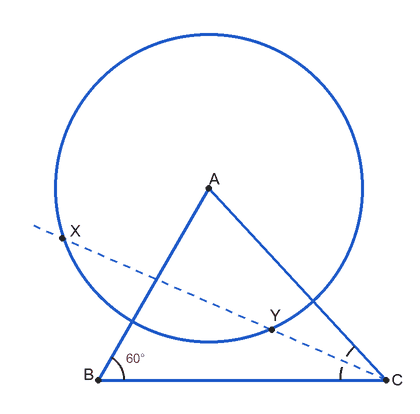
Step 5 — Find AC and angle C.
By the cosine rule (or by measuring), AC ≈ 5·89 cm, and then ∠ACB ≈ 47·3°, so half of ∠ACB is about 23·6°.
Step 6 — Find the distance of A from the bisector.
In the right-angled triangle formed by A, C and the foot of the perpendicular from A to the bisector, the sine of the half-angle gives this distance.
Step 7 — Find XY.
XY is a chord of the circle of radius 3·5 cm at the distance d from its centre A. The perpendicular from the centre bisects the chord, so Pythagoras' theorem gives half of XY.
Watch out: The bisector is of the angle at C (between AC and BC), not of the angle at B.
Therefore, X and Y are the two points where the bisector of ∠ACB cuts the circle of radius 3·5 cm about A, and XY ≈ 5·2 cm.
What Class 10 Maths Ch 16 covers
The sections of the chapter, in the order the book takes them. Every question above comes from one of these.
- 01Definition
- 02Theorems Based on Symmetry
- 03Applications
- 04Important
More ways to study this chapter
The same chapter asked three other ways. Practise it, revise it, and see what the board has set on Ch 16 before.
- Competency-Based Questions (CBQ)Case study questions: a situation, and the part of the chapter that answers it.40questionsOpen
- Previous Year QuestionsQuestions that have actually appeared in board papers, each tagged with its year.7questionsOpen
- Practice QuestionsExtra questions per chapter, for when one attempt at a method is not enough.40questionsOpen
Ch 16 in past ICSE papers
The same chapter as the board has actually asked it. These are worded differently from the textbook exercise, which is the point of reading them.
- 14 marks
Board paper question 1
Use ruler and compasses only for the following question. All construction lines and arcs must be clearly shown.
(i) Construct a in which BC = 6.5 cm, , AB = 5cm.
(ii) Construct the locus of points at a distance of 3.5 cm from A.
(iii) Construct the locus of points equidistant from AC and BC.
(iv) Mark 2 points X and Y which are at a distance of 3.5cm from A and also equidistant from AC and BC. Measure XY.
Solve with AIWritten solution
Solution:
Concept: The locus of points at a fixed distance r from a fixed point is the circle with that point as centre and radius r. The locus of points equidistant from two intersecting lines is the bisector of the angle between them: every point on it is the same perpendicular distance from both arms.
Given: BC = 6.5 cm, ∠ABC = 60°, AB = 5 cm; circle radius 3.5 cm about A.
Step 1 — Draw BC and the 60° angle at B.
Draw BC = 6.5 cm. With centre B and any radius, draw an arc cutting BC at a point; with the same radius and centre at that point, cut the arc again. The ray BP through this second point makes ∠CBP = 60°, because the two radii and the chord between the marks form an equilateral triangle.
Step 2 — Complete ΔABC.
With centre B and radius 5 cm, cut the ray BP at A. Join AC. This is ΔABC with BC = 6.5 cm, ∠ABC = 60° and AB = 5 cm.
Step 3 — Draw the locus of points 3.5 cm from A.
With centre A and radius 3.5 cm, draw a circle. Every point of this circle is 3.5 cm from A, and no other point is, so the circle is the locus.
Step 4 — Draw the locus of points equidistant from AC and BC.
AC and BC meet at C, so this locus is the bisector of ∠ACB. With centre C draw an arc cutting CA and CB; with these two points as centres and equal radii draw arcs cutting each other; join C to that point and produce the line across the circle.
Step 5 — Mark X and Y and measure XY.
The bisector cuts the circle at two points; mark them X and Y. Each is on the circle (3.5 cm from A) and on the bisector (equidistant from AC and BC), so each satisfies both conditions. Measure XY.
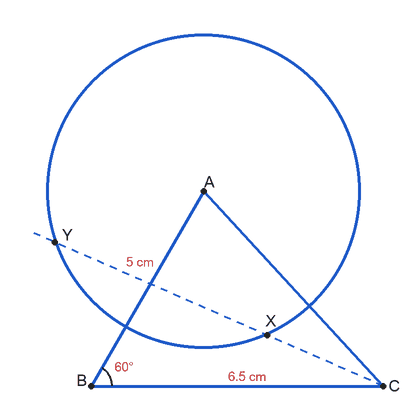
Check: Working the figure out with coordinates gives XY ≈ 5.16 cm, so a careful drawing measures about 5.2 cm.
Watch out: Bisect the angle between the two LINES named (for AC and BC that is ∠ACB at C), not the angle at another vertex.
Therefore, XY ≈ 5.2 cm (on measuring).
- 24 marks
Board paper question 2
Use ruler and compass for this question. Construct a circle of radius 4.5 cm. Draw a chord cm.
(i) Find the locus of points equidistant from and .
Mark the point where it meets the circle as .
(ii) Join and find the locus of points which are equidistant from and . Mark the point where it meets the circle as .
(iii) Join and , Measure and write down the length of side of the quadrilateral .
Solve with AIWritten solution
Solution:
Concept: The locus of points equidistant from two points A and B is the perpendicular bisector of AB: every point on it is the same distance from A as from B. The locus of points equidistant from two intersecting lines is the bisector of the angle between them: every point on it is the same perpendicular distance from both arms.
Given: Circle of radius 4.5 cm; chord AB = 6 cm.
Step 1 — Draw the circle and the chord.
With centre O and radius 4.5 cm, draw a circle. Take a point A on it; with centre A and radius 6 cm, cut the circle at B. Join AB, a chord of length 6 cm.
Step 2 — Draw the locus of points equidistant from A and B.
With centres A and B and equal radii (more than 3 cm), draw arcs on both sides of AB and join the two crossing points. This perpendicular bisector of AB is the locus; it passes through the centre O. Mark D where it meets the circle on the major arc (the side of AB on which O lies).
Step 3 — Draw the locus of points equidistant from AD and AB.
Join AD. These two lines meet at A, so the locus is the bisector of ∠DAB. With centre A draw an arc cutting AD and AB; from these two points draw equal arcs cutting each other; join A to that point and produce it to meet the circle again at C.
Step 4 — Complete ABCD and measure CD.
Join BC and CD. Measure CD.

Check: AC bisects ∠DAB, so the chords CD and CB subtend equal angles at A and are equal. Measuring CB therefore gives the same length. A coordinate calculation gives CD ≈ 5.10 cm.
Watch out: Take D on the major arc (the far side, through O); the other end of the bisector on the minor arc gives a much shorter CD (about 1.6 cm).
Therefore, CD ≈ 5.1 cm (on measuring).
- 31 mark
Board paper question 3
The circumcentre of a triangle is the point which is ∶
Solve with AIAnswer
(A) at equal distance from the three sides of the triangle.
- Correct
(B) at equal distance from the three vertices of the triangle.
(C) the point of intersection of the three medians.
(D) the point of intersection of the three altitudes of the triangle.
Answer: (B) at equal distance from the three vertices of the triangle.
Concept: The circumcentre of a triangle is the point where the perpendicular bisectors of its sides meet. The locus of points equidistant from two points A and B is the perpendicular bisector of AB: every point on it is the same distance from A as from B.
Step 1 — Use the perpendicular bisector of AB.
Let O be the circumcentre of ΔABC, where the perpendicular bisectors of the sides meet. O is on the perpendicular bisector of AB, so OA = OB.
Step 2 — Use the perpendicular bisector of BC.
O is also on the perpendicular bisector of BC, so OB = OC.
Step 3 — Combine the two.
Since OA equals OB and OB equals OC, the three distances are equal. So the circumcentre is at equal distance from the three vertices, and the circle with centre O and radius OA passes through A, B and C.
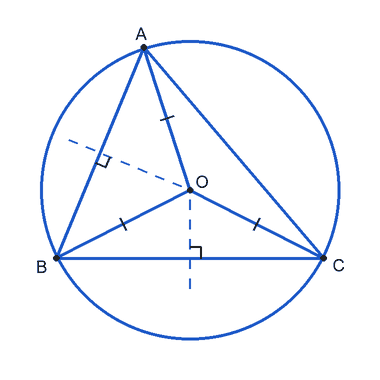
Watch out: The words 'vertices' (corners) and 'sides' are different: equal distance from the SIDES describes the incentre.
Why the other options are wrong:
- (A) at equal distance from the three sides of the triangle: a point at equal distance from the three sides is the incentre, where the angle bisectors meet.
- (C) the point of intersection of the three medians: the point where the three medians meet is the centroid.
- (D) the point of intersection of the three altitudes of the triangle: the point where the three altitudes meet is the orthocentre.
Therefore, the circumcentre is at equal distance from the three vertices, option (B).
- 44 marks
Board paper question 4
Use ruler and compass to answer this question. Construct , where cm, cm.
(a) Construct the locus of points equidistant from B and C.
(b) Construct the locus of points equidistant from A and B.
(c) Mark the point which satisfies both the conditions (a) and (b) as O. Construct the locus of points keeping a fixed distance OA from the fixed point O.
(d) Construct the locus of points which are equidistant from BA and BC.
Solve with AIWritten solution
Solution:
Concept: The locus of points equidistant from two points A and B is the perpendicular bisector of AB: every point on it is the same distance from A as from B. The locus of points equidistant from two intersecting lines is the bisector of the angle between them: every point on it is the same perpendicular distance from both arms. The locus of points at a fixed distance r from a fixed point is the circle with that point as centre and radius r.
Given: ∠ABC = 90°, AB = 6 cm, BC = 8 cm.
Step 1 — Construct the right angle ABC with AB = 6 cm and BC = 8 cm.
Draw BC = 8 cm. With centre B draw an arc cutting BC; with the same radius mark off 60° and then 120° along the arc, and bisect the angle between these two marks. The ray BP through the bisecting point makes a right angle with BC. Cut off BA = 6 cm on BP.
Step 2 — Part (a): locus of points equidistant from B and C.
With centres B and C and equal radii (more than 4 cm), draw arcs on both sides of BC and join the crossing points. This perpendicular bisector of BC is the locus.
Step 3 — Part (b): locus of points equidistant from A and B.
In the same way (radii more than 3 cm), draw the perpendicular bisector of AB. It is the locus of points equidistant from A and B.
Step 4 — Part (c): the point O and the circle.
Mark O where the two perpendicular bisectors meet. O is equidistant from B and C and also from A and B; so OA, OB and OC are all equal. With centre O and radius OA draw a circle; it is the locus of points at the fixed distance OA from O, and it passes through A, B and C.
Step 5 — Find the radius.
∠ABC = 90°, so AC is a diameter of this circle (an angle in a semicircle is a right angle) and O is the mid-point of AC. Pythagoras in ΔABC gives AC:
So the radius OA is half of 10 cm, that is 5 cm.
Step 6 — Part (d): locus of points equidistant from BA and BC.
BA and BC meet at B, so the locus is the bisector of ∠ABC. With centre B draw an arc cutting BA and BC; from these points draw equal arcs cutting each other; join B to the crossing point. This bisector makes 45° with each arm.
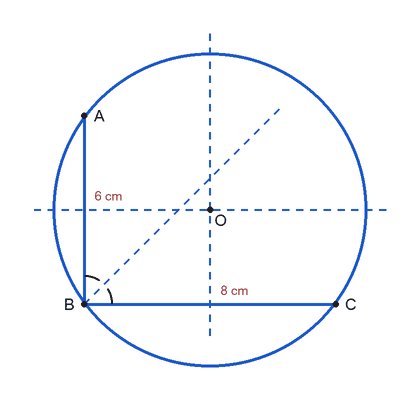
Watch out: In part (d) the locus is the bisector of the angle at B, not a perpendicular bisector.
Therefore, the loci are the perpendicular bisectors of BC and AB (meeting at O, the mid-point of AC), the circle with centre O and radius OA = 5 cm through A, B and C, and the bisector of ∠ABC.
- 51 mark
Board paper question 5
Statement 1: The point which is equidistant from three non-collinear points D, E and F is the circumcentre of the .
Statement 2: The incentre of a triangle is the point where the bisector of the angles intersects.
Solve with AIAnswer
- Correct
(A) Both the statements are true.
(B) Both the statements are false.
(C) Statement 1 is true and Statement 2 is false.
(D) Statement 1 is false and Statement 2 is true.
Answer: (A) Both the statements are true.
Concept: The locus of points equidistant from two points A and B is the perpendicular bisector of AB: every point on it is the same distance from A as from B. The locus of points equidistant from two intersecting lines is the bisector of the angle between them: every point on it is the same perpendicular distance from both arms. The perpendicular bisectors of the sides meet at the circumcentre; the angle bisectors meet at the incentre.
Step 1 — Judge Statement 1.
Let O be equidistant from D, E and F. Since OD = OE, O lies on the perpendicular bisector of DE. Since OE = OF, O lies on the perpendicular bisector of EF. The point where the perpendicular bisectors of the sides meet is the circumcentre, so O is the circumcentre of ΔDEF. Statement 1 is true.

Step 2 — Judge Statement 2.
The bisectors of the three angles of a triangle meet at one point. That point is equidistant from the three sides and is called the incentre. Statement 2 is true.

Watch out: Do not mix the two centres: circumcentre comes from perpendicular bisectors (equal distance from vertices), incentre from angle bisectors (equal distance from sides).
Why the other options are wrong:
- (B) Both the statements are false: it calls both statements false, but each is a correct description.
- (C) Statement 1 is true and Statement 2 is false: it calls Statement 2 false, but the incentre is exactly where the angle bisectors meet.
- (D) Statement 1 is false and Statement 2 is true: it calls Statement 1 false, but a point equidistant from the three vertices is the circumcentre.
Therefore, both statements are true, option (A).
- 61 mark
Board paper question 6
The locus of a toy bird fixed at the tip of one of the blades of a rotating ceiling fan is a:
Solve with AIAnswer
(A) straight line
- Correct
(B) circle
(C) semi-circular arc
(D) diameter of the circle so formed
Answer: (B) circle
Concept: A locus is the path traced by a point that moves according to a rule. The locus of points at a fixed distance r from a fixed point is the circle with that point as centre and radius r.
Step 1 — Find what stays fixed.
The toy bird is fixed at the tip P of a blade. However the fan turns, the distance from the bird to the centre O of the fan stays equal to the length of the blade.
Step 2 — Follow the motion.
As the fan rotates, the blade goes all the way round O, again and again. So the bird moves keeping a fixed distance from the fixed point O.
Step 3 — Name the locus.
A point that keeps a fixed distance from a fixed point traces a circle. So the bird's path is a circle with centre O and radius equal to the blade length.
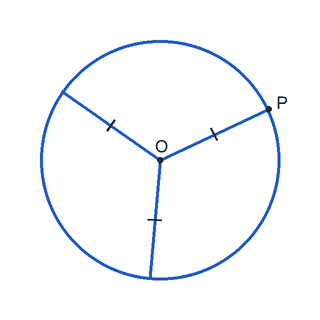
Watch out: The bird never passes through the centre, so no answer that includes the centre (a diameter) can be right.
Why the other options are wrong:
- (A) straight line: on a straight line the bird's distance from the centre would keep changing; here it stays the same.
- (C) semi-circular arc: the blade makes full turns, not half turns, so the path is a complete circle, not a semicircular arc.
- (D) diameter of the circle so formed: a diameter is a segment through the centre; the bird always stays one blade length away from the centre.
Therefore, the locus is a circle, option (B).
All 7 board paper questions for this chapter, solved the same way.
Class 10 Maths Ch 16 questions students ask
How many questions are there in Class 10 Maths Ch 16?
58 questions. Every one is solved step by step on this page.
Are these Class 10 Maths solutions free?
Yes. Every question and its full working is free to read, with no account needed.
Can I download the Class 10 Maths Ch 16 solutions as a PDF?
There is no PDF to download. Every solution is on this page instead, which means it is searchable, always the current syllabus, and readable on a phone. Use your browser's print option if you want it on paper.