
Question 93 marksMedium
Construct a triangle ABC, in which AB = 4·2 cm, BC = 6·3 cm and AC = 5 cm. Draw perpendicular bisector of BC which meets AC at point D. Prove that D is equidistant from B and C.
Confirming your payment
Sign up now and get 250 free tokens.
Loci · Question 9 of 58
Construct a triangle ABC, in which AB = 4·2 cm, BC = 6·3 cm and AC = 5 cm. Draw perpendicular bisector of BC which meets AC at point D. Prove that D is equidistant from B and C.
Solution:
Concept: Every point on the perpendicular bisector of a line segment is equidistant from the two end points of the segment. Conversely, every point equidistant from the two end points lies on the perpendicular bisector. D lies on the perpendicular bisector of BC, so DB = DC.
Step 1 — Construct the triangle.
We draw the base first and fix A with two arcs, because all three sides are known.
Step 2 — Draw the perpendicular bisector of BC.
With B and C as centres and any radius more than half of BC, draw arcs on both sides of BC. The line through the two points where the arcs cut is the perpendicular bisector of BC. Mark D, where it meets AC, and M, where it meets BC. Join DB.
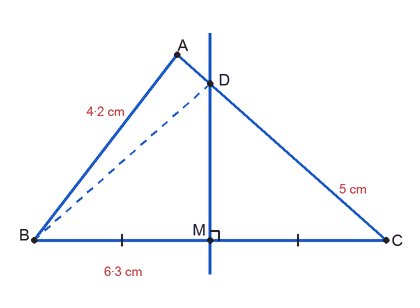
Step 3 — Compare triangles DMB and DMC.
M is the mid-point of BC and DM ⊥ BC, so the two triangles match side, angle, side.
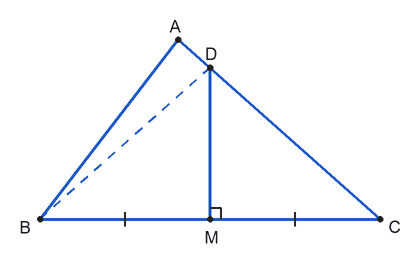
In ΔDMB and ΔDMC:
So ΔDMB ≅ ΔDMC by SAS, and hence DB = DC.
Check: On measuring, DB and DC both come to about 4·2 cm (by calculation 4·22 cm).
Watch out: The perpendicular bisector must pass through the mid-point of BC and be at right angles to it; draw the arcs with the same radius from B and from C.
Therefore, DB = DC, so D is equidistant from B and C. Hence proved.