
Question 83 marksMedium
Given : AX bisects angle BAC and PQ is perpendicular bisector of AC which meets AX at point Y.

Prove : (i) X is equidistant from AB and AC. (ii) Y is equidistant from A and C.
Confirming your payment
Sign up now and get 250 free tokens.
Loci · Question 8 of 58
Given : AX bisects angle BAC and PQ is perpendicular bisector of AC which meets AX at point Y.
Prove : (i) X is equidistant from AB and AC. (ii) Y is equidistant from A and C.
Solution:
Concept: Two locus theorems are used. Every point on the bisector of an angle is equidistant from the two arms of the angle. Every point on the perpendicular bisector of a line segment is equidistant from the two end points of the segment.
Given: AX bisects ∠BAC. PQ is the perpendicular bisector of AC and meets AX at Y.
To prove: (i) X is equidistant from AB and AC. (ii) Y is equidistant from A and C.
(i)
Step 1 — Draw the perpendiculars from X.
Draw XM ⊥ AB and XN ⊥ AC. These are the distances of X from the two sides.
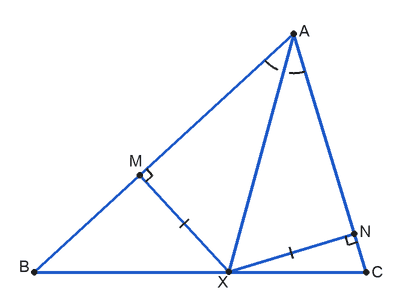
Step 2 — Compare triangles AXM and AXN.
Both are right-angled, they share AX, and AX makes equal angles with AB and AC.
In ΔAXM and ΔAXN:
So ΔAXM ≅ ΔAXN by AAS, and hence XM = XN.
So X is equidistant from AB and AC.
(ii)
Step 3 — Name the foot of PQ and join YC.
Let PQ meet AC at D, and join YC. Since PQ is the perpendicular bisector of AC, AD = DC and PQ ⊥ AC.
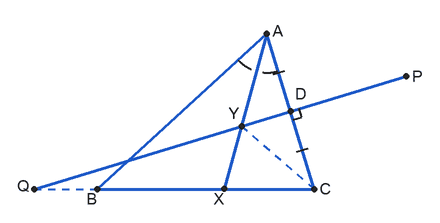
Step 4 — Compare triangles ADY and CDY.
They share DY, have equal bases AD and CD, and equal right angles at D.
In ΔADY and ΔCDY:
So ΔADY ≅ ΔCDY by SAS, and hence YA = YC.
So Y is equidistant from A and C.
Watch out: X is on an angle bisector, so it is equidistant from two lines; Y is on a perpendicular bisector, so it is equidistant from two points.
Therefore, (i) XM = XN, so X is equidistant from AB and AC; (ii) YA = YC, so Y is equidistant from A and C. Hence proved.