
Question 73 marksEasy
Given : CP is bisector of angle C of Δ ABC.
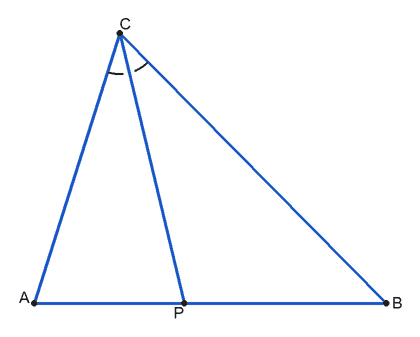
Prove : P is equidistant from AC and BC.
Confirming your payment
Sign up now and get 250 free tokens.
Loci · Question 7 of 58
Given : CP is bisector of angle C of Δ ABC.
Prove : P is equidistant from AC and BC.
Solution:
Concept: Every point on the bisector of an angle is equidistant from the two arms of the angle. Conversely, a point inside an angle that is equidistant from its arms lies on the bisector. The distance of a point from a line always means the length of the perpendicular from the point to the line. Here we prove it for the point P.
Given: CP is the bisector of ∠C of ΔABC, so ∠ACP = ∠BCP.
To prove: P is equidistant from AC and BC.
Step 1 — Draw the construction.
Draw PM ⊥ AC and PN ⊥ BC. PM and PN are the distances of P from the two sides.
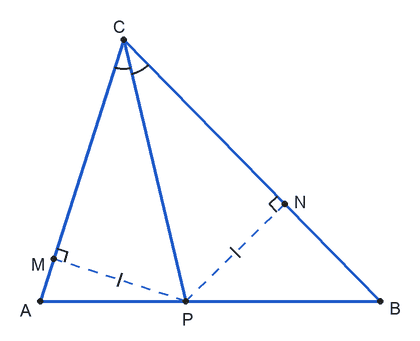
Step 2 — Compare triangles CPM and CPN.
Both are right-angled, they share CP, and CP makes equal angles with CA and CB.
In ΔCPM and ΔCPN:
So ΔCPM ≅ ΔCPN by AAS.
Step 3 — Conclude.
Corresponding parts of congruent triangles are equal, so PM = PN.
Watch out: The distance of a point from a line is the perpendicular distance. Any other segment from the point to the line is longer.
Therefore, PM = PN, so P is equidistant from AC and BC. Hence proved.