
Question 63 marksEasy
Given : PQ is perpendicular bisector of side AB of the triangle ABC.
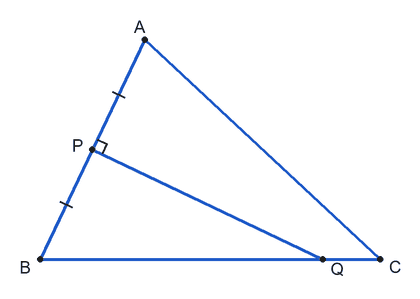
Prove : Q is equidistant from A and B.
Confirming your payment
Sign up now and get 250 free tokens.
Loci · Question 6 of 58
Given : PQ is perpendicular bisector of side AB of the triangle ABC.
Prove : Q is equidistant from A and B.
Solution:
Concept: Every point on the perpendicular bisector of a line segment is equidistant from the two end points of the segment. Conversely, every point equidistant from the two end points lies on the perpendicular bisector. Here we prove this for the point Q using congruent triangles.
Given: PQ is the perpendicular bisector of side AB of ΔABC, so AP = PB and PQ ⊥ AB.
To prove: QA = QB.
Step 1 — Draw the construction.
Join AQ, so that ΔAPQ and ΔBPQ are formed on either side of PQ.
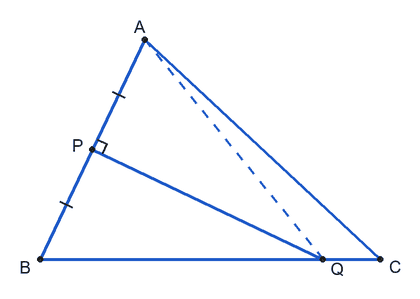
Step 2 — Compare triangles APQ and BPQ.
PQ bisects AB at P and is perpendicular to it, which gives one pair of equal sides and one pair of equal angles; PQ itself is shared.
In ΔAPQ and ΔBPQ:
So ΔAPQ ≅ ΔBPQ by SAS.
Step 3 — Conclude.
Corresponding parts of congruent triangles are equal, so QA = QB.
Watch out: SAS needs the angle between the two sides. Here ∠APQ lies between AP and PQ, so SAS applies.
Therefore, QA = QB, so Q is equidistant from A and B. Hence proved.