
Question 51 markMCQEasy
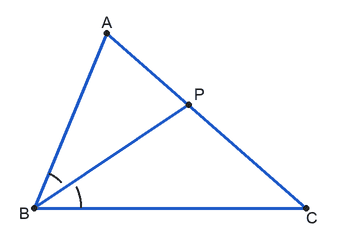
Bisector of angle B of triangle ABC intersects side AC at point P, then point P is :
Confirming your payment
Sign up now and get 250 free tokens.
Loci · Question 5 of 58
Bisector of angle B of triangle ABC intersects side AC at point P, then point P is :
(A) equidistant from vertices A and C
(B) PA = PB
(C) PB = PC
(D) equidistant from sides AB and BC
Answer: (D) equidistant from sides AB and BC
Concept: Every point on the bisector of an angle is equidistant from the two arms of the angle. Conversely, a point inside an angle that is equidistant from its arms lies on the bisector. The distance of a point from a line always means the length of the perpendicular from the point to the line.
Step 1 — Name the arms of angle B.
P lies on the bisector of ∠B. The arms of ∠B are BA and BC.
Step 2 — Draw the perpendicular distances.
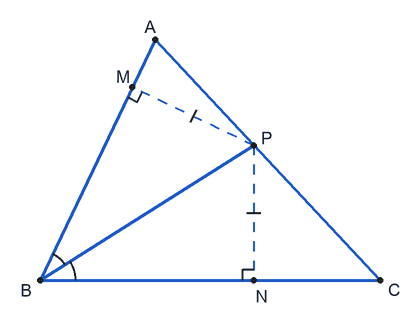
Draw PM ⊥ AB and PN ⊥ BC. These are the distances of P from the two sides.
Step 3 — Apply the theorem.
P is on the bisector of ∠B, so by the theorem in the Concept line PM = PN. Hence P is equidistant from the sides AB and BC.
Watch out: P being on side AC does not make it the mid-point of AC. The bisector of ∠B meets AC at its mid-point only when AB = BC.
Why the other options are wrong:
Therefore, P is equidistant from the sides AB and BC, option (D).