
Question 103 marksMedium
In each of the given figures; PA = PB and QA = QB.
(i)
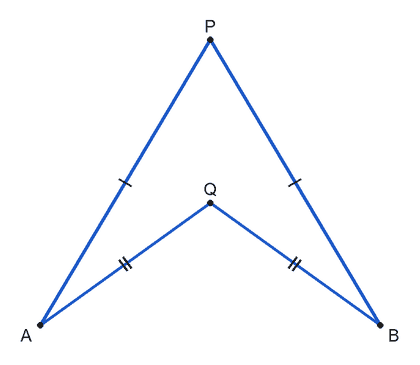
(ii)

Prove, in each case, that PQ (produce, if required) is perpendicular bisector of AB. Hence, state the locus of the points equidistant from two given fixed points.
Confirming your payment
Sign up now and get 250 free tokens.
Loci · Question 10 of 58
In each of the given figures; PA = PB and QA = QB.
(i)
(ii)
Prove, in each case, that PQ (produce, if required) is perpendicular bisector of AB. Hence, state the locus of the points equidistant from two given fixed points.
Solution:
Concept: Use congruent triangles twice. First show that PQ bisects ∠APB; then show that PQ meets AB at its mid-point and at right angles. This proves the converse of the perpendicular bisector theorem.
Given: PA = PB and QA = QB, in both figures.
To prove: PQ (produced, if required) is the perpendicular bisector of AB.
Step 1 — Draw the construction.
Join PQ. Let PQ (produced in figure (i)) meet AB at M. The same proof works for both figures.
Figure (i):

Figure (ii):

Step 2 — Show that PQ bisects angle APB.
The triangles PAQ and PBQ have all three sides equal in pairs.
In ΔPAQ and ΔPBQ:
So ΔPAQ ≅ ΔPBQ by SSS, and hence ∠APQ = ∠BPQ, that is, ∠APM = ∠BPM.
Step 3 — Show that M is the mid-point and the angles at M are equal.
Now compare the triangles that PM makes with A and with B.
In ΔAPM and ΔBPM:
So ΔAPM ≅ ΔBPM by SAS. Hence AM = BM and ∠AMP = ∠BMP.
Step 4 — Show that the angles at M are right angles.
∠AMP and ∠BMP lie on the straight line AB, so they add up to 180°. They are also equal (Step 3), so each is half of 180°.
Step 5 — State the locus.
P and Q are any two points that are each equidistant from A and B, and both lie on the perpendicular bisector of AB. So every point equidistant from A and B lies on this line.
Watch out: Showing AM = BM alone is not enough; a perpendicular bisector must also be at 90° to AB, which is why Step 4 is needed.
Therefore, PQ is the perpendicular bisector of AB, and the locus of points equidistant from two given fixed points is the perpendicular bisector of the line segment joining them. Hence proved.