Solution:
Concept: P lies on two loci. Every point on the perpendicular bisector of a line segment is equidistant from the two end points of the segment. Every point on the bisector of an angle is equidistant from the two arms of the angle.
Step 1 — Construct the triangle.
Two sides and the included angle are known, so we draw the base and the 75° angle at B first.
- Draw BC = 6·4 cm.
- At B, construct ∠CBX = 75° (construct 60° and 90° at B and bisect the angle between them).
- On BX, cut off BA = 5 cm. Join AC.
Step 2 — Draw the two bisectors.
The point P must lie on both loci, so we draw both and mark where they meet.
- Draw the perpendicular bisector of BC; let it meet BC at M.
- Draw the bisector of ∠ACB.
- Mark P, where the two bisectors meet. Join PB.
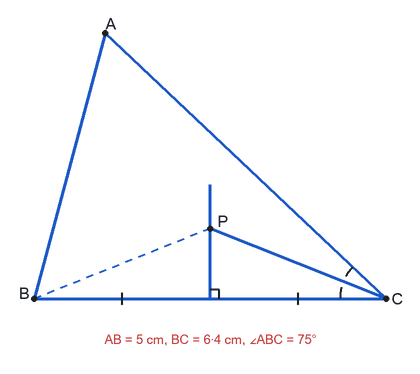
Step 3 — Draw the construction for the proof.
Draw PN ⊥ AC, so that the distances of P from AC and from BC are PN and PM.
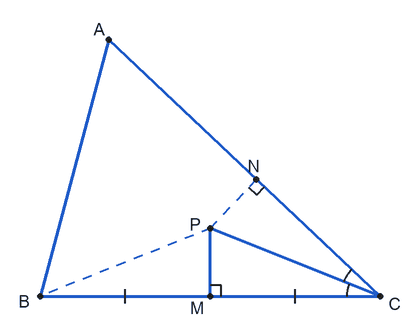
Step 4 — Prove PB = PC.
Compare the triangles on either side of PM.
In ΔPMB and ΔPMC:
- BM = CM (M is the mid-point of BC)
- ∠PMB = ∠PMC (each is 90°)
- PM = PM (common side)
So ΔPMB ≅ ΔPMC by SAS, and hence PB = PC.
Step 5 — Prove PM = PN.
Compare the two right-angled triangles that share PC.
In ΔPMC and ΔPNC:
- ∠PCM = ∠PCN (CP bisects ∠ACB)
- ∠PMC = ∠PNC (each is 90°)
- PC = PC (common side)
So ΔPMC ≅ ΔPNC by AAS, and hence PM = PN.
Check: On measuring, PB = PC ≈ 3·4 cm (by calculation 3.44 cm).
Watch out: PM is the distance of P from BC because PM ⊥ BC; P is equidistant from the lines AC and BC, which is not the same as PA = PC.
Therefore, PB = PC, so P is equidistant from B and C; and PM = PN, so P is equidistant from AC and BC. Hence proved.
