
Question 123 marksEasy
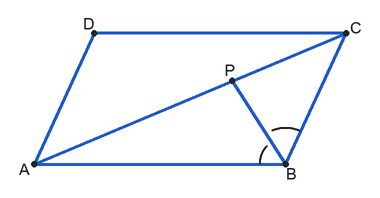
In parallelogram ABCD, side AB is greater than side BC and P is a point in AC such that PB bisects angle B. Prove that P is equidistant from AB and BC.
Confirming your payment
Sign up now and get 250 free tokens.
Loci · Question 12 of 58
In parallelogram ABCD, side AB is greater than side BC and P is a point in AC such that PB bisects angle B. Prove that P is equidistant from AB and BC.
Solution:
Concept: Every point on the bisector of an angle is equidistant from the two arms of the angle. Conversely, a point inside an angle that is equidistant from its arms lies on the bisector. The distance of a point from a line always means the length of the perpendicular from the point to the line. P lies on the bisector of ∠B, whose arms are BA and BC.
Given: ABCD is a parallelogram with AB > BC. P is a point on the diagonal AC such that PB bisects ∠ABC.
To prove: P is equidistant from AB and BC.
Step 1 — Draw the construction.
Draw PM ⊥ AB and PN ⊥ BC. These are the distances of P from the two sides.
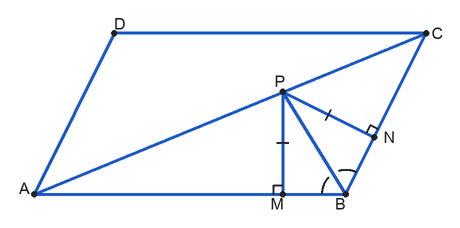
Step 2 — Compare triangles BPM and BPN.
Both are right-angled, they share BP, and BP makes equal angles with BA and BC.
In ΔBPM and ΔBPN:
So ΔBPM ≅ ΔBPN by AAS.
Step 3 — Conclude.
Corresponding parts of congruent triangles are equal, so PM = PN.
Watch out: The proof uses only the fact that P is on the bisector of ∠B. The condition AB > BC just tells us that this bisector is not the diagonal BD, so it cuts the diagonal AC at a point P that is not its mid-point.
Therefore, PM = PN, so P is equidistant from AB and BC. Hence proved.