
Question 133 marksMedium
In triangle LMN, bisectors of interior angles at L and N intersect each other at point A. Prove that :
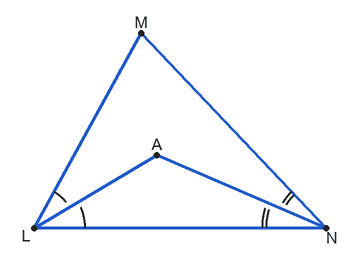
(i) point A is equidistant from all the three sides of the triangle.
(ii) AM bisects angle LMN.
Confirming your payment
Sign up now and get 250 free tokens.
Loci · Question 13 of 58
In triangle LMN, bisectors of interior angles at L and N intersect each other at point A. Prove that :
(i) point A is equidistant from all the three sides of the triangle.
(ii) AM bisects angle LMN.
Solution:
Concept: Every point on the bisector of an angle is equidistant from the two arms of the angle. Conversely, a point inside an angle that is equidistant from its arms lies on the bisector. The distance of a point from a line always means the length of the perpendicular from the point to the line. Part (ii) uses the converse.
Given: In ΔLMN, the bisectors of ∠L and ∠N meet at A.
To prove: (i) A is equidistant from LM, MN and LN. (ii) AM bisects ∠LMN.
Step 1 — Draw the construction.
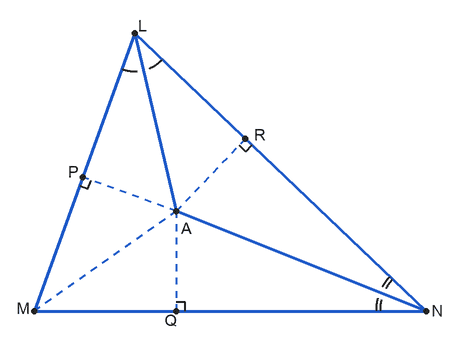
Draw AP ⊥ LM, AQ ⊥ MN and AR ⊥ LN, and join AM. AP, AQ and AR are the distances of A from the three sides.
(i)
Step 2 — Use the bisector of angle L.
A lies on the bisector of ∠L, whose arms are LM and LN. So A is equidistant from LM and LN, that is, AP = AR.
Step 3 — Use the bisector of angle N.
A also lies on the bisector of ∠N, whose arms are NL and NM. So AR = AQ.
Step 4 — Combine the two results.
AP = AR and AR = AQ, so all three distances are equal. Hence A is equidistant from all three sides of the triangle.
(ii)
Step 5 — Compare triangles APM and AQM.
Both are right-angled triangles with the same hypotenuse AM, and AP = AQ from part (i).
In ΔAPM and ΔAQM:
So ΔAPM ≅ ΔAQM by RHS, and hence ∠AMP = ∠AMQ.
So AM bisects ∠LMN.
Watch out: In RHS the right angle, the hypotenuse and one other side must match; here the other side is AP = AQ from part (i).
Note: A is the incentre of ΔLMN. All three angle bisectors of a triangle pass through it.
Therefore, (i) AP = AQ and AQ = AR, so A is equidistant from all three sides; (ii) ∠AMP = ∠AMQ, so AM bisects ∠LMN. Hence proved.