
Question 533 marksMedium
On a graph paper, draw the lines x = 3 and y = –5. Now, on the same graph paper, draw the locus of the point which is equidistant from the given lines.
Confirming your payment
Sign up now and get 250 free tokens.
Loci · Question 53 of 58
On a graph paper, draw the lines x = 3 and y = –5. Now, on the same graph paper, draw the locus of the point which is equidistant from the given lines.
Solution:
Concept: The locus of points equidistant from two intersecting lines is the pair of lines that bisect the angles between them. On a graph, the distance of the point (x, y) from the vertical line x = 3 is |x − 3|, and from the horizontal line y = −5 it is |y + 5|.
Step 1 — Draw the given lines.
x = 3 is a vertical line and y = −5 is a horizontal line. They meet at right angles at the point (3, −5).
Step 2 — Write the condition.
A point (x, y) of the locus is equally far from the two lines, so the two distances are equal.
Step 3 — Take the same signs.
If y + 5 and x − 3 have the same sign, the two expressions are equal. We then subtract 5 from both sides.
Step 4 — Take opposite signs.
If they have opposite signs, one is minus the other. We remove the bracket and then subtract 5 from both sides.
Step 5 — Plot the two lines.
We plot three points on each line and join them.
| Line | Points |
|---|---|
| y = x − 8 | (0, −8), (3, −5), (8, 0) |
| y = −x − 2 | (0, −2), (3, −5), (−2, 0) |
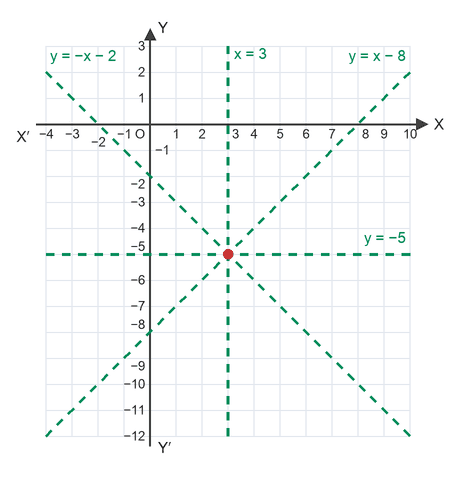
Check: Take the point (8, 0), which lies on the line y = x − 8. Its distances from the two given lines are worked out below, and they are equal.
Watch out: Both lines pass through (3, −5), where the given lines cross; check this on your graph before joining the points.
Therefore, the locus is the pair of lines y = x − 8 and y = −x − 2, the two bisectors of the angles between x = 3 and y = −5.