
Question 523 marksMedium
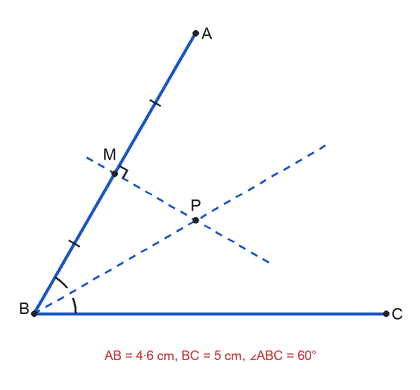
Draw an ∠ABC = 60°, having AB = 4·6 cm and BC = 5 cm. Find a point P equidistant from AB and BC; and also equidistant from A and B.
Confirming your payment
Sign up now and get 250 free tokens.
Loci · Question 52 of 58
Draw an ∠ABC = 60°, having AB = 4·6 cm and BC = 5 cm. Find a point P equidistant from AB and BC; and also equidistant from A and B.
Solution:
Concept: Points equidistant from AB and BC lie on the bisector of ∠ABC. Points equidistant from A and B lie on the perpendicular bisector of AB. P lies on both loci.
Step 1 — Draw the angle.
Two arm lengths and the angle between them are given.
Step 2 — Draw the two loci.
P must satisfy both conditions, so we draw both loci.
Step 3 — Mark P.
Mark P, where the two loci meet. P is on the bisector of ∠ABC, so it is equidistant from AB and BC; P is on the perpendicular bisector of AB, so PA = PB.
Step 4 — Check BP by calculation.
M is the mid-point of AB, so BM is half of 4·6 cm. BP bisects 60°, so ∠PBM = 30°, and ΔPMB is right-angled at M.
Using the cosine of ∠PBM:
Watch out: Here the perpendicular bisector is of AB (equidistant from A and B), not of BC.
Therefore, P is the point where the bisector of ∠ABC meets the perpendicular bisector of AB, and BP ≈ 2·7 cm.