
Question 31 markMCQEasy
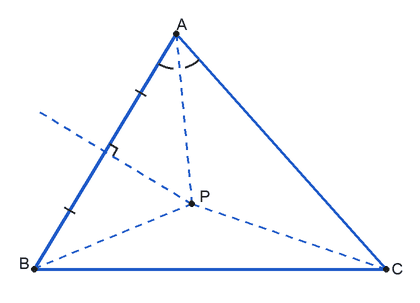
The perpendicular bisector of side AB and bisector of angle A of ΔABC meet at point P. Then :
Confirming your payment
Sign up now and get 250 free tokens.
Loci · Question 3 of 58
The perpendicular bisector of side AB and bisector of angle A of ΔABC meet at point P. Then :
(A) PA = PB
(B) PA = PC
(C) PB = PC
(D) PB bisects ∠ABC
Answer: (A) PA = PB
Concept: P lies on two loci, so it has both properties. A perpendicular bisector gives equal distances from two points: every point on the perpendicular bisector of a segment is equidistant from its end points. An angle bisector gives equal distances from two lines: every point on it is equidistant from the arms of the angle.
Step 1 — Use the perpendicular bisector of AB.
P is on the perpendicular bisector of AB, so P is equidistant from the end points A and B. This gives PA = PB.
Step 2 — Use the bisector of angle A.
P is also on the bisector of ∠A. This tells us only that P is equidistant from the sides AB and AC. It says nothing about the distances of P from the vertices B or C.
Watch out: Equidistant from two points gives a perpendicular bisector; equidistant from two lines gives an angle bisector. Read the question carefully to see which one is meant.
Why the other options are wrong:
Therefore, PA = PB, option (A).