
Question 161 markMCQEasy
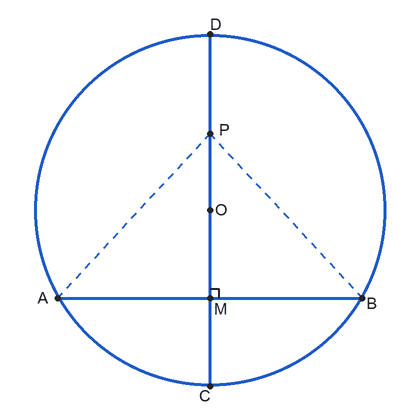
P is a moving point and AB is a chord of a circle. If P moves, within this circle, in such a way that it is at equal distances from points A and B. The locus of P is :
Confirming your payment
Sign up now and get 250 free tokens.
Loci · Question 16 of 58
P is a moving point and AB is a chord of a circle. If P moves, within this circle, in such a way that it is at equal distances from points A and B. The locus of P is :
(A) a chord perpendicular to chord AB
(B) a chord that bisects the chord AB.
(C) a diameter of the circle
(D) the diameter of the circle which is perpendicular to chord AB
Answer: (D) the diameter of the circle which is perpendicular to chord AB
Concept: Every point on the perpendicular bisector of a line segment is equidistant from the two end points of the segment. The perpendicular bisector of any chord of a circle passes through the centre of the circle.
Step 1 — Use PA = PB.
P is always at equal distances from A and B, so P lies on the perpendicular bisector of AB.
Step 2 — Locate this line in the circle.
AB is a chord, so its perpendicular bisector passes through the centre O.
Step 3 — Keep only the part inside the circle.
P moves within the circle. The part of this line inside the circle is a chord through the centre, that is, a diameter, and it is perpendicular to AB.
Watch out: A diameter is the right kind of line, but only the one diameter perpendicular to AB works.
Why the other options are wrong:
Therefore, the locus of P is the diameter of the circle which is perpendicular to chord AB (CD in the figure), option (D).