
Question 181 markMCQEasy
AB is a line segment and P is a moving point that moves in such a way that it is always equidistant from AB. The locus of point P is the line which:
Confirming your payment
Sign up now and get 250 free tokens.
Loci · Question 18 of 58
AB is a line segment and P is a moving point that moves in such a way that it is always equidistant from AB. The locus of point P is the line which:
(A) is parallel to AB and through point P.
(B) is perpendicular to AB through point P.
(C) is perpendicular bisector of AB.
(D) passes through the mid-point of AB.
Answer: (A) is parallel to AB and through point P.
Concept: The distance of a point from a line is the length of the perpendicular from the point to the line. The locus of a point at a fixed distance from a fixed straight line is a pair of straight lines parallel to the given line, one on each side of it, each at that distance from it.
Step 1 — Read the condition.
P moves so that its perpendicular distance from AB always stays the same.
Step 2 — Find the points at that distance.
On the side of AB where P is, all the points at this fixed distance lie on one straight line parallel to AB.
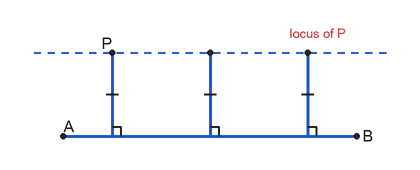
Step 3 — Fix the line.
P itself is one of these points, so this parallel line passes through P.
Watch out: The full locus at a fixed distance is a pair of parallel lines, one on each side of AB. The option describes the one on P's side, which is the best of the four choices.
Why the other options are wrong:
Therefore, the locus of P is the line parallel to AB through the point P, option (A).