
Question 303 marksMedium
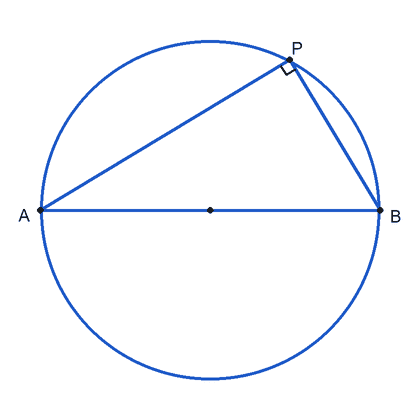
Describe the locus of a point P, so that : AB² = AP² + BP², where A and B are two fixed points.
Confirming your payment
Sign up now and get 250 free tokens.
Loci · Question 30 of 58
Describe the locus of a point P, so that : AB² = AP² + BP², where A and B are two fixed points.
Solution:
Concept: By the converse of Pythagoras' theorem, if the square on one side of a triangle equals the sum of the squares on the other two sides, the angle opposite the first side is 90°. The angle in a semicircle is 90°.
Step 1 — Write the condition.
In ΔAPB it is given that the square on AB equals the sum of the squares on AP and BP.
Step 2 — Find the angle at P.
By the converse of Pythagoras' theorem, the angle opposite AB is a right angle. So ∠APB = 90°.
Step 3 — Name the circle.
AB is fixed, and AB subtends a right angle at P. The angle in a semicircle is 90°, so P lies on the circle that has AB as a diameter.
Step 4 — Check the converse.
For any point P on this circle (other than A and B), ∠APB = 90°, so AB² = AP² + BP². So every point of the circle satisfies the condition.
Watch out: The right angle is at P, the vertex opposite AB, because AB is the side whose square is the sum of the other two.
Note: At A and at B no triangle APB is formed, but the equation still holds there (at P = A, AP = 0 and BP = AB), so these two points also satisfy the condition.
Therefore, the locus is the circle drawn on AB as diameter.