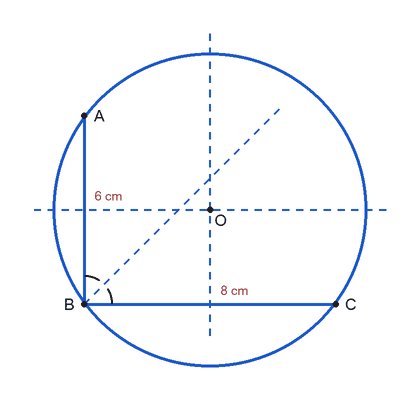
Use ruler and compass to answer this question. Construct ∠ ABC = 90^° , where AB = 6 cm, BC = 8 cm.
Question 44 marksAsked 2024Medium
Use ruler and compass to answer this question. Construct ∠ABC=90∘, where AB=6 cm, BC=8 cm.
(a) Construct the locus of points equidistant from B and C.
(b) Construct the locus of points equidistant from A and B.
(c) Mark the point which satisfies both the conditions (a) and (b) as O. Construct the locus of points keeping a fixed distance OA from the fixed point O.
(d) Construct the locus of points which are equidistant from BA and BC.
Solution:
Concept: The locus of points equidistant from two points A and B is the perpendicular bisector of AB: every point on it is the same distance from A as from B. The locus of points equidistant from two intersecting lines is the bisector of the angle between them: every point on it is the same perpendicular distance from both arms. The locus of points at a fixed distance r from a fixed point is the circle with that point as centre and radius r.
Given: ∠ABC = 90°, AB = 6 cm, BC = 8 cm.
Step 1 — Construct the right angle ABC with AB = 6 cm and BC = 8 cm.
Draw BC = 8 cm. With centre B draw an arc cutting BC; with the same radius mark off 60° and then 120° along the arc, and bisect the angle between these two marks. The ray BP through the bisecting point makes a right angle with BC. Cut off BA = 6 cm on BP.
Step 2 — Part (a): locus of points equidistant from B and C.
With centres B and C and equal radii (more than 4 cm), draw arcs on both sides of BC and join the crossing points. This perpendicular bisector of BC is the locus.
Step 3 — Part (b): locus of points equidistant from A and B.
In the same way (radii more than 3 cm), draw the perpendicular bisector of AB. It is the locus of points equidistant from A and B.
Step 4 — Part (c): the point O and the circle.
Mark O where the two perpendicular bisectors meet. O is equidistant from B and C and also from A and B; so OA, OB and OC are all equal. With centre O and radius OA draw a circle; it is the locus of points at the fixed distance OA from O, and it passes through A, B and C.
Step 5 — Find the radius.
∠ABC = 90°, so AC is a diameter of this circle (an angle in a semicircle is a right angle) and O is the mid-point of AC. Pythagoras in ΔABC gives AC:
AC=62+82=100=10 cm
So the radius OA is half of 10 cm, that is 5 cm.
Step 6 — Part (d): locus of points equidistant from BA and BC.
BA and BC meet at B, so the locus is the bisector of ∠ABC. With centre B draw an arc cutting BA and BC; from these points draw equal arcs cutting each other; join B to the crossing point. This bisector makes 45° with each arm.
Watch out: In part (d) the locus is the bisector of the angle at B, not a perpendicular bisector.
Therefore, the loci are the perpendicular bisectors of BC and AB (meeting at O, the mid-point of AC), the circle with centre O and radius OA = 5 cm through A, B and C, and the bisector of ∠ABC.