
Opening your dashboard
Class 10 Maths Chapter 16 Loci: Previous Year Questions
7 questions on Chapter 16, each solved step by step. Class 10 Maths, ICSE 2026-27.
7 questions with solutions
1–4 marks · Mixed difficulty
- 14 marks
Question 1
Use ruler and compasses only for the following question. All construction lines and arcs must be clearly shown.
(i) Construct a in which BC = 6.5 cm, , AB = 5cm.
(ii) Construct the locus of points at a distance of 3.5 cm from A.
(iii) Construct the locus of points equidistant from AC and BC.
(iv) Mark 2 points X and Y which are at a distance of 3.5cm from A and also equidistant from AC and BC. Measure XY.
Solve with AIWritten solution
Solution:
Concept: The locus of points at a fixed distance r from a fixed point is the circle with that point as centre and radius r. The locus of points equidistant from two intersecting lines is the bisector of the angle between them: every point on it is the same perpendicular distance from both arms.
Given: BC = 6.5 cm, ∠ABC = 60°, AB = 5 cm; circle radius 3.5 cm about A.
Step 1 — Draw BC and the 60° angle at B.
Draw BC = 6.5 cm. With centre B and any radius, draw an arc cutting BC at a point; with the same radius and centre at that point, cut the arc again. The ray BP through this second point makes ∠CBP = 60°, because the two radii and the chord between the marks form an equilateral triangle.
Step 2 — Complete ΔABC.
With centre B and radius 5 cm, cut the ray BP at A. Join AC. This is ΔABC with BC = 6.5 cm, ∠ABC = 60° and AB = 5 cm.
Step 3 — Draw the locus of points 3.5 cm from A.
With centre A and radius 3.5 cm, draw a circle. Every point of this circle is 3.5 cm from A, and no other point is, so the circle is the locus.
Step 4 — Draw the locus of points equidistant from AC and BC.
AC and BC meet at C, so this locus is the bisector of ∠ACB. With centre C draw an arc cutting CA and CB; with these two points as centres and equal radii draw arcs cutting each other; join C to that point and produce the line across the circle.
Step 5 — Mark X and Y and measure XY.
The bisector cuts the circle at two points; mark them X and Y. Each is on the circle (3.5 cm from A) and on the bisector (equidistant from AC and BC), so each satisfies both conditions. Measure XY.
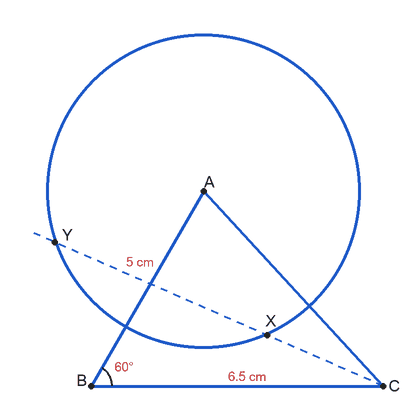
Check: Working the figure out with coordinates gives XY ≈ 5.16 cm, so a careful drawing measures about 5.2 cm.
Watch out: Bisect the angle between the two LINES named (for AC and BC that is ∠ACB at C), not the angle at another vertex.
Therefore, XY ≈ 5.2 cm (on measuring).
- 24 marks
Question 2
Use ruler and compass for this question. Construct a circle of radius 4.5 cm. Draw a chord cm.
(i) Find the locus of points equidistant from and .
Mark the point where it meets the circle as .
(ii) Join and find the locus of points which are equidistant from and . Mark the point where it meets the circle as .
(iii) Join and , Measure and write down the length of side of the quadrilateral .
Solve with AIWritten solution
Solution:
Concept: The locus of points equidistant from two points A and B is the perpendicular bisector of AB: every point on it is the same distance from A as from B. The locus of points equidistant from two intersecting lines is the bisector of the angle between them: every point on it is the same perpendicular distance from both arms.
Given: Circle of radius 4.5 cm; chord AB = 6 cm.
Step 1 — Draw the circle and the chord.
With centre O and radius 4.5 cm, draw a circle. Take a point A on it; with centre A and radius 6 cm, cut the circle at B. Join AB, a chord of length 6 cm.
Step 2 — Draw the locus of points equidistant from A and B.
With centres A and B and equal radii (more than 3 cm), draw arcs on both sides of AB and join the two crossing points. This perpendicular bisector of AB is the locus; it passes through the centre O. Mark D where it meets the circle on the major arc (the side of AB on which O lies).
Step 3 — Draw the locus of points equidistant from AD and AB.
Join AD. These two lines meet at A, so the locus is the bisector of ∠DAB. With centre A draw an arc cutting AD and AB; from these two points draw equal arcs cutting each other; join A to that point and produce it to meet the circle again at C.
Step 4 — Complete ABCD and measure CD.
Join BC and CD. Measure CD.

Check: AC bisects ∠DAB, so the chords CD and CB subtend equal angles at A and are equal. Measuring CB therefore gives the same length. A coordinate calculation gives CD ≈ 5.10 cm.
Watch out: Take D on the major arc (the far side, through O); the other end of the bisector on the minor arc gives a much shorter CD (about 1.6 cm).
Therefore, CD ≈ 5.1 cm (on measuring).
- 31 mark
Question 3
The circumcentre of a triangle is the point which is ∶
Solve with AIAnswer
(A) at equal distance from the three sides of the triangle.
- Correct
(B) at equal distance from the three vertices of the triangle.
(C) the point of intersection of the three medians.
(D) the point of intersection of the three altitudes of the triangle.
Answer: (B) at equal distance from the three vertices of the triangle.
Concept: The circumcentre of a triangle is the point where the perpendicular bisectors of its sides meet. The locus of points equidistant from two points A and B is the perpendicular bisector of AB: every point on it is the same distance from A as from B.
Step 1 — Use the perpendicular bisector of AB.
Let O be the circumcentre of ΔABC, where the perpendicular bisectors of the sides meet. O is on the perpendicular bisector of AB, so OA = OB.
Step 2 — Use the perpendicular bisector of BC.
O is also on the perpendicular bisector of BC, so OB = OC.
Step 3 — Combine the two.
Since OA equals OB and OB equals OC, the three distances are equal. So the circumcentre is at equal distance from the three vertices, and the circle with centre O and radius OA passes through A, B and C.
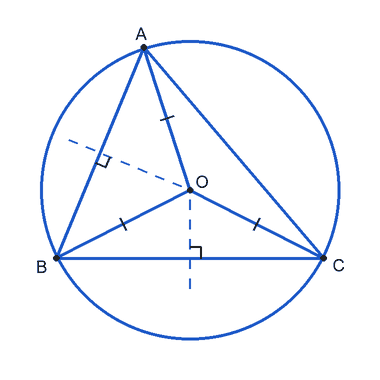
Watch out: The words 'vertices' (corners) and 'sides' are different: equal distance from the SIDES describes the incentre.
Why the other options are wrong:
- (A) at equal distance from the three sides of the triangle: a point at equal distance from the three sides is the incentre, where the angle bisectors meet.
- (C) the point of intersection of the three medians: the point where the three medians meet is the centroid.
- (D) the point of intersection of the three altitudes of the triangle: the point where the three altitudes meet is the orthocentre.
Therefore, the circumcentre is at equal distance from the three vertices, option (B).
- 44 marks
Question 4
Use ruler and compass to answer this question. Construct , where cm, cm.
(a) Construct the locus of points equidistant from B and C.
(b) Construct the locus of points equidistant from A and B.
(c) Mark the point which satisfies both the conditions (a) and (b) as O. Construct the locus of points keeping a fixed distance OA from the fixed point O.
(d) Construct the locus of points which are equidistant from BA and BC.
Solve with AIWritten solution
Solution:
Concept: The locus of points equidistant from two points A and B is the perpendicular bisector of AB: every point on it is the same distance from A as from B. The locus of points equidistant from two intersecting lines is the bisector of the angle between them: every point on it is the same perpendicular distance from both arms. The locus of points at a fixed distance r from a fixed point is the circle with that point as centre and radius r.
Given: ∠ABC = 90°, AB = 6 cm, BC = 8 cm.
Step 1 — Construct the right angle ABC with AB = 6 cm and BC = 8 cm.
Draw BC = 8 cm. With centre B draw an arc cutting BC; with the same radius mark off 60° and then 120° along the arc, and bisect the angle between these two marks. The ray BP through the bisecting point makes a right angle with BC. Cut off BA = 6 cm on BP.
Step 2 — Part (a): locus of points equidistant from B and C.
With centres B and C and equal radii (more than 4 cm), draw arcs on both sides of BC and join the crossing points. This perpendicular bisector of BC is the locus.
Step 3 — Part (b): locus of points equidistant from A and B.
In the same way (radii more than 3 cm), draw the perpendicular bisector of AB. It is the locus of points equidistant from A and B.
Step 4 — Part (c): the point O and the circle.
Mark O where the two perpendicular bisectors meet. O is equidistant from B and C and also from A and B; so OA, OB and OC are all equal. With centre O and radius OA draw a circle; it is the locus of points at the fixed distance OA from O, and it passes through A, B and C.
Step 5 — Find the radius.
∠ABC = 90°, so AC is a diameter of this circle (an angle in a semicircle is a right angle) and O is the mid-point of AC. Pythagoras in ΔABC gives AC:
So the radius OA is half of 10 cm, that is 5 cm.
Step 6 — Part (d): locus of points equidistant from BA and BC.
BA and BC meet at B, so the locus is the bisector of ∠ABC. With centre B draw an arc cutting BA and BC; from these points draw equal arcs cutting each other; join B to the crossing point. This bisector makes 45° with each arm.
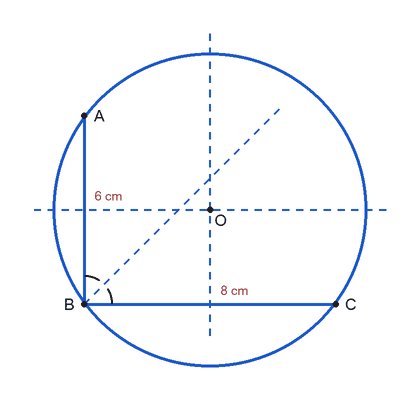
Watch out: In part (d) the locus is the bisector of the angle at B, not a perpendicular bisector.
Therefore, the loci are the perpendicular bisectors of BC and AB (meeting at O, the mid-point of AC), the circle with centre O and radius OA = 5 cm through A, B and C, and the bisector of ∠ABC.
- 51 mark
Question 5
Statement 1: The point which is equidistant from three non-collinear points D, E and F is the circumcentre of the .
Statement 2: The incentre of a triangle is the point where the bisector of the angles intersects.
Solve with AIAnswer
- Correct
(A) Both the statements are true.
(B) Both the statements are false.
(C) Statement 1 is true and Statement 2 is false.
(D) Statement 1 is false and Statement 2 is true.
Answer: (A) Both the statements are true.
Concept: The locus of points equidistant from two points A and B is the perpendicular bisector of AB: every point on it is the same distance from A as from B. The locus of points equidistant from two intersecting lines is the bisector of the angle between them: every point on it is the same perpendicular distance from both arms. The perpendicular bisectors of the sides meet at the circumcentre; the angle bisectors meet at the incentre.
Step 1 — Judge Statement 1.
Let O be equidistant from D, E and F. Since OD = OE, O lies on the perpendicular bisector of DE. Since OE = OF, O lies on the perpendicular bisector of EF. The point where the perpendicular bisectors of the sides meet is the circumcentre, so O is the circumcentre of ΔDEF. Statement 1 is true.

Step 2 — Judge Statement 2.
The bisectors of the three angles of a triangle meet at one point. That point is equidistant from the three sides and is called the incentre. Statement 2 is true.

Watch out: Do not mix the two centres: circumcentre comes from perpendicular bisectors (equal distance from vertices), incentre from angle bisectors (equal distance from sides).
Why the other options are wrong:
- (B) Both the statements are false: it calls both statements false, but each is a correct description.
- (C) Statement 1 is true and Statement 2 is false: it calls Statement 2 false, but the incentre is exactly where the angle bisectors meet.
- (D) Statement 1 is false and Statement 2 is true: it calls Statement 1 false, but a point equidistant from the three vertices is the circumcentre.
Therefore, both statements are true, option (A).
- 61 mark
Question 6
The locus of a toy bird fixed at the tip of one of the blades of a rotating ceiling fan is a:
Solve with AIAnswer
(A) straight line
- Correct
(B) circle
(C) semi-circular arc
(D) diameter of the circle so formed
Answer: (B) circle
Concept: A locus is the path traced by a point that moves according to a rule. The locus of points at a fixed distance r from a fixed point is the circle with that point as centre and radius r.
Step 1 — Find what stays fixed.
The toy bird is fixed at the tip P of a blade. However the fan turns, the distance from the bird to the centre O of the fan stays equal to the length of the blade.
Step 2 — Follow the motion.
As the fan rotates, the blade goes all the way round O, again and again. So the bird moves keeping a fixed distance from the fixed point O.
Step 3 — Name the locus.
A point that keeps a fixed distance from a fixed point traces a circle. So the bird's path is a circle with centre O and radius equal to the blade length.
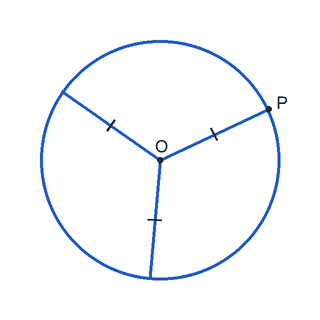
Watch out: The bird never passes through the centre, so no answer that includes the centre (a diameter) can be right.
Why the other options are wrong:
- (A) straight line: on a straight line the bird's distance from the centre would keep changing; here it stays the same.
- (C) semi-circular arc: the blade makes full turns, not half turns, so the path is a complete circle, not a semicircular arc.
- (D) diameter of the circle so formed: a diameter is a segment through the centre; the bird always stays one blade length away from the centre.
Therefore, the locus is a circle, option (B).
- 74 marks
Question 7
Use ruler and compass for the following constructions:
Construct:
(a) an isosceles in which cm and cm.
(b) the locus of points which moves such that it is 2.5 cm from the point A.
(c) the locus of points equidistant from B and C. Mark point P which satisfies both the conditions mentioned in (b) and (c).
(d) a circle passing through P, B and C.
Solve with AIWritten solution
Solution:
Concept: The locus of points at a fixed distance r from a fixed point is the circle with that point as centre and radius r. The locus of points equidistant from two points A and B is the perpendicular bisector of AB: every point on it is the same distance from A as from B. The centre of the circle through three points is where the perpendicular bisectors of the joining segments meet.
Given: AB and AC are 7 cm, BC = 6 cm; circle of radius 2.5 cm about A.
Step 1 — Part (a): construct the isosceles triangle.
Draw BC = 6 cm. With centres B and C and radius 7 cm, draw arcs cutting each other at A. Join AB and AC, so AB and AC are each 7 cm.
Step 2 — Part (b): locus of points 2.5 cm from A.
With centre A and radius 2.5 cm, draw a circle. This circle is the locus.
Step 3 — Part (c): locus of points equidistant from B and C.
With centres B and C and equal radii (more than 3 cm), draw arcs on both sides of BC and join the crossing points. This perpendicular bisector of BC is the locus. A is equidistant from B and C (AB = AC), so the line passes through A.
Step 4 — Part (c): mark P.
The perpendicular bisector meets the circle of part (b) at two points. Mark the one inside the triangle as P. It is 2.5 cm from A and equidistant from B and C, so it satisfies both conditions.
Step 5 — Part (d): the circle through P, B and C.
Draw the perpendicular bisector of PB. It meets the perpendicular bisector of BC at a point; that point is equidistant from P, B and C, so it is the centre. With this centre and radius equal to its distance from B, draw the circle; it passes through P, B and C.
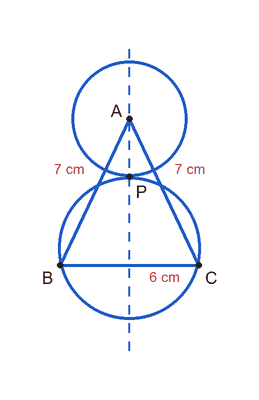
Check: A coordinate calculation gives the radius ≈ 3.09 cm, so a careful drawing measures about 3.1 cm.
Watch out: The circle through P, B and C is not centred at A; its centre must be found from two perpendicular bisectors.
Therefore, the circle through P, B and C has a radius of about 3.1 cm (on measuring).