Solution:
Concept: The locus of points at a fixed distance r from a fixed point is the circle with that point as centre and radius r. The locus of points equidistant from two points A and B is the perpendicular bisector of AB: every point on it is the same distance from A as from B. The centre of the circle through three points is where the perpendicular bisectors of the joining segments meet.
Given: AB and AC are 7 cm, BC = 6 cm; circle of radius 2.5 cm about A.
Step 1 — Part (a): construct the isosceles triangle.
Draw BC = 6 cm. With centres B and C and radius 7 cm, draw arcs cutting each other at A. Join AB and AC, so AB and AC are each 7 cm.
Step 2 — Part (b): locus of points 2.5 cm from A.
With centre A and radius 2.5 cm, draw a circle. This circle is the locus.
Step 3 — Part (c): locus of points equidistant from B and C.
With centres B and C and equal radii (more than 3 cm), draw arcs on both sides of BC and join the crossing points. This perpendicular bisector of BC is the locus. A is equidistant from B and C (AB = AC), so the line passes through A.
Step 4 — Part (c): mark P.
The perpendicular bisector meets the circle of part (b) at two points. Mark the one inside the triangle as P. It is 2.5 cm from A and equidistant from B and C, so it satisfies both conditions.
Step 5 — Part (d): the circle through P, B and C.
Draw the perpendicular bisector of PB. It meets the perpendicular bisector of BC at a point; that point is equidistant from P, B and C, so it is the centre. With this centre and radius equal to its distance from B, draw the circle; it passes through P, B and C.
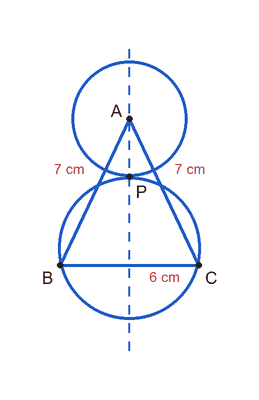
Check: A coordinate calculation gives the radius ≈ 3.09 cm, so a careful drawing measures about 3.1 cm.
Watch out: The circle through P, B and C is not centred at A; its centre must be found from two perpendicular bisectors.
Therefore, the circle through P, B and C has a radius of about 3.1 cm (on measuring).
