Use ruler and compasses only for the following question. All construction lines and arcs must be clearly shown.
Question 583 marksMedium
Use ruler and compasses only for the following question. All construction lines and arcs must be clearly shown.
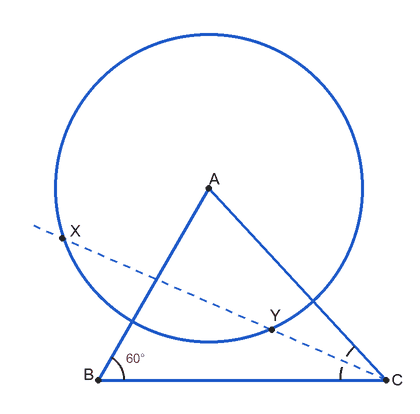
(i) Construct a ΔABC in which BC = 6·5 cm, ∠ABC = 60° and AB = 5 cm.
(ii) Construct the locus of points at a distance of 3·5 cm from A.
(iii) Construct the locus of points equidistant from AC and BC.
(iv) Mark 2 points X and Y which are at a distance of 3·5 cm from A and also equidistant from AC and BC. Measure XY.
Solution:
Concept: Points 3·5 cm from A lie on the circle with centre A and radius 3·5 cm. Points equidistant from AC and BC lie on the bisector of ∠ACB. X and Y lie on both loci.
(i)
Step 1 — Construct the triangle.
Two sides and the included angle are given.
Draw BC = 6·5 cm.
At B, construct ∠CBX = 60° with compasses. On BX, cut off BA = 5 cm. Join AC.
(ii)
Step 2 — Draw the circle.
With A as centre and radius 3·5 cm, draw a circle. It is the locus of points 3·5 cm from A.
(iii)
Step 3 — Draw the bisector.
Construct the bisector of ∠ACB and produce it. It is the locus of points equidistant from AC and BC.
(iv)
Step 4 — Mark X and Y and measure.
Mark X and Y, where the bisector of ∠C cuts the circle. Each is 3·5 cm from A and equidistant from AC and BC. On measuring, XY ≈ 5·2 cm.
Step 5 — Find AC and angle C.
By the cosine rule (or by measuring), AC ≈ 5·89 cm, and then ∠ACB ≈ 47·3°, so half of ∠ACB is about 23·6°.
Step 6 — Find the distance of A from the bisector.
In the right-angled triangle formed by A, C and the foot of the perpendicular from A to the bisector, the sine of the half-angle gives this distance.
d=5.89×sin23.6∘≈2.36 cm
Step 7 — Find XY.
XY is a chord of the circle of radius 3·5 cm at the distance d from its centre A. The perpendicular from the centre bisects the chord, so Pythagoras' theorem gives half of XY.
XY=23.52−2.362≈5.16 cm
Watch out: The bisector is of the angle at C (between AC and BC), not of the angle at B.
Therefore, X and Y are the two points where the bisector of ∠ACB cuts the circle of radius 3·5 cm about A, and XY ≈ 5·2 cm.