Solution:
Concept: Points equidistant from AB and BC lie on the bisector of ∠ABC. Points equidistant from C and D lie on the perpendicular bisector of CD. Each angle of a rectangle is 90°.
Step 1 — Construct triangle BCP.
Two sides and the included angle are given.
- Draw BC = 5 cm.
- At B, construct ∠CBX = 45° (construct 90° at B and bisect it).
- On BX, cut off BP = 4 cm. Join PC.
Step 2 — Use condition (a).
In rectangle ABCD, ∠ABC = 90°, and its bisector makes 45° with BC. Since ∠PBC = 45°, BP is already this bisector. So P is equidistant from AB and BC as soon as BA is drawn perpendicular to BC.
Step 3 — Use condition (b).
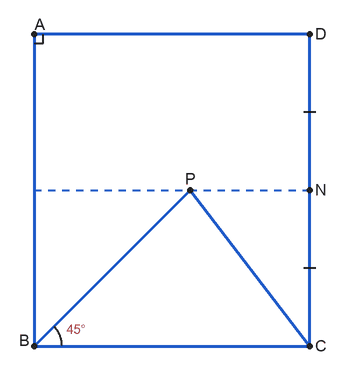
P must lie on the perpendicular bisector of CD. CD is perpendicular to BC, so its perpendicular bisector is parallel to BC, and it must pass through P. So the mid-point of CD is at the same height as P, and CD is twice the height of P above BC.
Step 4 — Complete the rectangle.
We now draw the sides through B and C and fix D from the mid-point N.
- At B, draw BY ⊥ BC. At C, draw CZ ⊥ BC.
- Through P, draw a line parallel to BC; let it meet CZ at N.
- On CZ, cut off ND = CN. Now the line through P bisects CD at right angles.
- Through D, draw a line parallel to BC to meet BY at A. ABCD is the required rectangle.
Step 5 — Measure AB.
On measuring, AB ≈ 5·7 cm.
Step 6 — Check AB by calculation.
The height of P above BC comes from the sine of 45°, and AB = CD is twice it.
height of P=4sin45∘≈2.83 cm
AB=2×2.83=5.66 cm
Watch out: CD must be twice the height of P, because P's level is the mid-point of CD, not its top.
Therefore, ABCD is the rectangle with CN = ND (N level with P), and AB ≈ 5·7 cm.
