
Question 471 markMCQEasy
The locus of a point which is equidistant from two non-parallel lines AB and CD is :
Confirming your payment
Sign up now and get 250 free tokens.
Loci · Question 47 of 58
The locus of a point which is equidistant from two non-parallel lines AB and CD is :
(A) perpendicular to AB.
(B) perpendicular to CD.
(C) bisector of angle between AB and CD.
(D) perpendicular bisector of CD.
Answer: (C) bisector of angle between AB and CD.
Concept: The locus of points equidistant from two intersecting lines is the pair of lines that bisect the angles between them.
Step 1 — Find where the lines meet.
AB and CD are not parallel, so they meet at a point; call it O.
Step 2 — Take a point of the locus.
Take a point P equidistant from the two lines, and draw PM ⊥ AB and PN ⊥ CD, so that PM = PN.
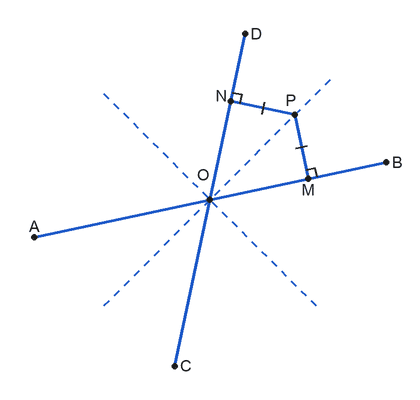
Step 3 — Compare triangles POM and PON.
Both are right-angled, they share the hypotenuse PO, and PM = PN. So ΔPOM ≅ ΔPON by RHS.
Step 4 — Conclude.
Hence ∠POM = ∠PON, so PO bisects the angle between AB and CD. (Two intersecting lines make two pairs of angles, so there are two such bisectors, shown dashed.)
Watch out: Equidistant from two points gives a perpendicular bisector; equidistant from two lines gives an angle bisector. Read the question carefully to see which one is meant.
Why the other options are wrong:
Therefore, the locus is the bisector of the angle between AB and CD, option (C).