
Opening your dashboard
Class 11 Physics Chapter 25: Principle of Superposition of Waves Solutions
86 textbook questions with step-by-step answers, free to read, for ISC 2026-27.
Get talked through Ch 25, not just shown the answer
Reading a finished solution is not the same as being able to do it. The AI tutor takes one question at a time and works it with you, in your own words, until you can.
- Ask it out loud, in your own words
- It gives you the next step, not the answer
- Stuck on part (ii)? Start there
86 questions with solutions
1–5 marks · Mixed difficulty
The first 25 solutions are on this page. This chapter is a long one, so the rest open on their own page to keep this one quick to load.
- 11 mark
Question 1
If the phase difference between the two wave is during superposition, then the resultant amplitude is
Solve with AIAnswer
- Correct
(A) Maximum
(B) Minimum
(C) Maximum or minimum
(D) None of the above
Answer: (A) Maximum
Concept: When two harmonic waves of the same frequency, with amplitudes and , meet at a point with a phase difference , the resultant amplitude there is given by . The intensity is proportional to the square of the amplitude.
Step 1 — Put in the phase difference. For , , so:
Step 2 — Interpret the result. This is the largest value can have: the two waves meet crest on crest, which is constructive interference.
- (B) A minimum needs , that is, a phase difference of , not .
- (C) A phase difference of fixes , so the result is always a maximum, never a minimum.
- (D) One of the given options, maximum, is correct, so "none of the above" is wrong.
Therefore, the resultant amplitude is maximum, option (A).
- 21 mark
Question 2
A stationary point source of sound emits sound uniformly in all directions in a non-absorbing medium. Two points and are at a distance of 4 m and 9 m respectively from the source. The ratio of amplitudes of the waves at and is
Solve with AIAnswer
(A)
(B)
(C)
- Correct
(D)
Answer: (D)
Concept: A point source of power spreads its energy over spheres of area , so the intensity at distance is when the medium absorbs nothing. The intensity is also proportional to the square of the amplitude, .
Step 1 — Relate amplitude to distance. Since and , we have , so .
Step 2 — Find the ratio. We put in and :
- (A) is ; it would follow if the amplitude fell as , as it does for a line source (cylindrical waves), not a point source.
- (B) is the ratio upside down: the nearer point must have the larger amplitude.
- (C) is , upside down and with the wrong power of .
Therefore, the ratio of the amplitudes at and is , option (D).
- 31 mark
Question 3
Two waves are propagating to the point along a straight line produced by two sources and of simple harmonic and of equal frequency. The amplitude of every wave at is ‘’ and the phase of is ahead by than that of and the distance is greater than by 50 cm. Then the resultant amplitude at the point will be, if the wavelength is 1 metre
Solve with AIAnswer
(A)
(B)
(C)
- Correct
(D)
Answer: (D)
Concept: When two harmonic waves of the same frequency, with amplitudes and , meet at a point with a phase difference , their resultant amplitude there is given by (we use here because names a source). A path difference adds a phase difference ; the wave that travels farther lags behind.
Step 1 — Find the phase difference due to the path. The wave from travels farther, and :
So, because of the extra path, the wave from lags by .
Step 2 — Combine with the phase at the sources. At the sources is ahead by , so at the wave from lags behind that from by:
Step 3 — Find the resultant amplitude. Both amplitudes are equal to , and :
- (A) needs the two waves to arrive exactly in phase; here they differ by .
- (B) is what a phase difference of only gives; it leaves out the phase difference caused by the 50 cm extra path.
- (C) is the resultant for a phase difference of , which is not the case here.
Therefore, the resultant amplitude at is , option (D).
- 41 mark
Question 4
Two identical sinusoidal waves each of amplitude 5 mm with a phase difference of are traveling in the same direction in a string. The amplitude of the resultant wave (in mm) is
Solve with AIAnswer
(A) Zero
- Correct
(B)
(C)
(D) 2.5
Answer: (B)
Concept: When two harmonic waves of the same frequency, with amplitudes and , meet at a point with a phase difference , the resultant amplitude there is given by . The intensity is proportional to the square of the amplitude.
Step 1 — Write the data. Each wave has an amplitude of , and the phase difference is , so .
Step 2 — Find the resultant amplitude. The cross term vanishes:
This is about .
- (A) The amplitude is zero only when equal waves are exactly out of phase, a phase difference of .
- (C) divides by instead of multiplying; two equal waves would give this only with a phase difference of about .
- (D) is less than either wave's amplitude; two equal 5 mm waves give this only with a phase difference of about .
Therefore, the amplitude of the resultant wave is mm, option (B).
- 51 mark
Question 5
Two waves having the intensities in the ratio of 9 : 1 produce interference. The ratio of maximum to the minimum intensity is equal to
Solve with AIAnswer
(A) 2 : 1
- Correct
(B) 4 : 1
(C) 9 : 1
(D) 10 : 8
Answer: (B) 4 : 1
Concept: When two harmonic waves of the same frequency, with amplitudes and , meet at a point with a phase difference , the resultant amplitude there is given by . The intensity is proportional to the square of the amplitude. So the largest amplitude, for waves in phase, is , and the smallest, for waves in opposite phase, is .
Step 1 — Find the ratio of the amplitudes. Since , the amplitudes are in the ratio of the square roots of the intensities:
Step 2 — Find the ratio of maximum to minimum intensity. We take and (in any unit):
- (A) is , the ratio of the maximum to the minimum amplitude; it has not been squared to give intensities.
- (C) is the ratio of the two original intensities, not of the maximum to the minimum intensity of the pattern.
- (D) comes from adding and subtracting the intensities, ; amplitudes, not intensities, add.
Therefore, the ratio of maximum to minimum intensity is 4 : 1, option (B).
- 61 mark
Question 6
Two sources produce sound waves of equal amplitudes and travelling along the same direction producing 18 beats in 3 seconds. If one source has a frequency of 341 Hz, the frequency of the other source may be
Solve with AIAnswer
(A) 329 or 353 Hz
- Correct
(B) 335 or 347 Hz
(C) 338 or 344 Hz
(D) 332 or 350 Hz
Answer: (B) 335 or 347 Hz
Concept: The number of beats heard per second equals the difference of the two frequencies, (larger minus smaller).
Step 1 — Find the beat frequency. There are 18 beats in 3 seconds:
Step 2 — Find the lower possible frequency. The other frequency differs from 341 Hz by 6 Hz. If it is the lower of the two, we subtract 6 Hz:
Step 3 — Find the higher possible frequency. If the other frequency is the higher of the two, we add 6 Hz instead:
The beats alone cannot tell which of the two it is, so both values are possible.
- (A) 329 Hz and 353 Hz differ from 341 Hz by 12 Hz; they would give 12 beats per second, 36 beats in 3 s.
- (C) 338 Hz and 344 Hz differ by 3 Hz; they would give 3 beats per second, 9 beats in 3 s.
- (D) 332 Hz and 350 Hz differ by 9 Hz; they would give 9 beats per second, 27 beats in 3 s.
Therefore, the frequency of the other source may be 335 Hz or 347 Hz, option (B).
- 71 mark
Question 7
Maximum number of beats frequency heard by a human being is
Solve with AIAnswer
- Correct
(A) 10
(B) 4
(C) 20
(D) 6
Answer: (A) 10
Concept: The impression of a sound stays in the ear for about s (persistence of hearing). Two loud sounds can be heard as separate only if they are more than about s apart.
Step 1 — Apply this to beats. The time between two successive beats is . For the beats to be heard separately, this time must be at least about s.
Step 2 — Find the largest beat frequency. The beat frequency can therefore be at most about 10 per second.
- (B) 4 beats per second are easily heard, but this is not the largest number; up to about 10 can be counted.
- (C) 20 beats per second come only s apart, less than the persistence of hearing, so they merge and are not heard as separate beats.
- (D) 6 beats per second are also heard easily; this too is below the limit of about 10.
Note: The limit of 10 is approximate; above roughly 10 to 15 beats per second the ear hears a rough, rattling tone instead of separate beats.
Therefore, the maximum beat frequency a person can hear is about 10 per second, option (A).
- 81 mark
Question 8
Two sound waves of slightly different frequencies propagating in the same direction produce beats due to
Solve with AIAnswer
- Correct
(A) Interference
(B) Diffraction
(C) Polarisation
(D) Refraction
Answer: (A) Interference
Concept: Beats are the regular rise and fall of loudness when two sound waves of slightly different frequencies are superposed. At a given place the two waves are sometimes in phase and sometimes out of phase.
Step 1 — Follow the phase difference. Because the frequencies differ slightly, the phase difference between the two waves at the ear changes steadily with time.
Step 2 — Name the effect. When they are in phase they reinforce (constructive interference, loud); when they are out of phase they cancel (destructive interference, faint). This is interference taking place in time.
- (B) Diffraction is the bending of a wave round an obstacle or through an opening; it does not make the loudness rise and fall.
- (C) Polarisation happens only with transverse waves, and sound in air is longitudinal.
- (D) Refraction is the change of direction of a wave when its speed changes, as at a boundary; it involves one wave, not two.
Therefore, beats are produced due to interference, option (A).
- 91 mark
Question 9
The distance between the nearest node and antinode in a stationary wave is
Solve with AIAnswer
(A)
(B)
- Correct
(C)
(D)
Answer: (C)
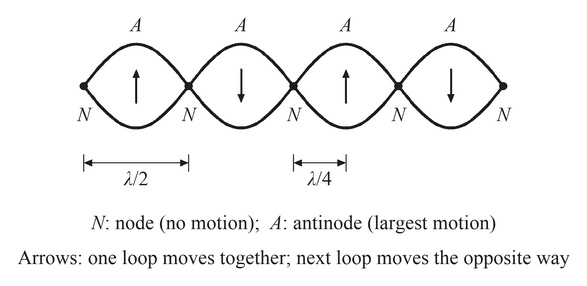
Concept: In a stationary wave the particles at the nodes stay at rest, and the particles between two neighbouring nodes (one loop) all move in the same phase, reaching their extreme positions together. Particles in neighbouring loops move in opposite phase. Node to node is and node to antinode is .
Step 1 — Use the spacing of nodes. Two neighbouring nodes are apart.
Step 2 — Place the antinode. An antinode lies midway between two neighbouring nodes, as the figure shows, so the nearest node and antinode are half of apart:
- (A) is the distance from a node to the next-but-one node, two loops away.
- (B) is the distance between two neighbouring nodes (or two neighbouring antinodes).
- (D) spans four loops, far more than from a node to the nearest antinode.
Therefore, the distance between the nearest node and antinode is , option (C).
- 101 mark
Question 10
The phase difference between two particles situated on both the sides of a node is
Solve with AIAnswer
(A)
(B)
- Correct
(C)
(D)
Answer: (C)
Concept: In a stationary wave the particles at the nodes stay at rest, and the particles between two neighbouring nodes (one loop) all move in the same phase, reaching their extreme positions together. Particles in neighbouring loops move in opposite phase. Node to node is and node to antinode is .
Step 1 — Look at the two sides of a node. The two particles lie in neighbouring loops, one on each side of the node, as the arrows in the figure show.
Step 2 — Compare their motion. When the particle on one side moves up, the particle on the other side moves down; they reach their extreme positions at the same time but on opposite sides. They are therefore in opposite phase.
- (A) A phase difference of is found between particles in the same loop, not on the two sides of a node.
- (B) In a stationary wave, particles are either in phase or in opposite phase; none differ by .
- (D) means the same phase as , which is true only for particles in the same loop.
Therefore, the phase difference between particles on the two sides of a node is , option (C).
- 111 mark
Question 11
In a stationary wave all the particles
Solve with AIAnswer
(A) On either side of a node vibrate in same phase
- Correct
(B) In the region between two nodes vibrate in same phase
(C) In the region between two antinodes vibrate in same phase
(D) Of the medium vibrate in same phase
Answer: (B) In the region between two nodes vibrate in same phase
Concept: In a stationary wave the particles at the nodes stay at rest, and the particles between two neighbouring nodes (one loop) all move in the same phase, reaching their extreme positions together. Particles in neighbouring loops move in opposite phase. Node to node is and node to antinode is .
Step 1 — Look at one loop. In the expression for a stationary wave, every particle between two neighbouring nodes has the same sign of , so they all move together, as in each loop of the figure.
Step 2 — Look across a node. On crossing a node, changes sign, so particles in the next loop move in the opposite direction.
- (A) Particles on either side of a node vibrate in opposite phase, not in the same phase.
- (C) Between two antinodes there is a node, and the particles on its two sides are in opposite phase, so not all of them are in the same phase.
- (D) Particles in neighbouring loops are in opposite phase, so the particles of the whole medium do not vibrate in the same phase.
Therefore, in a stationary wave all the particles between two nodes vibrate in the same phase, option (B).
- 121 mark
Question 12
“Stationary waves” are so called because in them
Solve with AIAnswer
(A) The particles of the medium are not disturbed at all
(B) The particles of the medium do not execute SHM
- Correct
(C) There occurs no flow of energy along the wave
(D) The interference effect cannot be observed
Answer: (C) There occurs no flow of energy along the wave
Concept: A stationary wave is formed when two identical waves travelling in opposite directions are superposed. The two waves carry equal amounts of energy in opposite directions.
Step 1 — Find the net energy flow. The energy carried one way by one wave is balanced by the energy carried the other way by the other wave, so there is no net flow of energy along the medium. The particles at the nodes never move, so no energy is passed across a node.
Step 2 — Explain the name. The wave pattern does not move forward either: the nodes and antinodes stay at fixed places. Because nothing travels along the medium, the wave is called stationary.
- (A) All particles except those at the nodes vibrate, with amplitudes up to at the antinodes, so the medium is disturbed.
- (B) Each particle (except at a node) executes SHM about its mean position, with an amplitude that depends on its position.
- (D) A stationary wave is itself the result of the interference of two waves, so interference is very much present.
Therefore, stationary waves are so called because there is no flow of energy along the wave, option (C).
- 131 mark
Question 13
Two waves are approaching each other with a velocity of 16 m/s and frequency . The distance between two consecutive nodes is
Solve with AIAnswer
(A)
- Correct
(B)
(C)
(D)
Answer: (B)
Concept: Two identical waves travelling in opposite directions form a stationary wave. Neighbouring nodes are apart, and the wavelength is .
Step 1 — Find the wavelength. We divide the speed, , by the frequency:
Step 2 — Find the node spacing. Two consecutive nodes are half a wavelength apart:
- (A) is the whole wavelength, the distance between alternate nodes.
- (C) is , which is not even a length (it has the unit ).
- (D) is the right answer turned upside down, again not a length.
Therefore, the distance between two consecutive nodes is m, option (B).
- 141 mark
Question 14
A device used for investigating the vibration of a fixed string or wire is
Solve with AIAnswer
- Correct
(A) Sonometer
(B) Barometer
(C) Hydrometer
(D) None of these
Answer: (A) Sonometer
Concept: A sonometer is a hollow wooden box with a wire stretched over two bridges and kept taut by a weight hanging over a pulley; the vibrating length between the bridges can be changed.
Step 1 — Recall its use. It is used to study the vibrations of a stretched wire: to verify the laws of vibrating strings and to compare or find the frequencies of tuning forks.
Step 2 — Pick the device. It is exactly the device the question describes.
- (B) A barometer measures atmospheric pressure.
- (C) A hydrometer measures the density (relative density) of a liquid.
- (D) "None of these" is wrong because the sonometer is listed.
Therefore, the device is the sonometer, option (A).
- 151 mark
Question 15
A stretched string of length , fixed at both ends can sustain stationary waves of wavelength , given by
Solve with AIAnswer
(A)
(B)
- Correct
(C)
(D)
Answer: (C)
Concept: A string fixed at both ends has a node at each end. A stationary wave fits on it only if the length holds a whole number of loops, each long ().
Step 1 — Write the condition. The string holds loops, so its length is:
Step 2 — Solve for the wavelength. We multiply both sides by :
The figure shows .

- (A) has the unit of , so it cannot be a wavelength.
- (B) has the unit of , so it cannot be a wavelength either.
- (D) makes the wavelength grow with the number of loops, but more loops on the same string means shorter loops and a shorter wavelength.
Therefore, the string can sustain stationary waves of wavelength , option (C).
- 161 mark
Question 16
A string is producing transverse vibration whose equation is , where and are in metres and is in seconds. If the linear density of the string is kg/m, then the tension in the string in N will be
Solve with AIAnswer
(A) 10
(B) 0.5
(C) 1
- Correct
(D) 0.117
Answer: (D) 0.117
Concept: A wave of the form travels in the direction, with speed . On a string, , so the tension is .
Step 1 — Read and . We compare the given equation with ; this gives the wave number , and the angular frequency .
Step 2 — Find the wave speed. We divide by :
Step 3 — Find the tension. We use , with :
- (A) A tension of 10 N would make the speed , not 30.
- (B) A tension of 0.5 N would give a speed of about , not 30.
- (C) A tension of 1 N would give a speed of about , not 30.
Therefore, the tension in the string is 0.117 N, option (D).
- 171 mark
Question 17
In order to double the frequency of the fundamental note emitted by a stretched string, the length is reduced to 3/4th of the original length and the tension is changed. The factor by which the tension is to be changed, is
Solve with AIAnswer
(A)
(B)
(C)
- Correct
(D)
Answer: (D)
Concept: A string of length , tension and mass per unit length carries transverse waves with speed . Fixed at both ends, it vibrates in its fundamental mode with frequency . So, for the same string, .
Step 1 — Write the ratio of frequencies. We compare the new note (2) with the old one (1):
Step 2 — Put in the data. The frequency doubles, , and the length becomes three-quarters, so :
Step 3 — Square both sides. This gives the factor for the tension:
- (A) With the tension multiplied by , the frequency would become times, lower, not double.
- (B) With , the frequency would become about times the original.
- (C) With , the frequency would become about times the original.
Therefore, the tension must be changed by the factor , option (D).
- 181 mark
Question 18
A string of 7 m length has a mass of 0.035 kg. If tension in the string is 60.5 N, then speed of a wave on the string is
Solve with AIAnswer
(A) 77 m/s
(B) 102 m/s
- Correct
(C) 110 m/s
(D) 165 m/s
Answer: (C) 110 m/s
Concept: The speed of a transverse wave on a string is , where is the tension and the mass per unit length.
Step 1 — Find the mass per unit length. We divide the mass by the length:
Step 2 — Find the speed. We put into the formula:
- (A) 77 m/s would need a mass per unit length of , about twice the real value.
- (B) 102 m/s would need , not 0.005.
- (D) 165 m/s would need , less than half the real value.
Therefore, the speed of a wave on the string is 110 m/s, option (C).
- 191 mark
Question 19
The first overtone of a stretched wire of given length is 320 Hz. The first harmonic is
Solve with AIAnswer
(A) 320 Hz
- Correct
(B) 160 Hz
(C) 480 Hz
(D) 640 Hz
Answer: (B) 160 Hz
Concept: A stretched wire can vibrate with frequencies The lowest, , is the first harmonic (fundamental); the next, (the second harmonic), is the first overtone.
Step 1 — Relate the first overtone to the fundamental. The first overtone is the second harmonic:
Step 2 — Find the first harmonic. We halve it:
- (A) 320 Hz is the first overtone itself, not the first harmonic.
- (C) 480 Hz is , the third harmonic (second overtone).
- (D) 640 Hz doubles 320 instead of halving it; it is the fourth harmonic.
Therefore, the first harmonic is 160 Hz, option (B).
- 201 mark
Question 20
The sound carried by air from a sitar to a listener is a wave of the following type
Solve with AIAnswer
(A) Longitudinal stationary
(B) Transverse progressive
(C) Transverse stationary
- Correct
(D) Longitudinal progressive
Answer: (D) Longitudinal progressive
Concept: Air has no rigidity, so a sound wave in air is longitudinal: the air layers vibrate along the direction of travel, forming compressions and rarefactions. A wave that carries energy from one place to another is progressive.
Step 1 — Decide the kind of vibration. The sitar string vibrates transversely, but the sound it sends into the air is a longitudinal wave of compressions and rarefactions.
Step 2 — Decide whether it travels. The sound carries energy from the sitar to the listener, so it is a progressive (travelling) wave.
- (A) A stationary wave needs a wave and its reflection travelling in opposite directions, as on the vibrating string; the sound travelling through the open air to the listener carries energy to the listener, so it is progressive.
- (B) Air cannot carry transverse waves because it has no rigidity.
- (C) The stationary transverse wave is on the sitar string itself, not in the air.
Therefore, the sound reaching the listener is a longitudinal progressive wave, option (D).
- 211 mark
Question 21
If the velocity of sound in air is 336 m/s. The maximum length of a closed pipe that would produce a just audible sound will be
Solve with AIAnswer
(A) 3.2 cm
- Correct
(B) 4.2 m
(C) 4.2 cm
(D) 3.2 m
Answer: (B) 4.2 m
Concept: A pipe closed at one end has a displacement node at the closed end and an antinode at the open end. Neglecting the end correction, its fundamental frequency is , where is its length and the speed of sound; an open pipe has . The lowest frequency the human ear can hear is about 20 Hz.
Step 1 — Choose the frequency. The longer the pipe, the lower its fundamental frequency. The longest pipe that still gives an audible sound has its fundamental at the lowest audible frequency, .
Step 2 — Find the length. From , :
- (A) A 3.2 cm closed pipe has a fundamental of , well inside the audible range, not at its limit.
- (C) A 4.2 cm closed pipe has a fundamental of 2000 Hz: the right digits but the wrong unit.
- (D) A 3.2 m closed pipe has a fundamental of about 26 Hz, audible, but it is not the longest such pipe.
Therefore, the maximum length is 4.2 m, option (B).
- 221 mark
Question 22
Two closed pipes produce 10 beats per second when emitting their fundamental modes. If their lengths are in ratio of 25 : 26. Then their fundamental frequency in Hz, are
Solve with AIAnswer
(A) 270, 280
(B) 260, 270
- Correct
(C) 260, 250
(D) 260, 280
Answer: (C) 260, 250
Concept: A pipe closed at one end has a displacement node at the closed end and an antinode at the open end. Neglecting the end correction, its fundamental frequency is , where is its length and the speed of sound; an open pipe has . So, for pipes in the same air, . The beat frequency is the difference of the two frequencies.
Step 1 — Write the ratio of frequencies. The shorter pipe () gives the higher note:
Step 2 — Use the beats. The two notes give 10 beats per second:
Step 3 — Solve. We put into the second equation:
- (A) 270 Hz and 280 Hz are in the ratio 27 : 28, not 25 : 26.
- (B) 260 Hz and 270 Hz are in the ratio 26 : 27, not 25 : 26.
- (D) 260 Hz and 280 Hz differ by 20 Hz, which would give 20 beats per second, not 10.
Therefore, the fundamental frequencies are 260 Hz and 250 Hz, option (C).
- 231 mark
Question 23
An open pipe of length vibrates in fundamental mode. The pressure variation is maximum at
Solve with AIAnswer
(A) 1/4 from ends
- Correct
(B) The middle of pipe
(C) The ends of the pipe
(D) At 1/8 from ends of pipe
Answer: (B) The middle of pipe
Concept: In a sound wave, a displacement node is a pressure antinode (the greatest variation of pressure) and a displacement antinode is a pressure node.
Step 1 — Locate the nodes in the fundamental mode. An open pipe has displacement antinodes at both open ends and, in its fundamental mode, one displacement node in the middle, as part (a) of the figure shows.
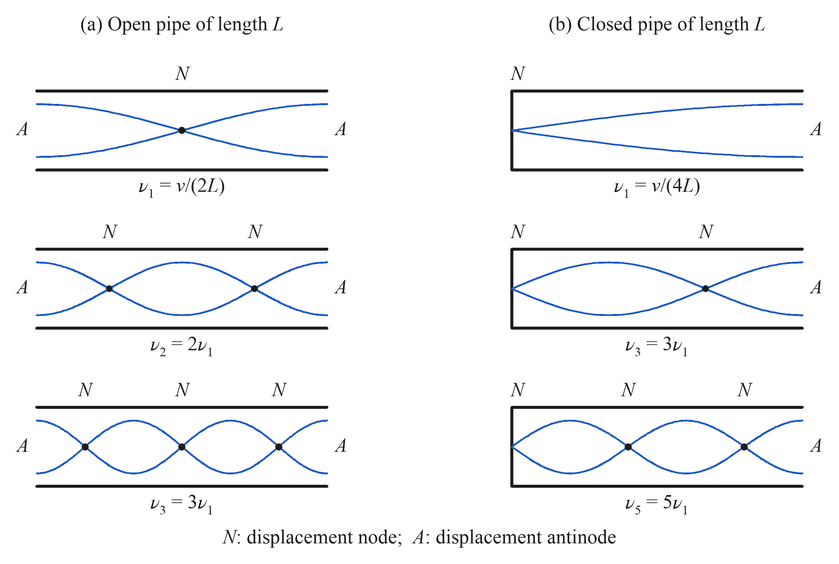
Step 2 — Locate the pressure antinode. The displacement node in the middle is a pressure antinode, so the pressure variation is greatest there.
- (A) A quarter of the length from an end lies between a node and an antinode; the pressure amplitude there is only about 0.71 of its largest value.
- (C) The open ends are joined to the atmosphere, so the pressure there stays close to atmospheric: they are pressure nodes, with the least variation.
- (D) At one-eighth of the length from an end, the pressure amplitude is only about 0.38 of its largest value.
Therefore, the pressure variation is maximum at the middle of the pipe, option (B).
- 241 mark
Question 24
Two open organ pipes give 4 beats/s when sounded together in their fundamental modes. If the length of the pipe are 100 cm and 102.5 cm respectively, then the velocity of sound is:
Solve with AIAnswer
(A) 496 m/s
- Correct
(B) 328 m/s
(C) 240 m/s
(D) 160 m/s
Answer: (B) 328 m/s
Concept: An open pipe of length has the fundamental frequency , where is the speed of sound (end corrections neglected). The beat frequency is the difference of the two frequencies.
Step 1 — Write the beat condition. The shorter pipe () gives the higher note and :
Step 2 — Put in the lengths. We take out the common factor :
Step 3 — Solve for . We multiply both sides by :
- (A) With the pipes would give about 6.0 beats per second, not 4.
- (C) With they would give about 2.9 beats per second.
- (D) With they would give about 2.0 beats per second.
Therefore, the velocity of sound is 328 m/s, option (B).
- 251 mark
Question 25
If is the speed of sound in air, then the shortest length of the closed pipe which resonates to a frequency is
Solve with AIAnswer
- Correct
(A)
(B)
(C)
(D)
Answer: (A)
Concept: A pipe closed at one end has a displacement node at the closed end and an antinode at the open end. Neglecting the end correction, its fundamental frequency is , where is its length and the speed of sound; an open pipe has . A closed pipe resonates when its length is an odd number of quarter wavelengths:
Step 1 — Choose the shortest length. The shortest resonating length is one quarter wavelength, the fundamental mode:
Step 2 — Write it in terms of . The wavelength is , so:
- (B) is half a wavelength, the shortest open pipe for frequency ; a closed pipe resonates only at an odd number of quarter wavelengths, and is an even number (two) of them.
- (C) has the unit , so it is not a length at all.
- (D) is the right answer turned upside down; it also has the unit .
Therefore, the shortest length of the closed pipe is , option (A).
- 261 mark
Question 26
State the principle of superposition of waves.
- 271 mark
Question 27
What should be the phase difference between two waves for constructive interference?
- 281 mark
Question 28
For destructive interference, what should be the phase difference between two waves?
- 291 mark
Question 29
Draw a diagram to show the resultant of two harmonic waves of equal amplitude and wavelength.
- 301 mark
Question 30
Two harmonic travelling waves propagating along the positive -axis superpose each other. Write down the expression for the resultant amplitude.
- 311 mark
Question 31
What are beats?
- 321 mark
Question 32
Mention two applications of beats.
- 331 mark
Question 33
What happens when a transverse wave is reflected from a rigid surface?
- 341 mark
Question 34
What is a stationary wave?
- 351 mark
Question 35
What are nodes?
- 361 mark
Question 36
What are antinodes?
- 371 mark
Question 37
What is fundamental frequency?
- 381 mark
Question 38
What is first overtone?
- 391 mark
Question 39
What is a sonometer?
- 401 mark
Question 40
Write down the expression for the fundamental frequency of closed pipe.
- 411 mark
Question 41
What is the expression for the frequency of the th harmonic of an open pipe?
- 421 mark
Question 42
What is end correction?
- 431 mark
Question 43
Define persistence of hearing.
- 441 mark
Question 44
Why no beats can be heard if the frequencies of the two interfering waves differ by more than ten?
- 451 mark
Question 45
Why is a stationary wave so named?
- 462 marks
Question 46
How should two waves superpose each other such that there is (i) constructive interference and (ii) destructive interference.
- 472 marks
Question 47
When a crest and trough of equal amplitude and wavelength superpose, there is destructive interference. What happens to the energy?
- 482 marks
Question 48
When two waves of amplitudes and superpose each other, what is the ratio of maximum intensity to the minimum intensity?
- 492 marks
Question 49
What are beats? What is beat frequency?
- 502 marks
Question 50
Draw diagrams to show the formation of beats?
- 512 marks
Question 51
Mention the applications of beats.
- 522 marks
Question 52
Draw a diagram to show the shape of a wave pulse on a string when it gets reflected from (i) fixed boundary and (ii) a free end boundary.
- 532 marks
Question 53
A longitudinal wave travels from a rarer medium to a denser medium and gets reflected. Draw a diagram to explain the reflection.
- 542 marks
Question 54
When a longitudinal wave travels from one medium to another, a condensation is reflected as a rarefaction. What can you say about the medium?
- 552 marks
Question 55
What are normal modes?
- 562 marks
Question 56
What are standing waves? Why are they called so?
- 572 marks
Question 57
How much energy is carried by a standing wave?
- 582 marks
Question 58
What are nodes and antinodes?
- 592 marks
Question 59
What is the distance between (i) two consecutive nodes or antinodes and (ii) a node and an antinode?
- 602 marks
Question 60
Give the name of the points in a stationary wave at which (i) velocity is zero (ii) displacement is zero and (iii) strain is maximum.
- 612 marks
Question 61
Write down the expression for the stationary wave.
- 622 marks
Question 62
Draw a diagram to show the various modes of vibration of a stretched string.
- 632 marks
Question 63
Write down the frequency of the th harmonic of a stretched string.
- 642 marks
Question 64
What is the frequency heard when a stretched wire is plucked in the middle?
- 652 marks
Question 65
“The weights used to stretch the wire in a sonometer are immersed in water.” What happens to the frequency?
- 662 marks
Question 66
State the laws of vibrating string.
- 672 marks
Question 67
Draw diagrams to show the loop formation in a vibrating tuning fork.
- 682 marks
Question 68
Draw diagrams to show the various modes of vibration in (i) an open pipe and (ii) a closed pipe.
- 692 marks
Question 69
What is the fundamental frequency of vibration of air in (i) an open pipe and (ii) a closed pipe?
- 702 marks
Question 70
Write down the expression for the th mode in (i) closed pipe and (ii) an open pipe.
- 712 marks
Question 71
“The sound produced by an open pipe is sweeter than that from a closed pipe.” Why?
- 722 marks
Question 72
Frequency of sound heard from an organ pipe decreases with increase in diameter. Why?
- 732 marks
Question 73
The frequency of the fundamental note emitted from an organ pipe is 200 Hz. When air is blown forcefully, the frequency of the first overtone emitted is 600 Hz. Is the pipe open or closed?
- 742 marks
Question 74
There are two organ pipes of exactly the same length and material but of different diameters. Will their fundamental frequencies be equal?
- 752 marks
Question 75
“In a resonance column experiment, when the length of the air column is increased by changing the water level, sound heard becomes louder.” Why?
- 763 marks
Question 76
Explain the principle of superposition of waves. Using diagrams explain (i) superposition of two pulses of identical shapes moving towards each other and (ii) superposition of two pulses of equal and opposite shapes moving towards each other.
- 773 marks
Question 77
(a) What are standing waves or stationary waves?
(b) Show that when a transverse wave travels from a rarer to a denser medium it gets reflected with a phase change of . Also prove that when a transverse wave travels from a denser to rarer medium, it gets reflected from the surface separating the two media without any phase change.
- 783 marks
Question 78
(a) What are the characteristics of stationary wave?
(b) Derive an expression for the stationary wave and using the expression, prove that there is no transfer of energy in a stationary wave.
- 793 marks
Question 79
Explain how a sonometer is used to verify the laws of vibrations of stretched string.
- 803 marks
Question 80
(a) Describe resonance column experiment to find the velocity of sound in air.
(b) How is end correction determined?
- 815 marks
Question 81
(a) Two wave pulses of identical shapes move towards each other. Draw diagrams to show the interference of the two waves.
(b) Using diagram explain what is meant by the destructive interference of two waves.
(c) Two waves of amplitudes and interferes. Obtain an expression for the ratio of maximum intensity to the minimum intensity.
- 825 marks
Question 82
(a) What happens when two sound waves of equal frequencies and amplitude travelling in the same direction are superposed?
(b) Draw a diagram to show the formation of beats.
(c) Derive an expression for the beat frequency.
- 835 marks
Question 83
A vibrating tuning fork is held at the mouth of (i) a closed pipe and (ii) an open pipe. Draw diagrams to show the formation of various modes. Obtain the frequency of (i) the fundamental mode and (ii) higher harmonics, in each case.
- 845 marks
Question 84
When a wire of length under a tension is set in transverse vibration in its fundamental mode, the frequency of vibration is . Describe experiments (one in each case) to determine the relation between (i) and when is constant (ii) and when is constant and state the relations you would expect to obtain.
- 855 marks
Question 85
(a) Distinguish between transverse wave and longitudinal wave. Give one example of each type.
(b) A stretched string of length and under a tension , emits a note of fundamental frequency . The tension is now reduced to and the vibrating length changed so that the frequency of the second harmonic is equal to . Find out the new length of the string in terms of its original length.
- 865 marks
Question 86
(a) Describe how a sound wave passes through air. Using graphs, illustrate and compare the variations of (i) the displacement of the air particles and (ii) the pressure changes, while the wave travels. Draw a sketch of the graph showing the variation of velocity of the air particles.
(b) A steel piano wire is stretched between two bridges. State the laws which govern the frequency of the fundamental note. What are harmonics and how are they produced?
What Class 11 Physics Ch 25 covers
The sections of the chapter, in the order the book takes them. Every question above comes from one of these.
- 01Principle of Superposition
- 02Beats
- 03Stationary Waves
- 04Fundamental Frequency, Harmonics and Overtones
- 05Laws of Vibrating Strings and Melde's Experiment
- 06Vibrations of Air Columns
More ways to study this chapter
The same chapter asked three other ways. Practise it, revise it, and see what the board has set on Ch 25 before.
Class 11 Physics Ch 25 questions students ask
How many questions are there in Class 11 Physics Ch 25?
86 questions. Every one is solved step by step on this page.
Are these Class 11 Physics solutions free?
Yes. Every question and its full working is free to read, with no account needed.
Can I download the Class 11 Physics Ch 25 solutions as a PDF?
There is no PDF to download. Every solution is on this page instead, which means it is searchable, always the current syllabus, and readable on a phone. Use your browser's print option if you want it on paper.