
Question 111 markMCQEasy
In a stationary wave all the particles
Confirming your payment
Sign up now and get 250 free tokens.
Principle of Superposition of Waves · Question 11 of 86
In a stationary wave all the particles
(A) On either side of a node vibrate in same phase
(B) In the region between two nodes vibrate in same phase
(C) In the region between two antinodes vibrate in same phase
(D) Of the medium vibrate in same phase
Answer: (B) In the region between two nodes vibrate in same phase
Concept: In a stationary wave the particles at the nodes stay at rest, and the particles between two neighbouring nodes (one loop) all move in the same phase, reaching their extreme positions together. Particles in neighbouring loops move in opposite phase. Node to node is and node to antinode is .
Step 1 — Look at one loop. In the expression for a stationary wave, every particle between two neighbouring nodes has the same sign of , so they all move together, as in each loop of the figure.
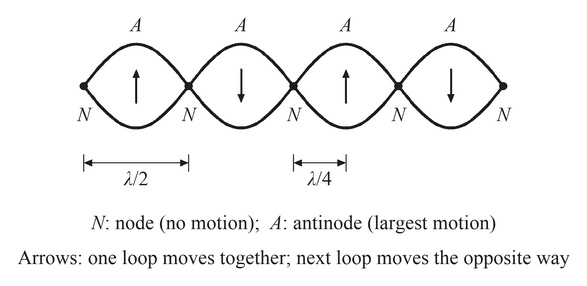
Step 2 — Look across a node. On crossing a node, changes sign, so particles in the next loop move in the opposite direction.
Therefore, in a stationary wave all the particles between two nodes vibrate in the same phase, option (B).