
Question 101 markMCQEasy
The phase difference between two particles situated on both the sides of a node is
Confirming your payment
Sign up now and get 250 free tokens.
Principle of Superposition of Waves · Question 10 of 86
The phase difference between two particles situated on both the sides of a node is
(A)
(B)
(C)
(D)
Answer: (C)
Concept: In a stationary wave the particles at the nodes stay at rest, and the particles between two neighbouring nodes (one loop) all move in the same phase, reaching their extreme positions together. Particles in neighbouring loops move in opposite phase. Node to node is and node to antinode is .
Step 1 — Look at the two sides of a node. The two particles lie in neighbouring loops, one on each side of the node, as the arrows in the figure show.
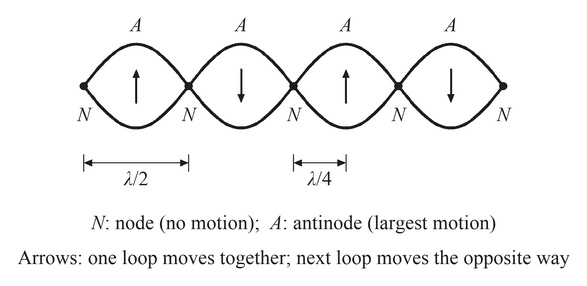
Step 2 — Compare their motion. When the particle on one side moves up, the particle on the other side moves down; they reach their extreme positions at the same time but on opposite sides. They are therefore in opposite phase.
Therefore, the phase difference between particles on the two sides of a node is , option (C).