
Question 672 marksEasy
Draw diagrams to show the loop formation in a vibrating tuning fork.
Confirming your payment
Sign up now and get 250 free tokens.
Principle of Superposition of Waves · Question 67 of 86
Draw diagrams to show the loop formation in a vibrating tuning fork.
Solution:
Concept: When a tuning fork vibrates in its fundamental mode, the two prongs move towards each other and then away from each other, and the stem moves up and down along its length. Points that hardly move are nodes; points that move most are antinodes.
Step 1 — Mark the nodes and antinodes. Two nodes N are formed near the bottom of the prongs, close to where they join the bend. The free ends of the prongs move the most, so antinodes A are formed at the tips.
Step 2 — Draw the loops. Each prong vibrates as one segment (loop) between a node near its base and the antinode at its tip; the dashed lines in the figure show the extreme positions of the prongs.
Step 3 — Show the stem. As the prongs move apart and together, the bend at the bottom rises and falls a little, so the stem moves up and down along its length; the stem is at an antinode of this motion.
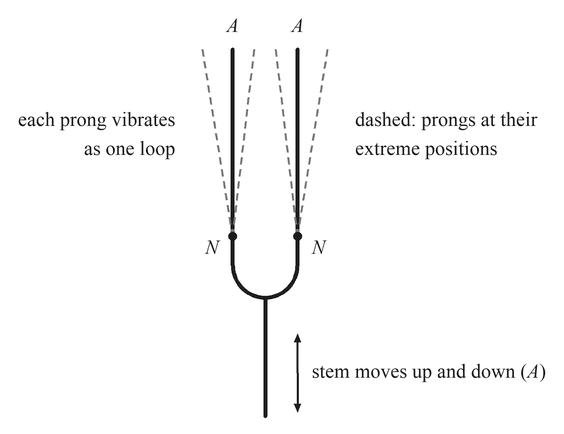
Therefore, in a vibrating tuning fork the nodes are formed near the base of the prongs and the antinodes at the tips of the prongs, each prong vibrating as one loop, while the stem moves up and down, as drawn in the figure.