
Question 682 marksMedium
Draw diagrams to show the various modes of vibration in (i) an open pipe and (ii) a closed pipe.
Confirming your payment
Sign up now and get 250 free tokens.
Principle of Superposition of Waves · Question 68 of 86
Draw diagrams to show the various modes of vibration in (i) an open pipe and (ii) a closed pipe.
Solution:
Concept: At an open end the air is free to move, so a displacement antinode A forms there; at a closed end the air cannot move, so a displacement node N forms there. Neighbouring nodes are apart, and a node and an antinode apart. is the length of the pipe and the speed of sound.
Step 1 — Draw the modes of the open pipe. Both ends are antinodes. The first three modes hold , and , so the frequencies are , and : all harmonics are present. These are drawn in part (a) of the figure.
(i) Open pipe:
Step 2 — Draw the modes of the closed pipe. The closed end is a node and the open end an antinode. The first three modes hold , and , so the frequencies are , and : only odd harmonics are present. These are drawn in part (b).
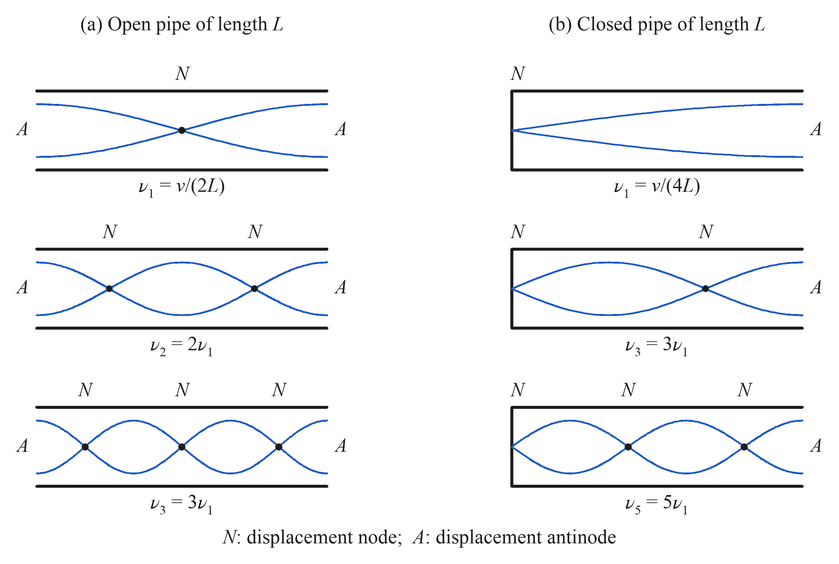
(ii) Closed pipe:
Therefore, an open pipe vibrates with antinodes at both ends and gives all harmonics (, , , …), while a closed pipe has a node at the closed end and gives only odd harmonics (, , , …), as drawn in the figure.