
Question 803 marksMedium
(a) Describe resonance column experiment to find the velocity of sound in air.
(b) How is end correction determined?
Confirming your payment
Sign up now and get 250 free tokens.
Principle of Superposition of Waves · Question 80 of 86
(a) Describe resonance column experiment to find the velocity of sound in air.
(b) How is end correction determined?
Solution:
Concept: The air column above the water in a tube is a pipe closed at the water surface. It resonates with a tuning fork of frequency held over its mouth when its effective length holds an odd number of quarter wavelengths; the antinode is a distance (the end correction) above the mouth.
(a) Step 1 — Describe the apparatus. A long glass tube, about 1 m long, is held vertically and joined at the bottom by a rubber tube to a water reservoir. Raising or lowering the reservoir raises or lowers the water level in the tube, so the length of the air column can be changed.
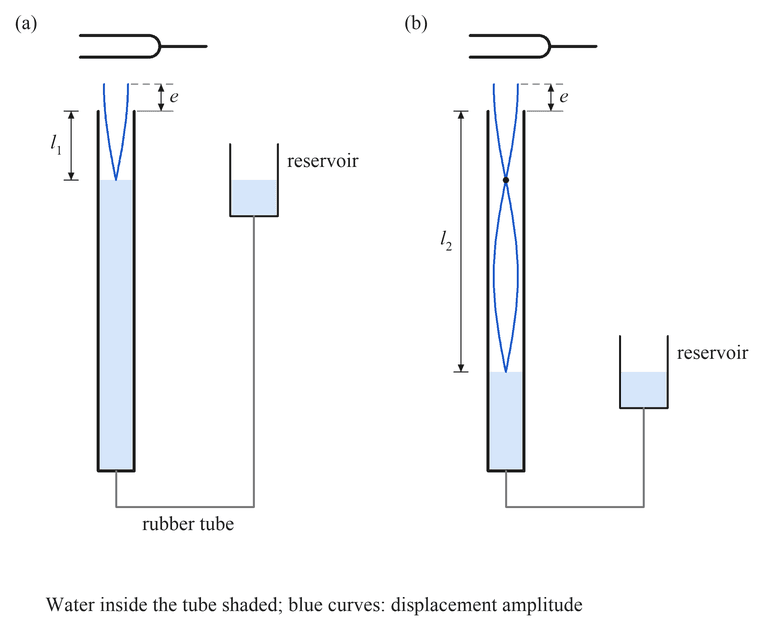
Step 2 — Find the first resonance. The tube is nearly filled with water. A tuning fork of frequency is struck and held horizontally over the mouth, and the water level is lowered slowly until the sound becomes loudest. The length of the air column (from the mouth to the water surface) is measured. The column then holds a quarter wavelength:
Step 3 — Find the second resonance. The water level is lowered further until the sound is loudest again, at the length . Now the column holds three quarter wavelengths:
Step 4 — Find the velocity of sound. Subtracting the first equation from the second removes :
Since :
The temperature of the air is noted, because the speed of sound depends on it.
(b) Step 5 — Find the end correction. Multiplying the first equation by 3 and comparing with the second:
The value can be checked against , where is the inner diameter of the tube.
Therefore, (a) the velocity of sound is found from the first two resonating lengths as , and (b) the end correction is found from the same two lengths as .