
Question 793 marksMedium
Explain how a sonometer is used to verify the laws of vibrations of stretched string.
Confirming your payment
Sign up now and get 250 free tokens.
Principle of Superposition of Waves · Question 79 of 86
Explain how a sonometer is used to verify the laws of vibrations of stretched string.
Solution:
Concept: The fundamental frequency of a stretched string is , where is the vibrating length, the tension and the mass per unit length. A string is in resonance with a tuning fork when its frequency equals that of the fork; it then vibrates strongly and a small paper rider placed on its middle is thrown off.
Step 1 — Describe the sonometer. A thin wire is fixed at one end of a hollow wooden box, passes over two movable bridges A and B and over a pulley, and is kept taut by a weight hanging from it, so . The length between the bridges is the vibrating length.
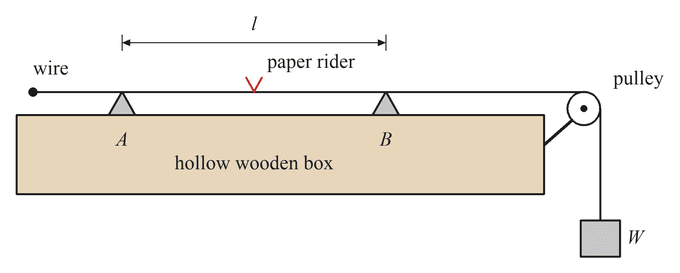
Step 2 — Verify the law of length (, and fixed). With a fixed load, a fork of frequency is struck and its stem pressed on the box. The bridge B is moved until the paper rider in the middle of AB flies off; the length is noted. This is repeated with forks of other frequencies In every case the product is found to be the same, for example:
The product is constant, so ; a graph of against is a straight line through the origin.
Step 3 — Verify the law of tension (, and fixed). One fork is used and the load is changed to ; for each load the resonating length is found. It is seen that is constant for a fixed frequency. Since at a fixed tension , this means that , so at a fixed length .
Step 4 — Verify the law of mass (, and fixed). One fork and one load are used with wires of different mass per unit length ; for each the resonating length is found. It is seen that stays constant; so at a fixed length.
Therefore, by finding the resonating length with the paper-rider method while changing one quantity at a time, the sonometer shows that , and stay constant, which verifies the laws , and .