Solution:
Concept: By the principle of superposition, the resultant displacement where waves overlap is the sum of their separate displacements, y=y1+y2. The intensity of a wave is proportional to the square of its amplitude.
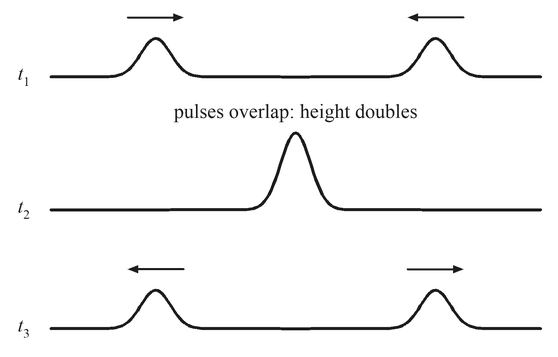
(a) Step 1 — Draw two identical pulses meeting. At t1 two identical upward pulses approach each other. At t2 they overlap exactly and their displacements add, giving one pulse of twice the height (constructive interference). At t3 they have passed through each other and move on unchanged.
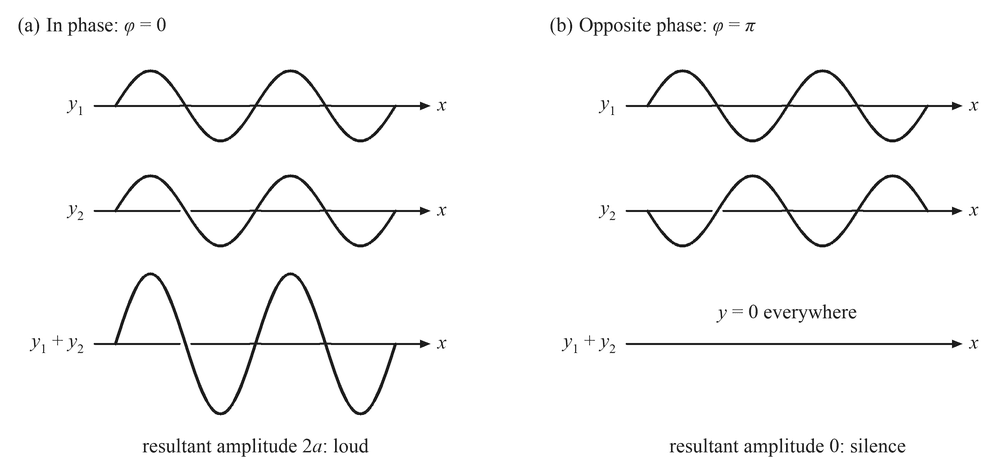
(b) Step 2 — Explain destructive interference. When two waves of equal amplitude and frequency meet in opposite phase (phase difference π), the crest of one falls on the trough of the other. At every point y2=−y1, so the resultant displacement is zero: the waves cancel. This is destructive interference. Part (b) of the figure shows it; part (a) shows the in-phase case for comparison.
(c) Step 3 — Write the two waves. Let the two waves at a point have the same angular frequency ω and a phase difference ϕ:
y1=A1sinωt
y2=A2sin(ωt+ϕ)
Step 4 — Add them. Expanding sin(ωt+ϕ) and collecting the sinωt and cosωt terms:
y=(A1+A2cosϕ)sinωt+A2sinϕcosωt
We write A1+A2cosϕ=Acosθ and A2sinϕ=Asinθ, so that y=Asin(ωt+θ), a wave of amplitude A.
Step 5 — Find the resultant amplitude. Squaring and adding the two defining equations:
A2=(A1+A2cosϕ)2+(A2sinϕ)2
A2=A12+A22+2A1A2cosϕ
Step 6 — Find the largest and smallest intensity. A is largest when cosϕ=1 and smallest when cosϕ=−1 (taking A1>A2):
Amax=A1+A2
Amin=A1−A2
Step 7 — Take the ratio of intensities. Since I∝A2:
IminImax=(A1−A2)2(A1+A2)2
Therefore, (a) two identical pulses add to a pulse of double height where they overlap and then pass on unchanged; (b) destructive interference is the cancellation of two waves meeting in opposite phase; (c) IminImax=(A1−A2)2(A1+A2)2.
