
Question 825 marksMedium
(a) What happens when two sound waves of equal frequencies and amplitude travelling in the same direction are superposed?
(b) Draw a diagram to show the formation of beats.
(c) Derive an expression for the beat frequency.
Confirming your payment
Sign up now and get 250 free tokens.
Principle of Superposition of Waves · Question 82 of 86
(a) What happens when two sound waves of equal frequencies and amplitude travelling in the same direction are superposed?
(b) Draw a diagram to show the formation of beats.
(c) Derive an expression for the beat frequency.
Solution:
Concept: When two sound waves are superposed, the resultant displacement is the sum of the separate displacements. If their frequencies are equal, their phase difference stays constant; if the frequencies differ slightly, the phase difference changes steadily with time, producing beats.
(a) Step 1 — Superpose two equal frequencies. Two waves of the same frequency and amplitude , travelling in the same direction with a constant phase difference , give a resultant wave of the same frequency with a steady amplitude . The sound is louder than either wave if they are nearly in phase, and silence results if they are in opposite phase (); its loudness does not change with time.
Note: If the two frequencies are only nearly equal, the phase difference changes with time and the loudness rises and falls periodically: beats, as in parts (b) and (c).
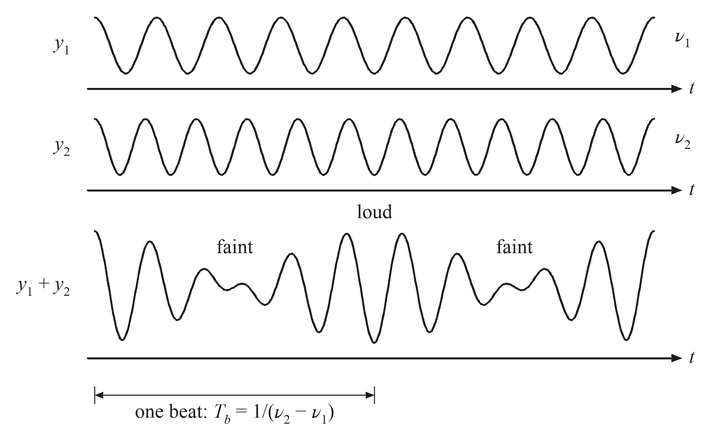
(b) Step 2 — Draw the formation of beats. The figure shows two waves of frequencies and (slightly different) and their sum: where they are in phase the sound is loud, where they are in opposite phase it is faint.
(c) Step 3 — Write the two waves at the ear. Let the waves have equal amplitude and frequencies :
Step 4 — Add them. We add the two waves with the identity :
This is a vibration of frequency whose amplitude, , changes slowly with time.
Step 5 — Find the times of maximum sound. The amplitude is largest, , when :
Step 6 — Find the times of minimum sound. The amplitude is zero when :
Step 7 — Find the beat frequency. Successive maxima (and successive minima) are separated by the time:
So the number of beats per second is:
Therefore, (a) equal frequencies give a steady sound whose loudness depends on the phase difference; (b) slightly different frequencies give loud and faint sounds in turn, as drawn; (c) the beat frequency equals the difference of the two frequencies, (the larger frequency minus the smaller).