Solution:
Concept: The sound wave sent into a pipe by the fork is reflected at the other end, and the incident and reflected waves form a stationary wave. At a closed end the air cannot move (displacement node N); at an open end it moves freely (displacement antinode A). The pipe resonates with the fork when its length fits one of these patterns. L is the length of the pipe (end correction neglected) and v the speed of sound.
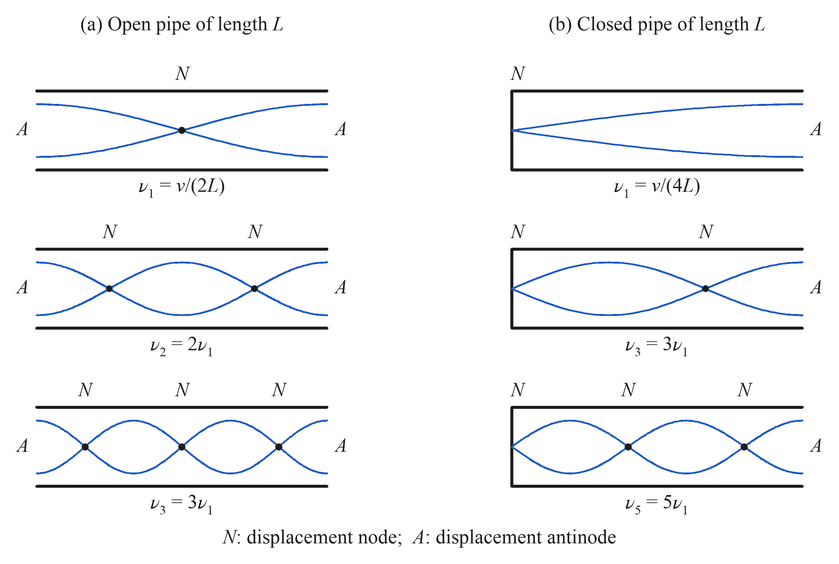
Step 1 — Find the fundamental of the closed pipe. The simplest pattern has a node at the closed end and an antinode at the mouth, so the pipe holds a quarter wavelength (part (b) of the figure):
L=4λ1
ν1=4Lv
Step 2 — Find the higher modes of the closed pipe. The next patterns hold 43λ,45λ,… In general L=(2n−1)4λn, so:
νn=4L(2n−1)v
νn=(2n−1)ν1
The frequencies are ν1,3ν1,5ν1,…: only odd harmonics.
Step 3 — Find the fundamental of the open pipe. Both ends are antinodes, with a node in the middle, so the pipe holds half a wavelength (part (a) of the figure):
L=2λ1
ν1=2Lv
Step 4 — Find the higher modes of the open pipe. The next patterns hold λ,23λ,… In general L=n2λn, so:
νn=2Lnv
νn=nν1
The frequencies are ν1,2ν1,3ν1,…: all harmonics.
Step 5 — Compare the two pipes. For the same length, the fundamental of an open pipe is twice that of a closed pipe, and the open pipe has the even harmonics as well, so its note is richer.
Therefore, (i) a closed pipe has fundamental 4Lv and higher harmonics 4L(2n−1)v (odd harmonics only), and (ii) an open pipe has fundamental 2Lv and higher harmonics 2Lnv (all harmonics), with the modes as drawn.
