Principle of Superposition of Waves · Question 84 of 86
When a wire of length l under a tension T is set in transverse vibration in its fundamental mode, the frequency of…
Question 845 marksMedium
When a wire of length l under a tension T is set in transverse vibration in its fundamental mode, the frequency of vibration is n. Describe experiments (one in each case) to determine the relation between (i)n and l when T is constant (ii)n and T when l is constant and state the relations you would expect to obtain.
Solution:
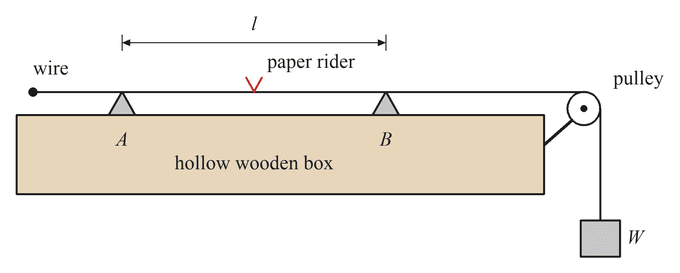
Concept: Both experiments use a sonometer: a wire stretched over two bridges on a hollow box, passing over a pulley and kept taut by a hanging load that fixes the tension T. The wire resonates with a tuning fork pressed on the box when its fundamental frequency equals the fork's; a paper rider on the middle of the wire is then thrown off. The expected result is n=2l1mT, where m is the mass per unit length.
(i)Step 1 — Set up the experiment for n and l. Keep the load (tension T) fixed. Take a set of tuning forks of known frequencies n1,n2,n3,…
Step 2 — Take the readings. Strike the first fork, press its stem on the box, and move one bridge until the paper rider flies off; measure the resonating length l1 between the bridges. Repeat with each fork to get l2,l3,…
Step 3 — State the relation. The product of frequency and resonating length is found to be the same for every fork, for example:
n1l1=n2l2
So a graph of n against l1 is a straight line through the origin, which means:
n∝l1
(ii)Step 4 — Set up the experiment for n and T. Keep the vibrating length l fixed by fixing the bridges. Take the same set of forks.
Step 5 — Take the readings. For each fork, change the load until the paper rider flies off, and note the tension T1,T2,T3,… at resonance.
Step 6 — State the relation. The ratio Tn is found to be the same for every fork, for example:
T1n1=T2n2
So a graph of n2 against T (or of n against T) is a straight line through the origin, which means:
n∝T
Therefore, (i) at constant tension the frequency is inversely proportional to the length, n∝l1, and (ii) at constant length it is proportional to the square root of the tension, n∝T.