
Question 291 markEasy
Draw a diagram to show the resultant of two harmonic waves of equal amplitude and wavelength.
Confirming your payment
Sign up now and get 250 free tokens.
Principle of Superposition of Waves · Question 29 of 86
Draw a diagram to show the resultant of two harmonic waves of equal amplitude and wavelength.
Solution:
Concept: By the principle of superposition, the displacement of the resultant wave at each point is the sum of the displacements of the two waves there. For and , the sum is .
Step 1 — Draw the two waves. The figure draws the two waves, of equal amplitude and equal wavelength, one below the other on the same scale; the second lags behind the first by .
Step 2 — Draw their sum. Adding the two displacements point by point gives the third curve: a wave of the same wavelength, with amplitude for this phase difference.
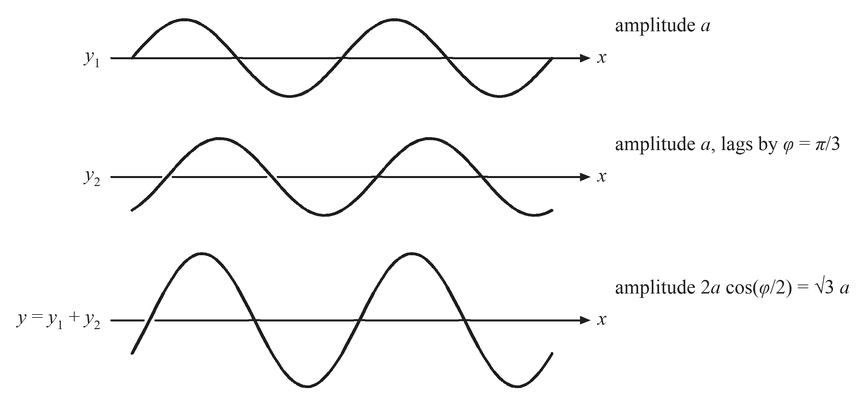
Step 3 — Note the special cases. In phase () the resultant amplitude is ; in opposite phase () the two waves cancel completely.
Therefore, the resultant of two harmonic waves of equal amplitude and wavelength is a harmonic wave of the same wavelength and of amplitude , where is their phase difference, as drawn in the figure.