
Question 331 markEasy
What happens when a transverse wave is reflected from a rigid surface?
Confirming your payment
Sign up now and get 250 free tokens.
Principle of Superposition of Waves · Question 33 of 86
What happens when a transverse wave is reflected from a rigid surface?
Solution:
Concept: At a rigid (fixed) boundary the medium cannot move, so the incident and reflected waves must add up to zero displacement there at every instant.
Step 1 — Apply the condition. To cancel the incident wave at the boundary, the reflected wave must have the opposite displacement there: it is reflected with a phase change of (or ).
Step 2 — Describe the result. A crest is reflected as a trough and a trough as a crest; a pulse comes back inverted, as part (i) of the figure shows.
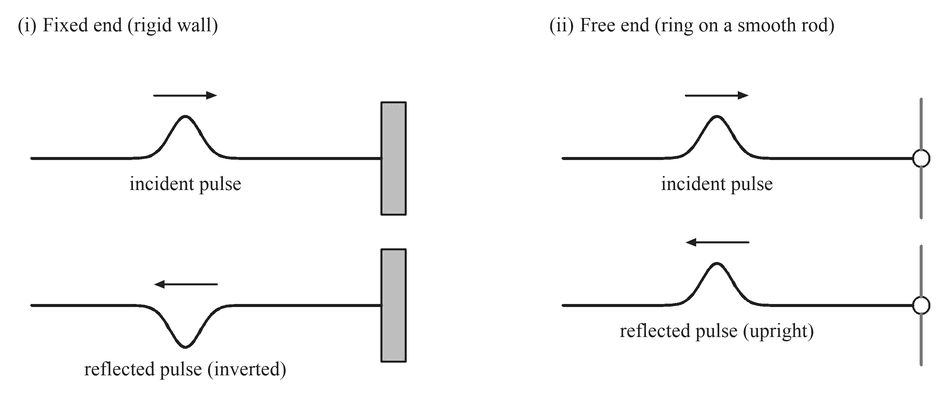
Therefore, on reflection from a rigid surface (a denser medium) a transverse wave undergoes a phase change of : a crest returns as a trough and a trough as a crest.