
Question 522 marksEasy
Draw a diagram to show the shape of a wave pulse on a string when it gets reflected from (i) fixed boundary and (ii) a free end boundary.
Confirming your payment
Sign up now and get 250 free tokens.
Principle of Superposition of Waves · Question 52 of 86
Draw a diagram to show the shape of a wave pulse on a string when it gets reflected from (i) fixed boundary and (ii) a free end boundary.
Solution:
Concept: At a fixed end the string cannot move, so the reflected pulse must cancel the incident pulse there: it comes back inverted (a phase change of ). At a free end (a light ring sliding on a smooth rod) the end can move freely, so the pulse comes back the same way up (no phase change).
Step 1 — Draw the fixed end. In part (i) of the figure, a pulse with its hump upward travels towards a rigid wall. After reflection it travels back with its hump downward: a crest comes back as a trough.
Step 2 — Draw the free end. In part (ii), the string is tied to a light ring that slides freely on a smooth vertical rod. The pulse comes back with its hump still upward: a crest comes back as a crest.
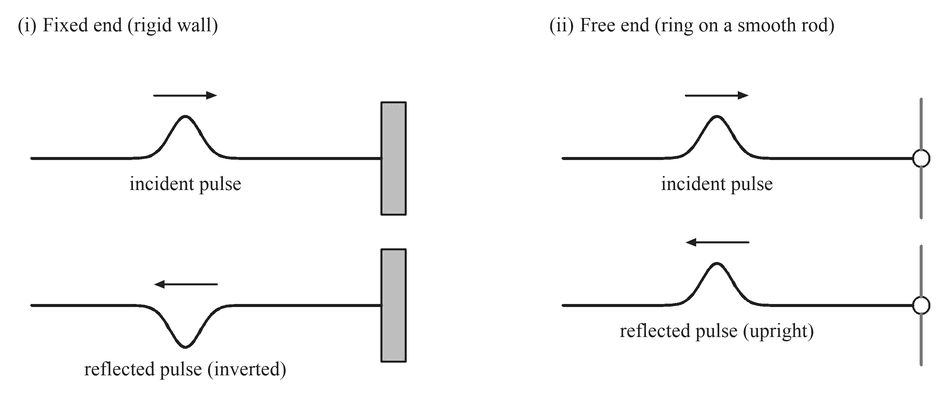
Therefore, (i) at a fixed boundary the reflected pulse is inverted (phase change ), and (ii) at a free end boundary it is reflected upright (no phase change), as drawn in the figure.