
Question 532 marksMedium
A longitudinal wave travels from a rarer medium to a denser medium and gets reflected. Draw a diagram to explain the reflection.
Confirming your payment
Sign up now and get 250 free tokens.
Principle of Superposition of Waves · Question 53 of 86
A longitudinal wave travels from a rarer medium to a denser medium and gets reflected. Draw a diagram to explain the reflection.
Solution:
Concept: At the boundary with a denser (more rigid) medium, the layer of the first medium at the boundary can hardly move. As with a transverse wave at a fixed end, the displacement is reflected with a phase change of ; for a longitudinal wave this means that a compression comes back as a compression and a rarefaction as a rarefaction.
Step 1 — Draw the incident compression. In the upper part of the figure, the vertical lines are layers of the rarer medium (air); where they are crowded together there is a compression C, moving towards the boundary with the denser medium.
Step 2 — Explain what happens at the boundary. When C reaches the boundary, the layers pushed against the denser medium cannot move it much, so they are squeezed even more and push back. The squeezed region starts moving back into the rarer medium.
Step 3 — Draw the reflected wave. In the lower part, the reflected wave travels away from the boundary with C still a compression.
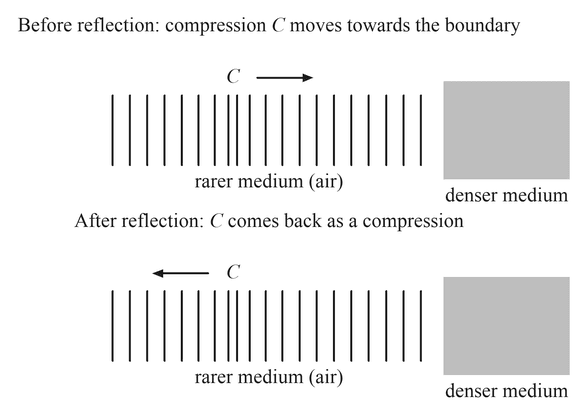
Therefore, when a longitudinal wave is reflected from a denser medium, a compression is reflected as a compression (and a rarefaction as a rarefaction), as the figure shows; the displacement of the layers is reversed (phase change ).