
Question 752 marksEasy
“In a resonance column experiment, when the length of the air column is increased by changing the water level, sound heard becomes louder.” Why?
Confirming your payment
Sign up now and get 250 free tokens.
Principle of Superposition of Waves · Question 75 of 86
“In a resonance column experiment, when the length of the air column is increased by changing the water level, sound heard becomes louder.” Why?
Solution:
Concept: The air column above the water acts as a pipe closed at one end. Its natural frequency is , where is the length of the air column, the end correction and the speed of sound. When this natural frequency equals the frequency of the tuning fork held over the mouth, the air column vibrates with the largest amplitude: resonance.
Step 1 — Follow the natural frequency. As the water level is lowered, the length of the air column increases and its natural frequency decreases, coming closer to the frequency of the fork.
Step 2 — Explain the loud sound. At the length , the natural frequency of the air column equals that of the fork. Resonance occurs: the air column vibrates with a large amplitude and the sound becomes loud. It is loud again at , where the column resonates in its next mode.
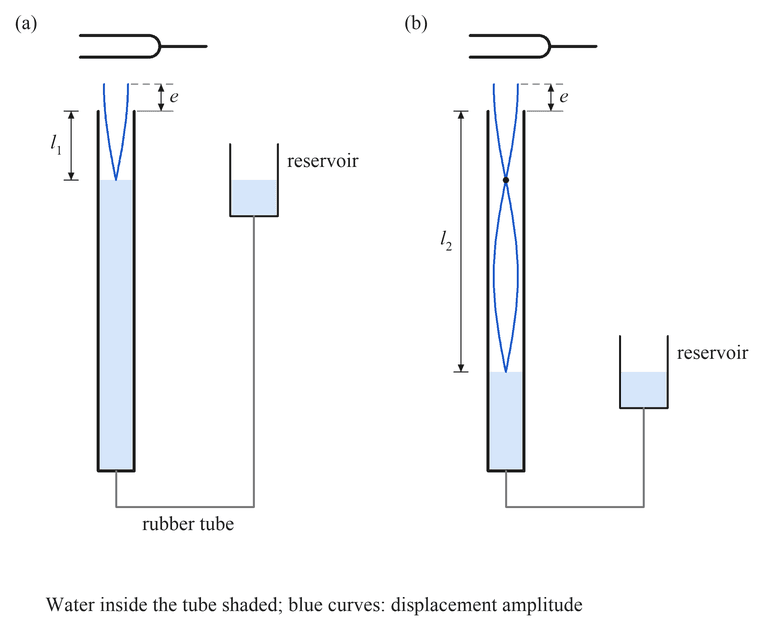
Note: The book's hint says that the second mode of a closed pipe has three times the fundamental frequency; this is why the second resonance comes at , but the sound becomes louder because of resonance.
Therefore, as the air column is lengthened its natural frequency approaches that of the tuning fork, and when they become equal the air column resonates, vibrating with a large amplitude, so the sound heard becomes louder.