Solution:
Concept: Waves pass through one another without being changed. Where they overlap, each particle of the medium is displaced by every wave at the same time.
Step 1 — State the principle. When two or more waves travel through the same part of a medium at the same time, the resultant displacement of any particle at any instant is the algebraic sum of the displacements it would have because of each wave separately:
y=y1+y2
After crossing, each wave moves on with its own shape and speed, as if the other had never been there.
Step 2 — Explain two identical pulses. The figure shows two identical upward pulses on a string moving towards each other (t1). When they overlap exactly (t2), the displacements add at every point, so the string has a single pulse of twice the height: constructive interference. Later (t3) the two pulses have passed through each other and move on unchanged.
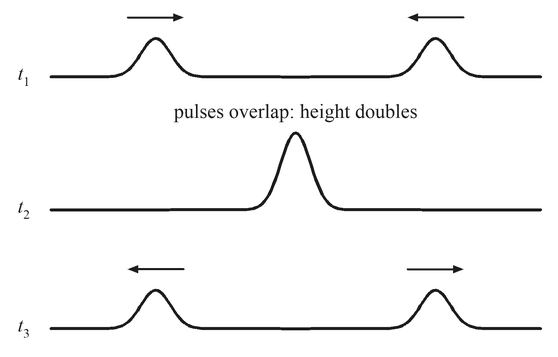
(i) Identical pulses add to a pulse of double height where they overlap, then separate unchanged.
Step 3 — Explain two equal and opposite pulses. Now one pulse is upward and the other an equal downward pulse (t1). When they overlap exactly (t2), the displacement y1 of one is cancelled by y2=−y1 of the other at every point, so the string is momentarily flat: destructive interference. The string is still moving at that instant (its energy is then all kinetic), so the pulses reappear and move on unchanged (t3).
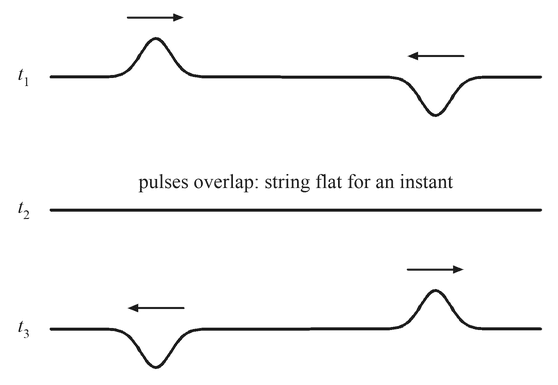
(ii) Equal and opposite pulses cancel completely for an instant where they overlap, then separate unchanged.
Therefore, by the principle of superposition the resultant displacement is the sum y1+y2: (i) two identical pulses give a pulse of double height where they overlap, and (ii) two equal and opposite pulses make the string flat for an instant; in both cases the pulses then move on unchanged.
