
Opening your dashboard
Class 11 Physics Chapter 25 Principle of Superposition of Waves: Practice Questions
157 questions on Chapter 25, each worked through on its own page with the AI tutor. Class 11 Physics, ICSE 2026-27.
157 questions
1–4 marks · Mixed difficulty
- 13 marks
Question 1
Two rectangular pulses travel towards each other along a long stretched rope. At , pulse P gives a displacement of to the part of the rope from to and moves in the direction, while pulse Q gives a displacement of to the part from to and moves in the direction, as shown in the figure. Each pulse moves at . (Hypothetical data.)
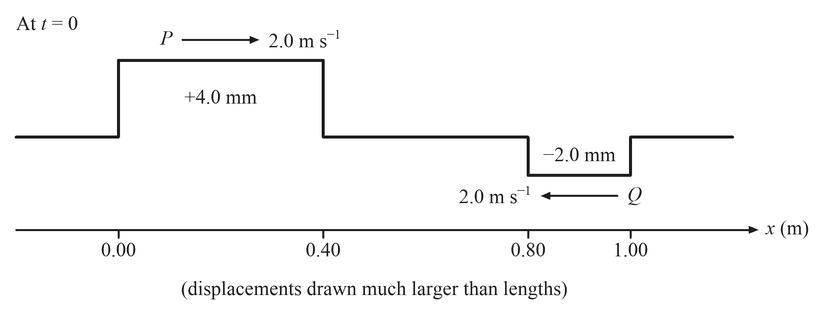
(i) At what time do the two pulses begin to overlap?
(ii) Describe the displacement of the rope between and at .
(iii) At what time are the two pulses completely separated again, and what are their shapes after that?
- 21 mark
Question 2
Two coherent sound waves of the same frequency overlap throughout a region. At every place in the region the first wave on its own would give an intensity and the second on its own an intensity , while the phase difference between them changes steadily from place to place and takes all values equally often. The average intensity over the region is
- 33 marks
Question 3
Noise-cancelling headphones use a small microphone to pick up a steady drone and a tiny speaker that sends out an "anti-noise" wave of the same frequency and the same amplitude. The anti-noise is meant to reach the ear exactly half a cycle out of step with the drone. In one test the drone has a frequency of , and the electronics delay the anti-noise by an extra beyond the ideal timing. (Hypothetical data.)
(i) What phase difference between the drone and the anti-noise gives complete cancellation?
(ii) Find the extra phase difference caused by the delay.
(iii) Find the amplitude of the sound left at the ear as a fraction of the amplitude of the drone, and the fraction of the drone's intensity that remains.
- 41 mark
Question 4
The graphs show, on the same time scale, the displacements and that two sound waves of the same frequency and the same amplitude, , would each produce at a point in the air; is their period. (Hypothetical data.)
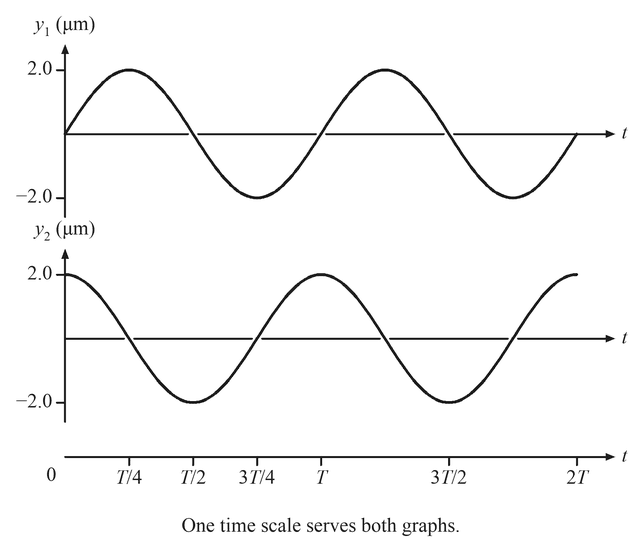
When both waves arrive together, the resultant displacement at the point is a wave of the same frequency with
- 53 marks
Question 5
At a point in a room, a sound of frequency on its own would give the air particles a displacement , and a second sound of frequency on its own would give , with in seconds. Both sounds reach the point together. (Hypothetical data.)
(i) Find the resultant displacement of an air particle at the point at and at .
(ii) After what shortest time does the pattern of the resultant displacement repeat itself?
(iii) Is the resultant motion of the air particle simple harmonic? Give a reason.
- 61 mark
Question 6
The principle of superposition says that the resultant displacement is the algebraic sum of the displacements that the individual waves would produce. In which of the following situations is this principle NOT expected to hold well?
- 73 marks
Question 7
Two coherent sound waves of the same frequency reach a microphone from two loudspeakers. When the two waves arrive in phase, the amplitude of the resultant pressure variation is ; when they arrive exactly out of phase, it is . (Hypothetical data.)
(i) Find the pressure amplitude of each wave on its own.
(ii) Find the ratio of the intensities of the two waves.
(iii) Find the amplitude of the resultant when the two waves arrive with a phase difference of .
- 81 mark
Question 8
Two tuning forks have exactly the same frequency. They are struck and sounded together near a listener, who stays in one place. Neglecting the slow dying away of the sound, what does the listener hear?
- 93 marks
Question 9
Two sound waves of frequencies and reach a listener together. At the listener, the first wave on its own has a pressure amplitude of and the second on its own has . (Hypothetical data.)
(i) How many times per second is the sound at its loudest?
(ii) At the two waves are exactly in phase at the listener. At what time is the sound next at its faintest?
(iii) Find the ratio of the intensity at the loudest moments to the intensity at the faintest moments. Is the sound ever completely silent?
- 103 marks
Question 10
Two tuning forks of frequencies and are sounded together, and each gives the same amplitude at the listener. (Hypothetical data.)
(i) Using the principle of superposition, show that the listener's eardrum vibrates at a single frequency whose amplitude changes slowly with time, and find that frequency.
(ii) Find the time between two successive moments of greatest loudness.
(iii) How many vibrations does the eardrum make between two successive moments of greatest loudness?
- 113 marks
Question 11
A violinist tunes the E string of a violin against the A string, which sounds . The violinist wants the two strings to form a pure fifth, a frequency ratio of exactly . Bowing both strings together, the violinist hears beats per second, which come from the third harmonic of the A string and the second harmonic of the E string. The violinist knows that the E string is a little above . (Hypothetical data.)
(i) Find the frequency of the E string.
(ii) What frequency should the E string have, and should it be raised or lowered?
(iii) Why does the violinist listen for beats between these harmonics rather than between the fundamental notes of the two strings?
- 121 mark
Question 12
A twin-engine aircraft has a three-bladed propeller on each engine, and each propeller gives a strong hum at its blade-passing frequency (the number of blades passing a fixed point each second). One engine turns at 2400 revolutions per minute and the other at 2430 revolutions per minute. (Hypothetical data.) The beat (throb) frequency heard in the cabin is
- 131 mark
Question 13
When two waves of the same amplitude and frequencies and (with ) superpose, the resultant can be written as . The factor repeats itself only after a time , yet the number of beats heard per second is . The reason is that
- 144 marks
Question 14
A stationary wave on a stretched string is described by , where is in metres and is in seconds. (Hypothetical data.)
(i) Write the equations of the two travelling waves whose superposition gives this stationary wave, and state the direction in which each one travels.
(ii) Find the greatest speed of the particle of the string at .
(iii) Find the first instant after at which the whole string is straight.
- 151 mark
Question 15
In a stationary wave on a string, N is a node. Point P of the string is at a distance from N, and point Q is at a distance from N on the same side, where is the wavelength of the travelling waves. The particle at P vibrates with an amplitude of . (Hypothetical data.) At an instant when P is at its greatest displacement on the positive side, , the displacement of Q is
- 163 marks
Question 16
The figure shows a string, fixed at both ends A and B, vibrating in a stationary wave at an instant when every particle is at its greatest displacement. The string is long, the greatest displacement is , and the frequency of vibration is . (Hypothetical data.)
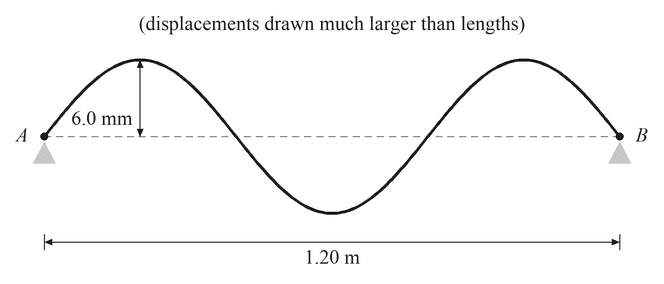
(i) Find the wavelength and the speed of the travelling waves on the string.
(ii) Draw the shape of the string and after the instant shown.
(iii) State the displacement of the particle at the middle of the string at each of these two later instants.
- 171 mark
Question 17
A string fixed at both ends vibrates in a stationary wave. At an instant when the whole string is momentarily straight,
- 183 marks
Question 18
A small loudspeaker faces a hard, flat wall and sends a steady note towards it. A pressure microphone is moved slowly along the line from the loudspeaker to the wall, as shown in the figure. Its reading rises and falls, and the places of minimum reading are apart. The speed of sound in the air is . (Hypothetical data.)
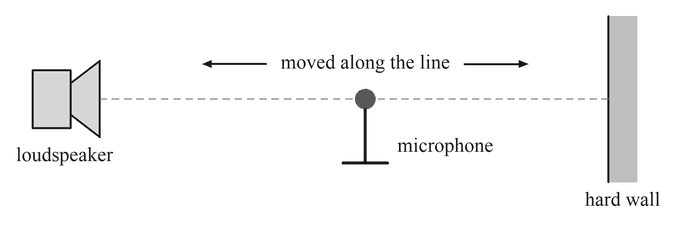
(i) Explain why the reading rises and falls along the line.
(ii) Find the frequency of the note.
(iii) At the hard wall the air particles cannot move. How far from the wall is the minimum reading nearest to it?
- 191 mark
Question 19
Two waves and travel in opposite directions along a long string and form a stationary wave. The point of the string is
- 203 marks
Question 20
A string long is fixed at both ends, and transverse waves travel along it at . (Hypothetical data.)
(i) Find the frequencies of its fundamental and of its first two overtones.
(ii) An electrically driven vibrator of frequency is attached to the string near one end. Can a stationary wave of large amplitude form on the string? Give a reason.
(iii) The frequency of the vibrator is then slowly raised from . At what frequency does the string next show a stationary wave of large amplitude, and how many loops does it have?
- 213 marks
Question 21
One end of a string long is tied to a rigid support. The other end is tied to a light ring that can slide without friction on a smooth vertical rod, as shown in the figure, so the string stays taut but that end is free to move up and down. Transverse waves travel along the string at . (Hypothetical data.)
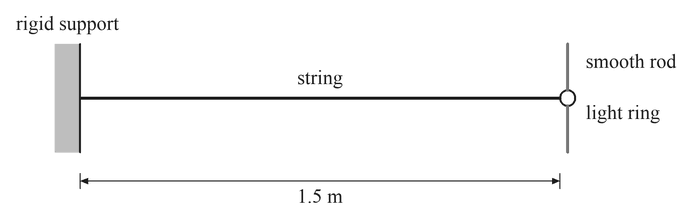
(i) Find the three lowest frequencies at which stationary waves can form on the string.
(ii) Name the first and second overtones of this string as harmonics of its fundamental.
(iii) Explain why a stationary wave of frequency cannot form on this string.
- 223 marks
Question 22
A violin string vibrates over a length of between its fixed ends, and its fundamental frequency is . A violinist bows the string while touching it very lightly with a fingertip at a point from one end, so that this point is forced to stay still while the rest of the string vibrates. (Hypothetical data.)
(i) Find the lowest frequency the string can now sound. Which harmonic and which overtone of the string is this?
(ii) The string is now touched lightly at its mid-point instead. Find the lowest frequency it can sound, and explain why this is not the note found in (i), even though the mode in (i) also has a node at the mid-point.
- 231 mark
Question 23
The figure shows a string, fixed at both ends, vibrating in one of its modes at . (Hypothetical data.)

The frequency of the second overtone of this string is
- 242 marks
Question 24
A note played on a violin has a fundamental frequency of . Assume that its sound contains every harmonic of this note. A young listener can hear sounds up to about . (Hypothetical data.)
(i) How many harmonics of the note, counting the fundamental, can the listener hear?
(ii) Name the highest audible one as an overtone.
- 251 mark
Question 25
A string fixed at both ends is first made to vibrate in its fundamental mode and then, with the same tension, in its third harmonic. Compared with the fundamental mode, in the third harmonic the travelling waves on the string have
- 261 mark
Question 26
A sonometer wire vibrating in its fundamental mode has frequency . Which one of the following changes will make its fundamental frequency ? (In each option, everything that is not mentioned stays the same.)
- 273 marks
Question 27
A student wants to find out which metal a sonometer wire is made of. The diameter of the wire, measured with a screw gauge, is , and the wire is stretched by a load of . With a tuning fork of frequency , the wire resonates in its fundamental mode when the bridges are apart, as shown in the figure. Take . (Hypothetical data.)
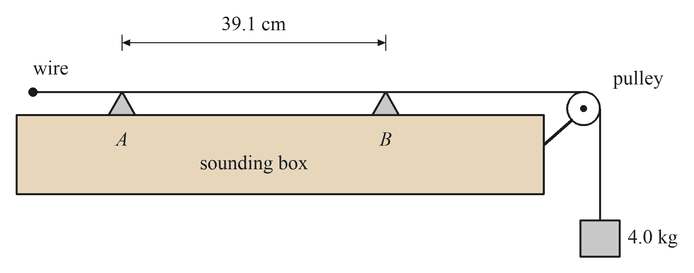
(a) Find the mass per unit length of the wire.
(b) Find the density of its material, and say which of these metals it is most likely to be: aluminium (), steel () or copper ().
- 281 mark
Question 28
In Melde's experiment the fork is first set up in the transverse arrangement (prongs vibrating at right angles to the string), as shown, and the string of length vibrates steadily in loops.
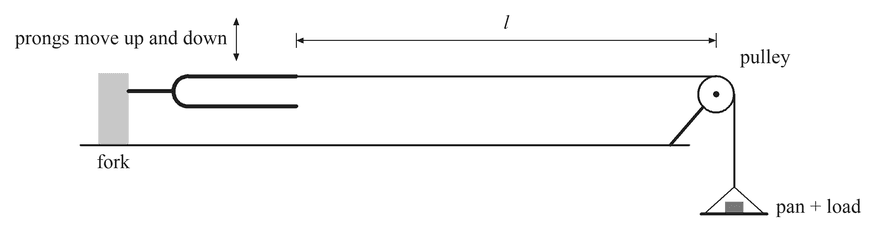
The pulley is now moved so that the length of the string becomes , the load in the pan is left unchanged, and the fork is turned to the longitudinal arrangement (prongs vibrating along the string). The number of loops now is
- 293 marks
Question 29
A steel sonometer wire of mass per unit length is set vibrating by a small electromagnet placed under its middle, as shown. The electromagnet runs on the a.c. mains. When the bridges are apart, the wire vibrates strongly in its fundamental mode. (Hypothetical data.)
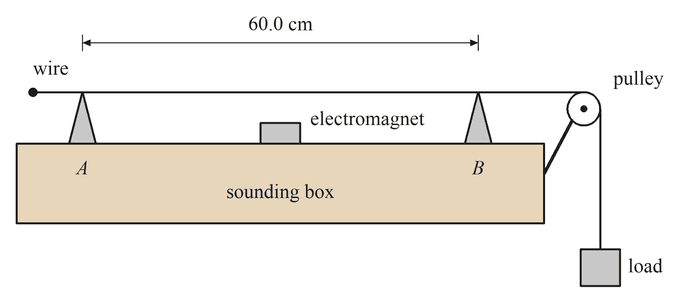
(a) Explain why the wire vibrates at and not at .
(b) Find the tension in the wire.
(c) A student who assumed that the wire vibrates at would get a wrong tension. Find this wrong value and say how many times too small it is.
- 301 mark
Question 30
In a sonometer experiment the tension is kept fixed, and the resonating length of the wire (fundamental mode) is found for several tuning forks of frequency . The graph of against is a straight line through the origin, as shown. The mass per unit length of the wire is . (Hypothetical data.)
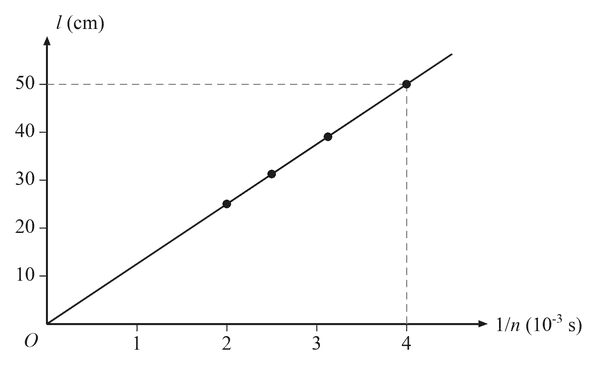
The tension in the wire is
- 314 marks
Question 31
In Melde's experiment, a light thread is tied to one prong of an electrically maintained tuning fork of frequency , passes over a pulley away and carries a pan. With the fork in the transverse arrangement and a total hanging mass (pan and weights) of , the thread vibrates steadily in 5 loops, as shown. Take . (Hypothetical data.)
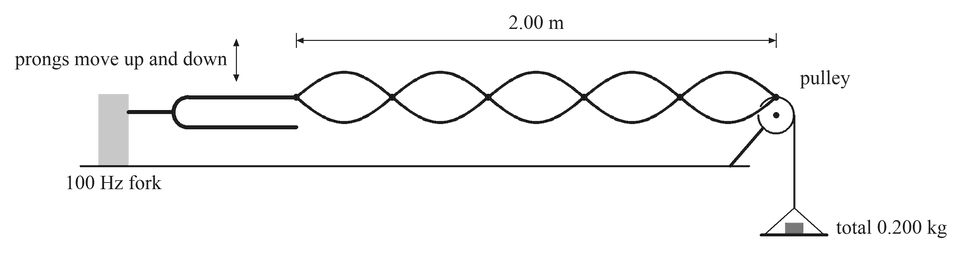
(a) Find the mass per unit length of the thread.
(b) The fork is turned to the longitudinal arrangement and the load is not changed. Explain why the thread no longer shows a steady pattern of loops.
(c) What total hanging mass would make the thread vibrate steadily in 2 loops in the longitudinal arrangement?
- 321 mark
Question 32
A pipe open at both ends has a fundamental frequency of . One of its ends is now closed, and the pipe is made to resonate again. Ignore end corrections. Which one of the following frequencies can the pipe NOT produce after the end is closed?
- 333 marks
Question 33
A pipe long is closed at one end. A loudspeaker near its open end produces a note. A tiny, very light feather on the end of a thin wire can be slid along inside the pipe, as shown; the feather flutters when the air around it moves to and fro. The speed of sound is ; ignore the end correction. (Hypothetical data.)
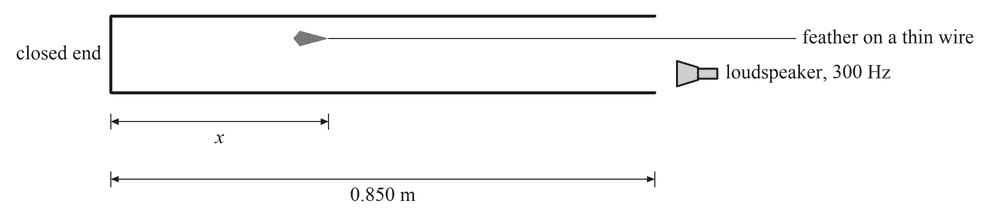
(a) Show that the air column resonates at , and name the harmonic.
(b) At what distances from the closed end does the feather flutter most, and where does it hardly move?
- 341 mark
Question 34
An open organ pipe long is found to have a fundamental frequency of when the speed of sound is . The difference from the value expected for a air column is due to the end correction, times the internal diameter at each open end. (Hypothetical data.) The internal diameter of the pipe is about
- 351 mark
Question 35
The ear canal of an adult is roughly a tube about long, open at the outer end and closed at the inner end by the eardrum. Treating it as a pipe closed at one end and taking the speed of sound as , its lowest resonant frequency is about
- 363 marks
Question 36
The figure shows the displacement amplitude of the air particles in a resonating pipe of length ; the left end of the pipe is closed. The speed of sound is ; ignore the end correction. (Hypothetical data.)

(a) How many displacement nodes and antinodes are there, and which harmonic (and which overtone) is this?
(b) Find the wavelength and the frequency of the note.
(c) What is the next higher frequency at which this pipe can resonate?
- 373 marks
Question 37
A flute behaves like a pipe open at both ends, while a clarinet behaves like a pipe closed at one end (the reed end). Suppose each has an effective air-column length of when all its holes are covered, and take the speed of sound as . (Hypothetical data.)
(a) Find the lowest note (fundamental frequency) of each instrument.
(b) When a player blows harder (“overblows”), the instrument jumps to its next possible resonance. Find the frequency each instrument jumps to, and compare it with that instrument's fundamental.
- 381 mark
Question 38
In a resonance-tube experiment done in a laboratory at with a fork, the first and second resonances occur at air-column lengths of and , as shown. (Hypothetical data.)
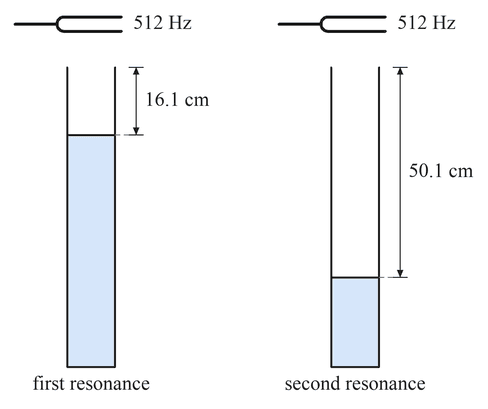
The speed of sound in air at worked out from these readings is about
- 393 marks
Question 39
A resonance tube has an internal diameter of . With a fork the first resonance occurs when the air column is long; with a second fork of unknown frequency it occurs at , as shown. Take the end correction as . (Hypothetical data.)
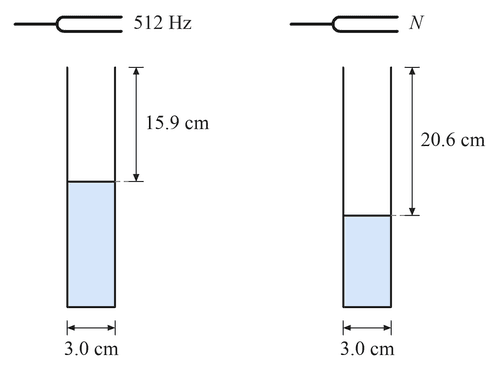
(a) Find the speed of sound in the tube.
(b) Find .
(c) Predict the air-column length at the second resonance with the unknown fork.
- 403 marks
Question 40
In a resonance-tube experiment with a fork, a student finds the first resonance at an air-column length of , as shown. The internal diameter of the tube is . The student forgets the end correction and takes . (Hypothetical data.)
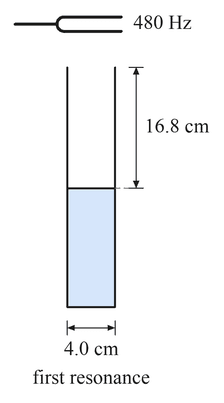
(a) Find the value of the student gets.
(b) Taking the end correction as , find the correct value of and the percentage error in the student's value.
(c) Where should the second resonance occur? Show that using both resonances, with , removes the need to know the end correction.
- 411 mark
Question 41
With a tuning fork of frequency , the first resonance of a resonance tube occurs at an air-column length of . The end correction of the tube is . The fork is replaced by one of frequency , as shown.
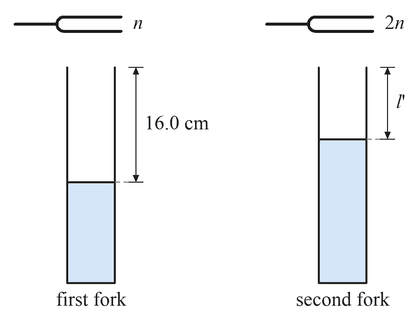
The first resonance with the new fork occurs at an air-column length of
- 423 marks
Question 42
A resonance tube is long and has an internal diameter of ; its water level can be set anywhere from the top to the bottom. A tuning fork of frequency is held over its mouth, as shown. The speed of sound is ; take the end correction as . (Hypothetical data.)
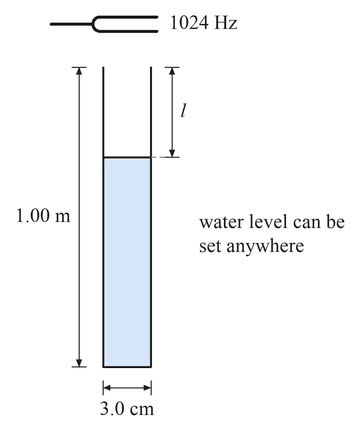
(a) Find the wavelength of the sound.
(b) Find all the air-column lengths at which resonance occurs, and say how many resonances can be found with this tube.
- 431 mark
Question 43
The figure shows a resonance tube at its first resonance with a tuning fork.
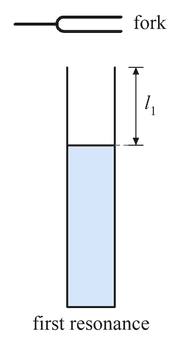
Which one of the following changes would make the first resonance occur at a longer air column ?
- 441 mark
Question 44
An aluminium rod long is clamped at its middle and stroked along its length, so that it vibrates longitudinally, as shown. The speed of sound in aluminium is .
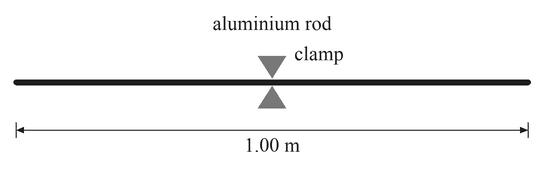
The frequency of the first overtone of the rod is
- 453 marks
Question 45
The frequency of a tuning fork is given by , where is the length of each prong, its thickness, the elastic modulus and the density of the material, and is a constant. A steel fork X, with prongs as shown, has a frequency of . (Hypothetical data.)
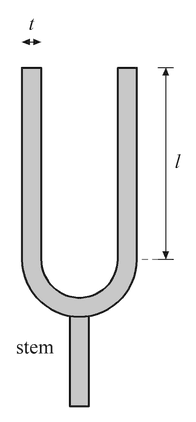
(a) Fork Y is made of the same steel, with prongs of the same thickness but shorter. Find its frequency.
(b) Fork Z is an exact copy of X made times larger in every dimension. Find its frequency.
(c) Using the formula, say whether filing a little metal off the free ends of the prongs raises or lowers the frequency of a fork.
- 461 mark
Question 46
The frequency of a steel tuning fork falls very slightly when the fork becomes warmer. Using (with the prong length, its thickness, the elastic modulus and the density), the main reason is that
- 473 marks
Question 47
In a Kundt's tube experiment, a brass rod long, clamped at its middle, is stroked so that it vibrates longitudinally in its fundamental mode. A light disc on its end sets the gas in a glass tube vibrating, and fine powder collects in heaps at the displacement nodes, as shown. With air in the tube the heaps are apart; when the air is replaced by carbon dioxide (same rod), they are apart. The speed of sound in air is . (Hypothetical data.)
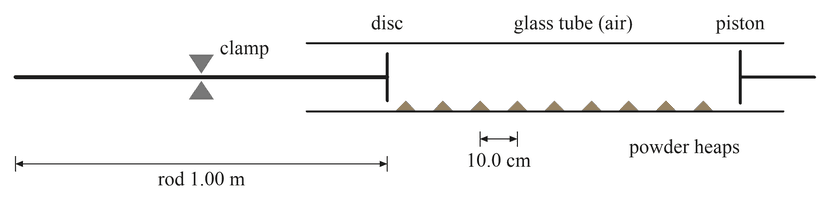
(a) Find the frequency of the rod's vibration.
(b) Find the speed of sound in brass.
(c) Find the speed of sound in carbon dioxide.
- 483 marks
Question 48
A metal rod of length , in which sound travels at speed , vibrates longitudinally. Wherever it is clamped there is a displacement node, and each free end is a displacement antinode. The rod is clamped at one end only, as shown.

(a) Find the wavelength and the frequency of its fundamental mode.
(b) Find the frequencies of its first and second overtones, and say which harmonics they are.
(c) If the same rod were clamped at its middle instead, how would its fundamental frequency compare with that in (a)?
- 492 marks
Question 49
‘In a sound wave, a displacement node is a pressure antinode and vice versa’. Why?
- 502 marks
Question 50
“The reverberation time is larger for an empty hall than a crowded hall”. Why?
- 512 marks
Question 51
“A violin note and a sitar note may have the same frequency, yet we can distinguish between the two notes.” Why?
- 522 marks
Question 52
“Solids can support both longitudinal and transverse waves, but only longitudinal waves can propagate in gases.” Why?
- 532 marks
Question 53
“Ocean waves hitting a beach are always found to be nearly normal to the shore.” Why?
- 541 mark
Question 54
“The shape of a pulse gets distorted during propagation in a dispersive medium.” Why?
- 552 marks
Question 55
Given below are some examples of wave motion. State in each case if the wave motion is transverse, longitudinal or a combination of both.
(i) Motion of a kink in a long coil spring, produced by displacing one end of the spring sideways.
(ii) Waves produced in a cylinder containing a liquid, by moving its piston back and forth.
(iii) Waves produced by a motorboat sailing in water.
(iv) Light waves travelling from the Sun to the Earth.
(v) Ultrasonic waves in air, produced by a vibrating quartz crystal.
- 562 marks
Question 56
Explain why sound produced by a vibrating tuning fork becomes louder when its stem is placed in contact with the table?
- 572 marks
Question 57
The fundamental frequency of a cylindrical tube, open at both ends, is in air. If half of the tube is dipped vertically in water, what is the new fundamental frequency?
- 581 mark
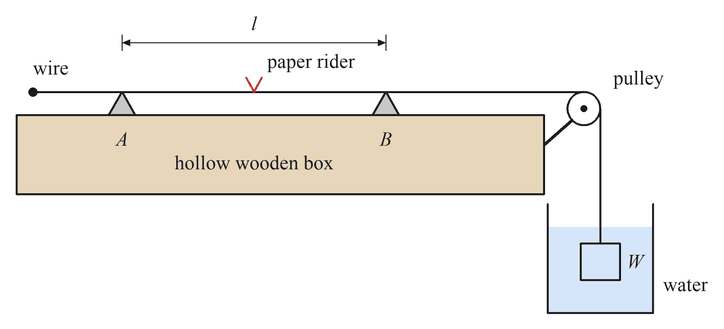
Question 58
What will happen to the frequency of a sonometer wire if the weight stretching the sonometer wire is dipped in water?
- 592 marks
Question 59
Two organ pipes of same length, open at both ends, produce sound of different frequencies if their radii are different. Why?
- 602 marks
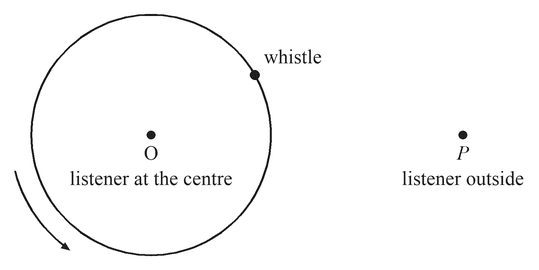
Question 60
A whistle is rotated in a horizontal circle. Is there any change in the sound of the whistle, heard by a person standing (i) at the centre of the circle and (ii) outside the circle?
- 612 marks
Question 61
Give the relationship between the fundamental note and overtone in closed pipe.
- 622 marks
Question 62
Give the relationship between the fundamental note and the overtone in an open pipe.
- 633 marks
Question 63
Two superposing waves are represented by the following equations.
and
Calculate the ratio of maximum intensity to minimum intensity.
- 643 marks
Question 64
Two periodic waves of intensities and pass through a region at the same time and in the same direction. Calculate the sum of the maximum and minimum intensities.
- 653 marks
Question 65
String of mass 2.50 kg is under tension of 200 N. The length of the stretched string is 20.0 m. If a tuning fork is struck at one end of the string, how long does the disturbance take to reach the other end?
- 663 marks
Question 66
A steel wire has a length of 12.0 m and a mass of 2.10 kg. What should be the tension in the wire, so that the speed of transverse wave on the wire equals the speed of sound in dry air at 20°C (i.e., )?
- 673 marks
Question 67
A wire of radius m and length 2 m is stretched by a force of 50 N. Calculate the fundamental frequency of the note emitted by it. Density of wire is .
- 683 marks
Question 68
A string when stretched with a force of 18 kg, it produces a note of frequency 652 Hz. What is the force required to produce an octave of the note?
- 693 marks
Question 69
When the tension of a sonometer is increased by 4.5 kg, the pitch of the note emitted by a given length of the wire increases in the ratio 4 : 5. Calculate the original tension in the wire.
- 703 marks
Question 70
Two strings (1) and (2) of equal thickness are made up of the same material. The length of the first string (1) is half that of the second string (2), while tension in (1) is twice that in the string (2). Compare the velocities of the transverse waves on them.
- 713 marks
Question 71
A wire stretched between two rigid supports, vibrates in fundamental mode with a frequency 45 Hz. The mass of the wire is kg and its linear density is . What is (a) the speed of transverse wave on the string and (b) the tension in the string?
- 723 marks
Question 72
A sitar wire 1 m long emits a note of frequency 480 Hz. How far from the top it may be pressed to get a note of frequency 512 Hz.
- 733 marks
Question 73
A wire 0.5 m long vibrates 100 times a second. If the length of the wire is shortened to 0.4 m and the stretching force is increased to 4 times, its original value, what will be the new frequency?
- 743 marks
Question 74
Three strings of equal lengths but stretched with different tensions are made to vibrate. If their masses per unit length are in the ratio 1 : 2 : 3 and the frequencies are the same, calculate the ratio of the tensions.
- 753 marks
Question 75
An open-end organ pipe is 0.50 m long. If the velocity of sound is , find the frequency of the fundamental note.
- 763 marks
Question 76
What will be the wavelength and pitch of the note emitted by a closed organ pipe 32.4 cm long at 0°C, if the velocity of sound in air at 0°C is .
- 773 marks
Question 77
A pipe 20 cm long is open at both ends. Which harmonic of mode of the pipe is resonantly excited by a 1.66 kHz? Given: velocity of sound
- 783 marks
Question 78
The frequency of the fundamental note of a tube closed at one end is 200 Hz. What will be the frequency of the fundamental note of a similar tube of the same length but open at both ends?
- 793 marks
Question 79
An open organ pipe produces a note of frequency 512 Hz at 15°C. Calculate the length of the pipe. Velocity of sound at 0°C is .
- 803 marks
Question 80
The fundamental frequency of a closed pipe is 200 Hz. What is the frequency of the first overtone?
- 813 marks
Question 81
The frequency of the first overtone of an open pipe is 300 Hz. What is the fundamental frequency?
- 823 marks
Question 82
Show that an organ pipe of length open at both ends has the same fundamental frequency as another pipe of length closed at one end.
- 833 marks
Question 83
What is the fundamental frequency of a closed pipe of length 25 cm filled with carbon dioxide? Velocity of sound in is .
- 843 marks
Question 84
An excited tuning fork of frequency 512 Hz is held over the open end of a tall jar and water is slowly poured into it. Resonance was first observed at a level and then at a higher level. Calculate the difference in heights of the two levels. Velocity of sound in air at the time of experiment is 346 m/s.
- 853 marks
Question 85
When a fork of frequency 512 Hz is sounded, the difference in level of water in tube between two successive positions of resonance is found to be 0.33 m. What is the velocity of sound in air?
- 863 marks
Question 86
Frequencies of two tuning forks are in the ratio 20 : 21. When sounded together 8 beats are heard per second. What are their frequencies?
- 873 marks
Question 87
Two notes of wavelength 2.08 m and 2.12 m produce 180 beats per minute in a gas. Find the velocity of sound in the gas.
- 883 marks
Question 88
64 tuning forks are arranged in order of increasing frequency and any two successive forks give four beats per second when sounded together. If the last fork gives the octave of the first, calculate the frequency of the latter.
- 893 marks
Question 89
Wavelength of two notes in air are m and m each note produces five beats per second with a third note of fixed frequency. Calculate the velocity of sound in air.
- 903 marks
Question 90
Two similar sonometer wires of the same material under the same tension produces 3 beats per second. The length of one wire is 40 cm and that of the other is 40.1 cm. Calculate the frequency of the two wires.
- 913 marks
Question 91
A tuning fork is in unison with a resonance column of length 17 cm. When the length is increased by 1 mm, three beats are heard in one second. What is the frequency of the fork? Neglect the end correction.
- 923 marks
Question 92
Two open organ pipes of lengths 60 cm and 60.5 cm produce 2 beats per second. Calculate the velocity of sound in air.
- 933 marks
Question 93
Two organ pipes of lengths 50 cm and 50.5 cm long are sounded together. 3 beats per second are heard. Find their frequencies.
- 943 marks
Question 94
Beats are produced by two waves, whose displacements are given by, and . Calculate the number of beats heard per second.
- 951 mark
Question 95
Two periodic waves of amplitude and pass through a region. If , the difference in the maximum and minimum resultant amplitude possible is
- 961 mark
Question 96
The displacements of the interfering sound waves are and . What is the amplitude of the resultant wave?
- 971 mark
Question 97
In the experiment to determine the speed of sound using a resonance column
- 981 mark
Question 98
Two sound waves travel in the same direction in a medium. The amplitude of each wave is and the phase difference between the two waves is . The resultant amplitude will be
- 991 mark
Question 99
Beats are the result of
- 1001 mark
Question 100
Two tuning forks of frequencies and produces beats per second. If and are known, may be given by
- 1011 mark
Question 101
Two sound waves with wavelengths and respectively, each propagate in a gas with velocity . We expect the following number of beats per second
- 1021 mark
Question 102
Two sound waves of wavelengths and formed 30 beats in 3 seconds. The velocity of sound is
- 1031 mark
Question 103
Three sound waves of equal amplitudes have frequencies , , . They superimpose to give beats. The number of beats produced per second will be
- 1041 mark
Question 104
When a stationary wave is formed then its frequency is
- 1051 mark
Question 105
A string vibrates according to the equation , where and are in cm and in s. The distance between two adjacent nodes is
- 1061 mark
Question 106
Stationary waves
- 1071 mark
Question 107
In stationary waves all particles between two nodes pass through the mean position
- 1081 mark
Question 108
A stretched string is vibrating in the second overtone, then the number of nodes and antinodes between the ends of the string are respectively
- 1091 mark
Question 109
A standing wave is represented by , where and are in millimetre, is in seconds and is in metre. The velocity of wave is
- 1101 mark
Question 110
The equation of a wave on a string of linear mass density is given by . The tension in the string is
- 1111 mark
Question 111
Standing waves are produced in a long stretched string. If the string vibrates in 5 segments and the wave velocity is , the frequency is
- 1121 mark
Question 112
The velocity of waves in a string fixed at both ends is . The string forms standing waves with nodes apart. The frequency of vibration of the string in Hz is
- 1131 mark
Question 113
A standing wave is produced in a string fixed at both ends. In this case
- 1141 mark
Question 114
Four wires of identical length, diameters and of the same material are stretched on a sonometer wire. If the ratio of their tensions is 1:4:9:6, then the ratio of their fundamental frequencies are
- 1151 mark
Question 115
Two stretched strings have lengths and while tensions are and respectively. If they are made of same material, the ratio of their frequency is
- 1161 mark
Question 116
The tension in a piano wire is . What should be the tension in the wire to produce a note of double the frequency?
- 1171 mark
Question 117
Length of a string tied to two rigid supports is . Maximum length (wavelength in cm) of a stationary wave produced on it is
- 1181 mark
Question 118
A string in musical instrument is long and its fundamental frequency is . If a frequency of is to be produced, then required length of string is
- 1191 mark
Question 119
In Melde's experiment in the transverse mode, the frequency of the tuning fork and the frequency of the waves in the strings are in the ratio
- 1201 mark
Question 120
Three similar wires of frequency , and are joined to make one wire. Its frequency will be
- 1211 mark
Question 121
A steel rod long is clamped at its mid-point. The fundamental frequency of longitudinal vibrations of the rod is given to be . What is the speed of sound in steel?
- 1221 mark
Question 122
On which principle does the sonometer work?
- 1231 mark
Question 123
The fundamental note produced by a closed organ pipe is of frequency . The fundamental note produced by an open organ pipe of same length will be of frequency
- 1241 mark
Question 124
If the length of a closed organ pipe is and velocity of sound is , then the frequency for the second note is
- 1251 mark
Question 125
The fundamental frequencies of an open and a closed tube, each of same length with as the speed of sound in air, respectively are
- 1261 mark
Question 126
A string is stretched between fixed points separated by . It is observed to have resonant frequencies of and . There are no other resonant frequencies between these two. Then, the lowest resonant frequency for this string is
- 1271 mark
Question 127
A closed pipe and an open pipe have their first overtones identical in frequency. Their lengths are in the ratio
- 1281 mark
Question 128
A resonance air column of length resonates with a tuning fork of frequency . The speed of sound in air is
- 1291 mark
Question 129
An open pipe resonates with a tuning fork of frequency . It is observed that two successive nodes are formed at distances and from the open end. The speed of sound in air in the pipe is
- 1301 mark
Question 130
Find the fundamental frequency of a closed pipe, if the length of the air column is . (Speed of sound in air )
- 1311 mark
Question 131
If fundamental frequency of closed pipe is , then frequency of 2nd overtone is
- 1321 mark
Question 132
The fundamental frequency of a closed pipe is equal to the frequency of the second harmonic of an open pipe. The ratio of their lengths is
- 1331 mark
Question 133
Tube A has both ends open while tube B has one end closed, otherwise they are identical. The ratio of fundamental frequency of tube A and B is
- 1341 mark
Question 134
Apparatus used to find out the velocity of sound in gas is
- 1351 mark
Question 135
If we study the vibration of a pipe open at both ends, then which of the following statement is not true?
- 1361 mark
Question 136
Fundamental frequency of an open pipe of length is equal to the frequency of the first overtone of a closed pipe of length . The value of is (m)
- 1371 mark
Question 137
In a closed organ pipe, the frequency of fundamental note is . The note of which of the following frequencies will not be emitted by it?
- 1381 mark
Question 138
The fundamental frequency in an open organ pipe is equal to the third harmonic of a closed organ pipe. If the length of the closed organ pipe is , the length of the open organ pipe is
- 1391 mark
Question 139
An air column, closed at one end and open at the other, resonates with a tuning fork when the smallest length of the column is . The next larger length of the column resonating with the same tuning fork is
- 1401 mark
Question 140
The two nearest harmonics of a tube closed at one end and open at other end are and . What is the fundamental frequency of the system?
- 1411 mark
Question 141
A tuning fork is used to produce resonance in a glass tube. The length of the air column in this tube can be adjusted by a variable piston. At room temperature of , two successive resonances are produced at and column length. If the frequency of the tuning fork is , the velocity of sound in air at is
- 1421 mark
Question 142
In an interference experiment, the ratio of amplitudes of coherent waves is . The ratio of maximum and minimum intensities of fringes will be
- 1431 mark
Question 143
A string is clamped at both the ends and it is vibrating in its 4th harmonic. The equation of the stationary wave is . The length of the string is (All quantities in S.I. units)
- 1441 mark
Question 144
The correct figure that shows, schematically, the wave pattern produced by superposition of two waves of frequencies and is
- 1451 mark
Question 145
A tuning fork of frequency is used in an experiment for measuring speed of sound () in air by resonance tube method. Resonance is observed to occur at two successive lengths of the air column, and . Then is equal to
- 1461 mark
Question 146
Two identical strings and made of same material have tension and in them. If their fundamental frequencies are and , respectively, then the ratio is
- 1471 mark
Question 147
In a resonance tube experiment, when the tube is filled with water up to a height of from bottom, it resonates with a given tuning fork. When the water level is raised, the next resonance with the same tuning fork occurs at a height of . If the velocity of sound in air is , the tuning fork frequency is
- 1481 mark
Question 148
In a guitar, two strings A and B made of same material are slightly out of tune and produce beats of frequency . When tension in B is slightly decreased, the beat frequency increases to . If the frequency of A is , the original frequency of B will be
- 1491 mark
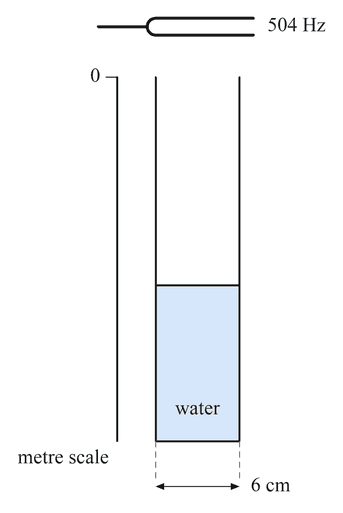
Question 149
A student is performing the experiment of resonance column. The diameter of the column tube is . The frequency of the tuning fork is . Speed of the sound at the given temperature is . The zero of the metre scale coincides with the top end of the resonance column tube. The reading of the water level in the column when the first resonance occurs is
- 1501 mark
Question 150
A tuning fork A of unknown frequency produces 5 beats/s with a fork of known frequency . When fork A is filed, the beat frequency decreases to 2 beats/s. What is the frequency of fork A?
- 1511 mark
Question 151
The equations of two waves are given by: and . These waves are simultaneously passing through a string. The amplitude of the resulting wave is
- 1521 mark
Question 152
Two light beams of intensities in the ratio 9:4 are allowed to interfere. The ratio of the intensity of maxima and minima will be
- 1531 mark
Question 153
The velocity of sound in a gas in which two wavelengths and produce 40 beats in will be
- 1541 mark
Question 154
The ratio of frequencies of fundamental harmonic produced by an open pipe to that of closed pipe having the same length is
- 1551 mark
Question 155
Two travelling waves of equal amplitudes and equal frequencies move in opposite directions along a string. They interfere to produce a stationary wave whose equation is given by, . The amplitude of the particle at will be ______ cm.
- 1561 mark
Question 156
The first overtone frequency of an open organ pipe is equal to the fundamental frequency of a closed organ pipe. If the length of the closed organ pipe is , the length of the open organ pipe is ______ cm.
- 1571 mark
Question 157
In an experiment to determine the velocity of sound in air at room temperature using a resonance, the air column has a length of for a tuning fork of frequency . The velocity of sound at room temperature is . The third resonance is observed when the air column has a length of ______ cm.