
Question 473 marksMedium
In a Kundt's tube experiment, a brass rod long, clamped at its middle, is stroked so that it vibrates longitudinally in its fundamental mode. A light disc on its end sets the gas in a glass tube vibrating, and fine powder collects in heaps at the displacement nodes, as shown. With air in the tube the heaps are apart; when the air is replaced by carbon dioxide (same rod), they are apart. The speed of sound in air is . (Hypothetical data.)
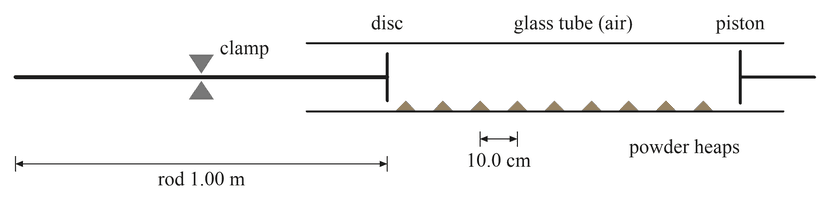
(a) Find the frequency of the rod's vibration.
(b) Find the speed of sound in brass.
(c) Find the speed of sound in carbon dioxide.