
Opening your dashboard
Class 11 Physics Chapter 25 Principle of Superposition of Waves: Competency-Based Questions (CBQ)
45 questions on Chapter 25, each worked through on its own page with the AI tutor. Class 11 Physics, ICSE 2026-27.
45 questions
1–4 marks · Mixed difficulty
- 14 marks
Question 1
Competency: Application
In a ripple tank, two dippers and , apart, touch the water surface and are driven up and down in phase by the same motor at . The ripples travel across the water at . Two small floating corks are placed at points and ; their distances from the dippers are shown in the figure. Because the dippers move in phase, the phase difference between the two ripples reaching a point is times the path difference. (Hypothetical data.)
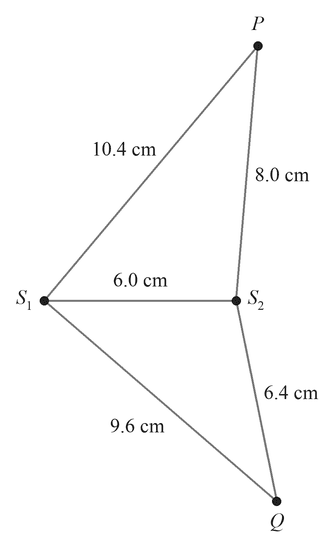
(a) Find the wavelength of the ripples.
(b) Which cork, at or at , stays almost still, and which one bobs up and down strongly? Give reasons.
(c) How many lines of calm water (nodal lines) cross the straight line joining and ?
- 24 marks
Question 2
Competency: Application
A sound engineer tests a small microphone on a laboratory bench. A small loudspeaker plays a steady note, and the sound reaches in two ways: directly, and after reflection from the hard, flat bench top. The positions are shown in the figure. The reflected sound behaves as if it came from the image of in the bench surface; reflection at the hard bench does not change the phase of the pressure wave, and the reflected sound at is only a little weaker than the direct sound. The speed of sound is . (Hypothetical data.)
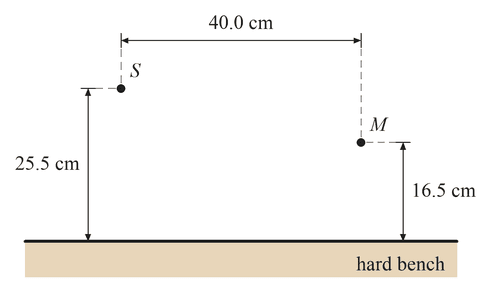
(a) Find the lengths of the direct path and the reflected path, and the path difference.
(b) As the frequency of the note is raised from , the output of the microphone shows sharp dips at certain frequencies. Find the three lowest of these frequencies.
(c) The microphone is now laid flat on the bench, so that its sensing point is only above the surface; is not moved, and the horizontal distance is still . Find the lowest dip frequency now, and explain why microphones are often laid flat on conference tables.
- 31 mark
Question 3
Competency: Analysis & Evaluation
In a quiet hall, a flute and a violin play two different notes at the same time, and the sounds of both instruments reach every listener in the hall.
Assertion (A): The violin's sound slightly changes the pitch of the flute's note heard by a listener, because the two sound waves overlap on the way.
Reason (R): Where two sound waves of ordinary loudness overlap, the resultant displacement of the air is the algebraic sum of the displacements due to each wave, and each wave travels on unchanged after the overlap.
- 43 marks
Question 4
Competency: Analysis & Evaluation
A student sounds two tuning forks together in front of a microphone connected to a data logger. The forks have nearly equal frequencies and give equal amplitudes at the microphone. The logger plots how the amplitude of the recorded sound changes over , as shown in the figure. Zooming into a stretch of around one of the loudest moments, the student counts complete vibrations of the air. (Hypothetical data.)
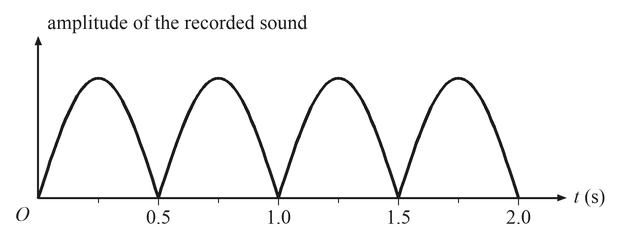
(a) Find the number of beats per second.
(b) Find the frequencies of the two forks.
(c) The fork of lower frequency is replaced by one of frequency . How far apart in time will the loudest moments of the new record be?
- 51 mark
Question 5
Competency: Application
Two cars wait side by side at a traffic signal with their turn indicators on. One indicator flashes 90 times per minute and the other 96 times per minute, and at one instant both flash exactly together. The two lights then drift out of step and back into step, in the same way as two sound waves of slightly different frequencies drift in and out of step to produce beats. (Hypothetical data.) After how long do the two indicators next flash exactly together?
- 61 mark
Question 6
Competency: Analysis & Evaluation
Two small loudspeakers in a room are fed by two separate signal generators set at and . A listener stands much nearer one loudspeaker than the other, so the two sounds reach the listener with clearly different amplitudes.
Assertion (A): The listener hears the loudness of the sound rise and fall three times every second.
Reason (R): Beats can be heard only at places where the two sound waves arrive with equal amplitudes.
- 73 marks
Question 7
Competency: Application
A student removes the rotating glass plate from a microwave oven, places a large flat bar of chocolate on the floor of the oven and switches the oven on for a few seconds. The microwaves have a frequency of . Reflected back and forth by the metal walls, they set up a stationary wave inside the oven. The chocolate melts only at a row of separate spots, which lie at the antinodes of this stationary wave. The centres of the first and fourth melted spots are apart, as shown. (Hypothetical data.)
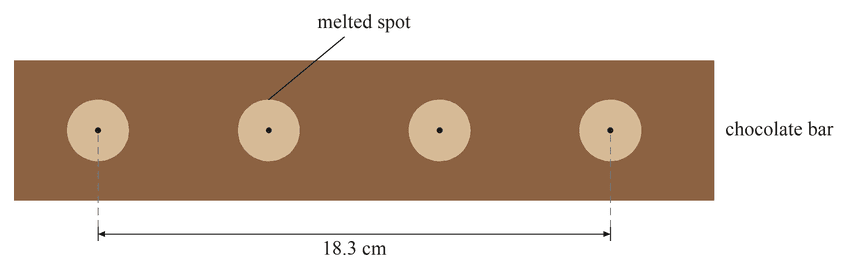
(a) Explain why the chocolate melts at separate spots instead of evenly.
(b) Find the wavelength of the microwaves and their speed.
(c) Explain why a microwave oven normally has a rotating plate.
- 81 mark
Question 8
Competency: Application
A child in a bathtub long, with water deep, slides back and forth to build up a big wave. In the steady pattern that forms, the water surface rises and falls most at the two end walls and keeps the same level across the middle of the tub. It is a stationary wave made by waves reflected back and forth between the end walls. In water this shallow, waves travel at a speed , where is the depth; take . (Hypothetical data.) To keep this wave growing, the child should slide back and forth once every
- 91 mark
Question 9
Competency: Application
An acoustic levitator sends ultrasound from a transducer up to a flat reflector and sets up a stationary wave in the air between them. Tiny polystyrene beads placed in the gap settle at the pressure nodes of the wave and float there in a vertical row. The speed of sound in the air is . (Hypothetical data.)
Assertion (A): Neighbouring beads float about apart.
Reason (R): Neighbouring pressure nodes of a stationary wave are half a wavelength apart.
- 104 marks
Question 10
Competency: Application
Engineers check the tension in a stay cable of a cable-stayed bridge by measuring how it vibrates. The cable is long between its anchorages and has a mass of per metre. A sensor clamped to the cable records its vibration while traffic shakes it, and the display, which covers only to , shows the spectrum in the figure. Treat the cable as a stretched string fixed at both ends. (Hypothetical data.)
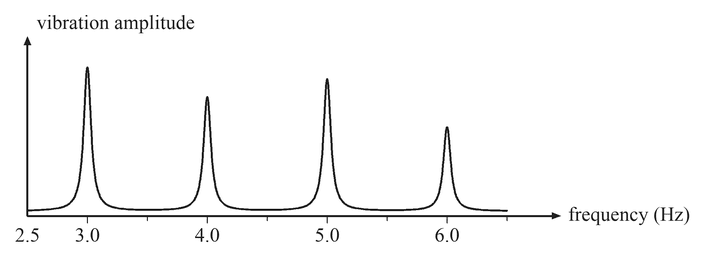
(a) Find the fundamental frequency of the cable, and say which harmonics the four peaks are.
(b) Find the speed of transverse waves on the cable and the tension in it.
(c) A month later the same four peaks are found at , , and . By what percentage has the tension fallen?
- 111 mark
Question 11
Competency: Analysis & Evaluation
A guitar string vibrates over a length of between the nut and the bridge. It is plucked once at a point between the bridge and the middle of the string. A sound-analysis app shows that the 5th, 10th and 15th harmonics are missing from the note, while all the other harmonics up to the 16th are present. When a string is plucked at a point, every harmonic that has a node at that point is missing. (Hypothetical data.) Which one of the following could be the distance of the plucking point from the bridge?
- 121 mark
Question 12
Competency: Analysis & Evaluation
A sonometer wire is made to vibrate steadily in its third harmonic, and small V-shaped paper riders are placed at different points along its vibrating length.
Assertion (A): A rider placed one-third of the way along the vibrating length stays on the wire.
Reason (R): In the third harmonic the wire has a node at its mid-point.
- 133 marks
Question 13
Competency: Application
A laboratory model of a vibrating-wire load sensor is shown in the figure. A steel wire of fixed vibrating length runs from a rigid support to a clamp, and a load hangs from the clamp, so the tension in the wire equals the weight of the load. A pick-up coil plucks the wire magnetically and measures its fundamental frequency. With a load the frequency is . Ignore the weight of the wire and the clamp, and the small stretching of the wire. (Hypothetical data.)
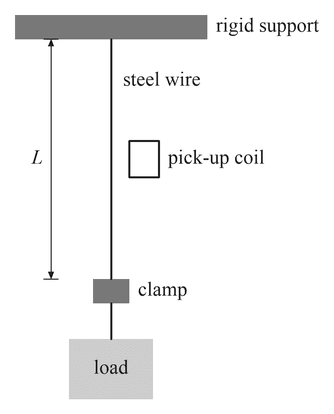
(a) Explain why the frequency rises when a heavier load is hung.
(b) An unknown load gives a frequency of . Find its mass.
(c) The frequency meter reads to . Estimate the smallest change in the unknown load that the sensor can detect.
- 141 mark
Question 14
Competency: Understanding
A piano technician explains how the strings of a piano are made.
Assertion (A): The strings for the lowest notes of a piano are steel wires wound round with copper wire, so that they can sound low notes without being extremely long.
Reason (R): For a string of given length and tension, the fundamental frequency is lower when the mass per unit length is larger.
- 151 mark
Question 15
Competency: Application
A guitarist clamps a capo across all six strings at the second fret. This shortens the vibrating length of every string from to , and the tension in each string stays the same. The six strings have different thicknesses and are tuned to different notes. (Hypothetical data.) The fundamental frequency of every string
- 164 marks
Question 16
Competency: Analysis & Evaluation
A farmer wants to know the depth of an old, dry tube well lined with a PVC pipe of internal diameter . A student holds a phone at the mouth of the pipe, as shown, and runs an app that sends out a slowly rising tone and records how strongly the air column responds. Between and the app finds resonances at , and , and none in between. Take the speed of sound in the well as , treat the dry bottom as a closed end, and use an end correction of at the open mouth, where is the internal diameter. (Hypothetical data.)
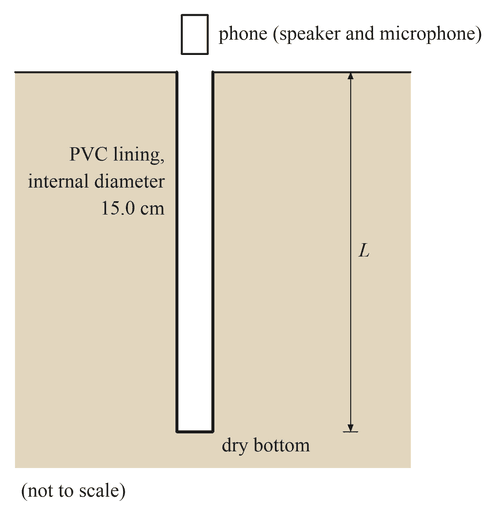
(a) Show that these frequencies fit a pipe closed at one end, and find its fundamental frequency.
(b) Find the depth of the well.
(c) Before the well ran dry, the water surface stood below the mouth. How far apart were the resonance frequencies then?
- 173 marks
Question 17
Competency: Analysis & Evaluation
A speech scientist models the human vocal tract, from the vocal folds to the lips, as a uniform tube closed at the vocal folds and open at the lips. When an adult says the neutral vowel "uh", the first three resonances of the tract (called formants) are measured at , and . The speed of sound in the warm, moist air of the tract is ; ignore the end correction. (Hypothetical data.)
(a) Show that the formants fit the model of a tube closed at one end.
(b) Estimate the length of the vocal tract.
(c) A deep-sea diver breathes a helium–oxygen mixture in which sound travels about times as fast as in the air of the tract. The pitch of the voice is set by how often the vocal folds vibrate, which the gas hardly changes. Find the new formants and explain why the diver's voice sounds squeaky.
- 181 mark
Question 18
Competency: Analysis & Evaluation
An organist notices that the church organ sounds slightly sharp (higher in pitch) on a warm summer afternoon compared with a cold winter morning.
Assertion (A): The pipes of an organ sound slightly higher notes when the air in the church is warmer.
Reason (R): The metal of the organ pipes expands slightly when it is warmed.
- 194 marks
Question 19
Competency: Analysis & Evaluation
In a resonance-tube experiment, a student finds the length of the air column at the first resonance for six tuning forks of frequency , using the same tube on the same day. The readings are in the table. (Hypothetical data.)
(Hz) 256 288 320 384 480 512 (cm) 32.7 29.0 26.0 21.5 17.0 15.9 (a) Using , where is the end correction, show that a graph of against should be a straight line, and state what its slope and its intercept on the -axis give.
(b) Plot the graph and use it to find the speed of sound and the end correction .
(c) Explain why this graph method is better than working out from a single fork with .
- 201 mark
Question 20
Competency: Analysis & Evaluation
A student holds a struck tuning fork over a resonance tube twice: once with the water level set for the first resonance, and once with the water level set well away from any resonance. The student strikes the fork equally hard each time.
Assertion (A): At resonance the sound is much louder, but the fork stops sounding a little sooner.
Reason (R): At resonance the air column vibrates with a large amplitude, so it takes energy from the fork, and sends it out as sound, at a greater rate.
- 211 mark
Question 21
Competency: Application
A student fixes the water level in a resonance tube of internal diameter so that the air column above the water is long. Instead of using tuning forks, the student holds a small loudspeaker driven by a signal generator over the mouth and slowly raises the frequency from to , listening for loud resonances. The speed of sound is , and the end correction is , where is the internal diameter. (Hypothetical data.) The student hears resonances at
- 221 mark
Question 22
Competency: Analysis & Evaluation
A steel rod long is clamped at a point one-quarter of its length from one end, as shown, and is stroked along its length so that it vibrates longitudinally. Wherever the rod is clamped there must be a displacement node, and each free end is a displacement antinode. Longitudinal waves travel along the rod at . (Hypothetical data.)
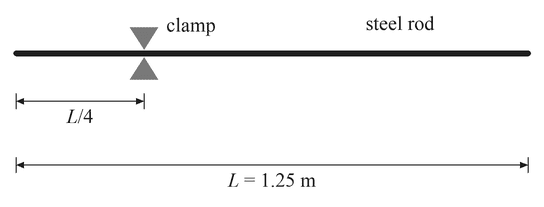
The lowest frequency at which the rod can vibrate is
- 231 mark
Question 23
Competency: Understanding
Tuning forks are used in laboratories as standards of frequency.
Assertion (A): A tuning fork struck gently with a rubber pad gives a nearly pure note of a single frequency.
Reason (R): The overtones of a tuning fork are not whole-number multiples of its fundamental; they are much higher in frequency and die away soon after the fork is struck.
- 241 mark
Question 24
Competency: Analysis & Evaluation
A student strikes a tuning fork, holds it by its stem close to one ear with the prongs vertical, and slowly turns it once about its stem.
Assertion (A): The loudness of the sound stays the same in every direction as the fork is turned.
Reason (R): The two prongs of a vibrating tuning fork always move in opposite directions, towards each other and then away from each other.
- 251 mark
Question 25
Competency: Analysis & Evaluation
Two identical loudspeakers stand side by side, apart, and play the same music. By mistake one of them is wired the wrong way round, so its cone moves out whenever the other's moves in. Listeners walking around the room in front of the speakers find that the deep bass notes (about ) are weak everywhere, while the high notes (about ) are loud in most places. The speed of sound is . (Hypothetical data.) The best explanation is that
- 264 marks
Question 26
An aluminium wire long is joined end to end to a steel wire long. Both wires have a cross-sectional area of . The combined wire is stretched between two rigid supports with a tension of , as shown. The densities of aluminium and steel are and . (Hypothetical data.)

(a) Find the speed of transverse waves in each wire.
(b) The wire is made to vibrate in a stationary-wave pattern that has a node at the joint J. Find the lowest frequency of such a vibration.
(c) How many loops are formed in each wire at this frequency?
- 273 marks
Question 27
A narrow tube long is first left open at both ends, and its fundamental frequency is measured as . One end is then closed with a flat cap, and the fundamental frequency becomes . Assume that the end correction at an open end is the same in both cases, and that there is none at the closed end. (Hypothetical data.)
(a) Write an equation for the speed of sound in each case.
(b) Find and .
(c) Estimate the internal diameter of the tube, using .
- 283 marks
Question 28
The ratio of the intensities of two interfering waves is 64 : 1. Calculate the ratio of the maximum to minimum intensity.
- 293 marks
Question 29
Two sinusoidal waves having the same frequency and travelling in the same direction are superposed. Calculate the amplitude of the resultant motion, if their amplitudes are 4 cm and 8 cm and they differ in phase by .
- 303 marks
Question 30
Three sinusoidal waves having amplitudes , and are superposed. They have the same period and their phases are 0, and respectively. Find (i) the resultant amplitude and (ii) phase.
- 313 marks
Question 31
A string of length 2 m and mass 2 g is stretched by a certain tension so that it vibrates in 4 segments with a frequency of 600 Hz. What is the tension?
- 324 marks
Question 32
A copper wire is held at the two ends by rigid supports. At 30°C, the wire is just taut with negligible tension. Find the speed of transverse wave in the wire at 10°C. Given: coefficient of linear expansion is , Young's modulus and density .
- 334 marks
Question 33
When the tension of a sonometer wire is increased by 25%, the fundamental increases by 10 Hz. If its length is increased by 25%, what will be the new frequency?
- 343 marks
Question 34
Explain how the bridges should be placed in order to divide a wire 1.10 m long into three segments whose fundamental frequencies are in the ratio 2 : 3 : 4.
- 354 marks
Question 35
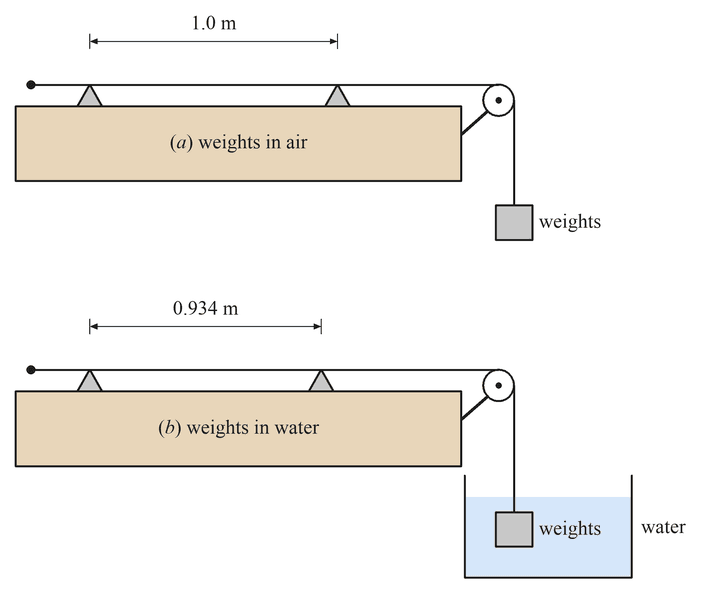
A tuning fork is in unison with 1.0 m length of sonometer wire. When the stretching weights are immersed in water, the length of the wire in unison with the same tuning fork is 0.934 m. Calculate the density of the material of the weights.
- 364 marks
Question 36
The fundamental frequency of an open organ pipe is 330 Hz. The first overtone of a closed organ pipe has the same frequency as the first overtone of the open pipe. How long is each pipe? Velocity of sound m/s.
- 373 marks
Question 37
In a resonance column, the first resonant length is 0.16 m using a tuning fork of frequency 512 Hz. If the diameter of the tube is 0.025 m, calculate the velocity of sound.
- 384 marks
Question 38
In a resonance tube using a tuning fork of frequency 325 Hz, two successive lengths are observed at 25.4 cm and 77.4 cm respectively. Calculate the velocity of sound in air and the end correction.
- 393 marks
Question 39
A tuning fork of unknown frequency produced 4 beats per second when sounded with a standard fork of frequency 256 Hz. The beat frequency decreased when a little wax was put on a prong of the first fork. What was the frequency of the fork before loading it with wax?
- 403 marks
Question 40
A tuning fork of frequency 256 produces 4 beats per second with another tuning fork . When the prongs of are loaded with 1 g wt, the number of beats is 1 per second and when loaded with 2 g wt, the number of beats becomes 2 per second. What is the frequency of ?
- 413 marks
Question 41
When the wire of a sonometer is 73 cm long, it is in resonance with a tuning fork. On shortening the wire by 0.5 cm, it makes 3 beats per second with the same fork. Calculate the frequency of the tuning fork.
- 424 marks
Question 42
Using a movable knife edge, the two parts of a sonometer wire with total length 4 m is divided into two parts, such that they differ in length by 8 mm and produce 4 beats per second when sounded together. Calculate their frequencies.

- 433 marks
Question 43
Two perfectly identical wires are in unison. When the tension in one wire is increased by 1% then on sounding them together 3 beats are heard in 2 seconds. Calculate the initial frequency of each other.
- 444 marks
Question 44
Using a tuning fork of frequency 512 Hz, the string of a sonometer has to be tuned. When they are vibrated together, they produce 10 beats per second. By what percentage should the length of the string be altered to achieve tuning, the tension remaining the same?
- 453 marks
Question 45
When two closed organ pipes at 0°C are sounded together, 20 beats are heard in 4 seconds. How many beats will be heard per second when the temperature is 100°C? The increase in length of the pipes due to rise in temperature may be neglected.