
Competency: Application
A sound engineer tests a small microphone on a laboratory bench. A small loudspeaker plays a steady note, and the sound reaches in two ways: directly, and after reflection from the hard, flat bench top. The positions are shown in the figure. The reflected sound behaves as if it came from the image of in the bench surface; reflection at the hard bench does not change the phase of the pressure wave, and the reflected sound at is only a little weaker than the direct sound. The speed of sound is . (Hypothetical data.)
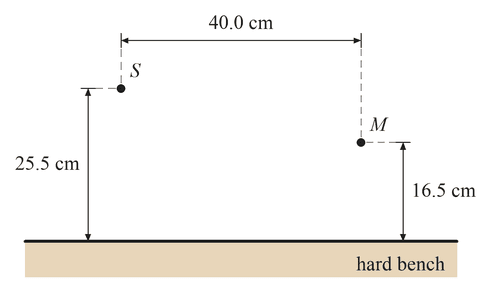
(a) Find the lengths of the direct path and the reflected path, and the path difference.
(b) As the frequency of the note is raised from , the output of the microphone shows sharp dips at certain frequencies. Find the three lowest of these frequencies.
(c) The microphone is now laid flat on the bench, so that its sensing point is only above the surface; is not moved, and the horizontal distance is still . Find the lowest dip frequency now, and explain why microphones are often laid flat on conference tables.